
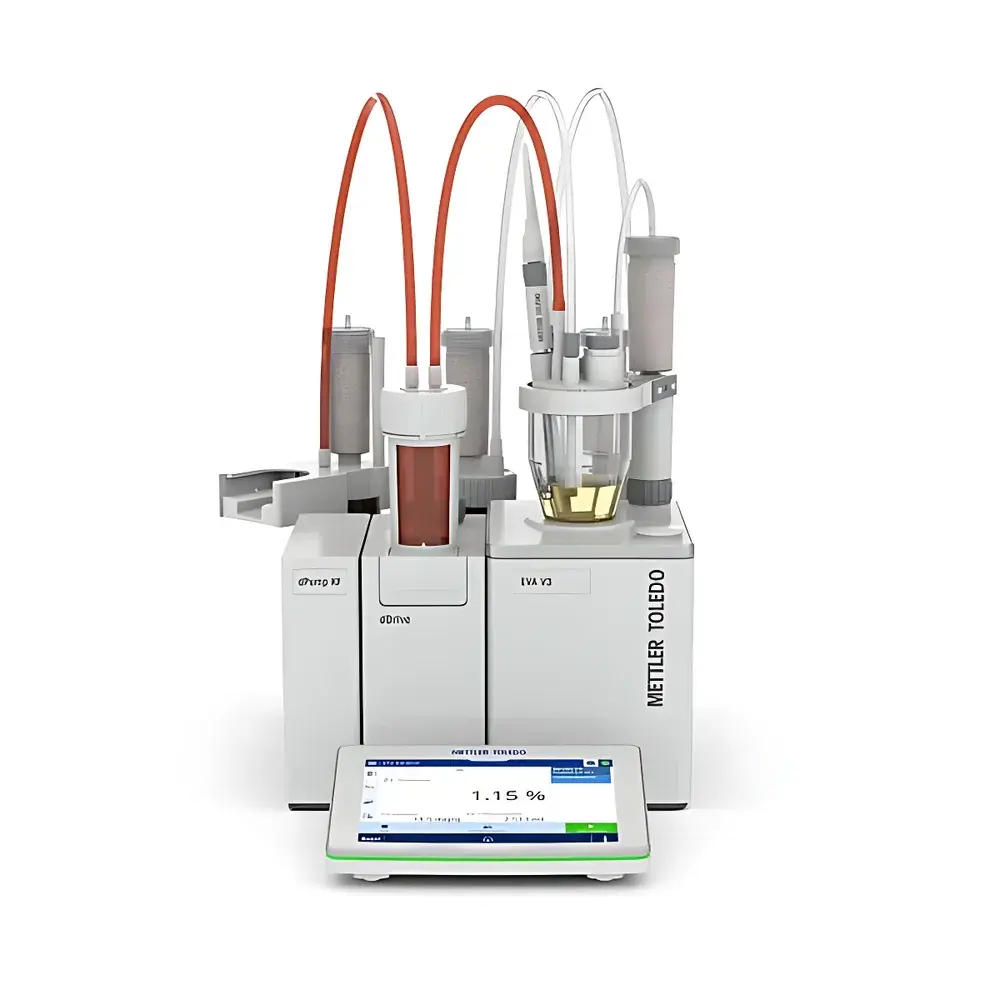
METTLER TOLEDO EVA V1 Volumetric Karl Fischer Titrator
| Brand | METTLER TOLEDO |
|---|---|
| Origin | Manufactured in China (for global distribution) |
| Manufacturer Type | Authorized Distribution Channel |
| Model | EVA V1 |
| Pricing Range | USD 19,500 – 22,000 (FOB) |
| Titration Principle | Volumetric Coulometric/KF Endpoint Detection via Bipotentiometric Electrode System |
| Dispensing Resolution | 120,000 steps per burette revolution |
| Control Algorithm | Fast Feedback Algorithm (FFA) for dynamic reagent dosing |
| Software Platform | LabX™ PC-based titration software with audit trail and electronic signature support |
| Compliance | Designed to support GLP/GMP workflows |
Overview
The METTLER TOLEDO EVA V1 is a high-precision volumetric Karl Fischer (KF) titrator engineered for reliable, trace-level moisture determination across pharmaceutical, chemical, polymer, and battery material laboratories. It operates on the classical volumetric KF principle—where iodine generated electrochemically or delivered via standardized KF reagent reacts stoichiometrically with water in the sample—and detects the endpoint using dual platinum indicator electrodes in bipotentiometric mode. Unlike coulometric systems optimized for sub-ppm analysis, the EVA V1 delivers optimal balance between speed, accuracy, and robustness for routine moisture quantification in samples containing 100 ppm to 100% water. Its core architecture integrates a precision glass syringe burette with 120,000-step motorized positioning, enabling sub-microliter dispensing resolution and long-term volumetric reproducibility essential for ISO 8587-compliant titration.
Key Features
- Fast Feedback Algorithm (FFA): Dynamically modulates titrant delivery rate based on real-time current response, sustaining optimal reagent concentration near the electrode surface to accelerate reaction kinetics without overshoot.
- High-Fidelity Burette Mechanics: Glass syringe design with ceramic-coated plunger and PTFE seals ensures chemical resistance to aggressive KF solvents (e.g., chloroform-free pyridine-free media) and maintains volumetric accuracy over >50,000 titrations.
- Integrated Solvent Exchange Module: Automates solvent purging and refilling between analyses, eliminating manual handling of toxic or hygroscopic solvents and reducing operator exposure per OSHA and CLSI H18-A4 guidelines.
- Touch-Optimized HMI: 7-inch capacitive touchscreen interface supports customizable method shortcuts, multi-language support (EN/DE/FR/ES/ZH), and context-sensitive help—designed for glove-compatible operation in cleanroom or QC environments.
- Modular Electrode Mounting: Accommodates standard double-platinum, generator-analyzer, or combination KF electrodes with automatic recognition via RFID-enabled electrode holders.
Sample Compatibility & Compliance
The EVA V1 accommodates solid, liquid, paste, and viscous samples—including APIs, excipients, lithium cathode powders, silicone oils, and epoxy resins—via optional oven coupling (with METTLER TOLEDO OMNIS or standalone S3000 oven) or direct injection. All hardware and firmware comply with IEC 61010-1 safety standards. The system supports full traceability under GLP and GMP frameworks: each titration record includes timestamped metadata (operator ID, method version, environmental humidity/temperature from optional sensor input), raw electrode potential curves, and integrated drift correction. LabX™ software enables role-based access control, 21 CFR Part 11–compliant electronic signatures, and automated report generation aligned with USP validation templates.
Software & Data Management
LabX™ software serves as the central data governance layer for the EVA V1. It provides method development wizards with real-time titration curve simulation, automated equivalence point calculation using first-derivative and Gran plot algorithms, and configurable pass/fail criteria per sample batch. All raw data—including voltage vs. time traces, burette position logs, and ambient condition stamps—are stored in encrypted SQLite databases with immutable audit trails. Data export supports CSV, PDF/A-2, and XML formats compatible with LIMS integration (via HL7 or REST API). Backup policies enforce daily off-server synchronization with configurable retention periods (up to 10 years).
Applications
- Pharmaceutical Quality Control: Moisture verification of lyophilized products, tablet granules, and sterile packaging headspace per USP and EP 2.5.12.
- Electrolyte & Battery Materials: Quantification of residual H2O in LiPF6 solutions and cathode precursors where <10 ppm deviation impacts SEI formation.
- Polymer Manufacturing: In-process monitoring of PET, PA6, and PC resin pellets prior to extrusion to prevent hydrolytic degradation.
- Fine Chemical Synthesis: Verification of anhydrous conditions in Grignard or organolithium reactions.
- Food & Feed Analysis: Determination of water activity-critical components in dairy powders and pet food formulations per AOAC 952.03.
FAQ
Does the EVA V1 support both volumetric and coulometric KF methods?
No—the EVA V1 is dedicated to volumetric KF titration only. For coulometric applications requiring sub-ppm detection, METTLER TOLEDO recommends the C30 or V30S systems.
Can LabX™ be deployed on virtual machines or cloud infrastructure?
Yes—LabX™ supports Windows Server 2016+ VM deployments and validated Azure-hosted instances when configured with domain authentication and encrypted database replication.
What maintenance intervals are recommended for the burette and electrode modules?
Burette calibration is advised every 6 months or after 10,000 dispenses; electrode cleaning and reference electrolyte replacement should occur weekly in high-throughput labs or after each 50 analyses with aggressive matrices.
Is method transfer possible from older METTLER TOLEDO titrators (e.g., DL series)?
Yes—LabX™ includes backward-compatible method import tools that auto-convert DL-series .met files into native EVA V1 protocols, preserving titration parameters, endpoint logic, and reporting templates.
How is temperature compensation handled during titration?
The EVA V1 does not integrate a built-in temperature probe; however, LabX™ allows manual entry or external feed of ambient/solvent temperature to adjust stoichiometric calculations per ISO 8587 Annex C guidance on thermal drift correction.






