
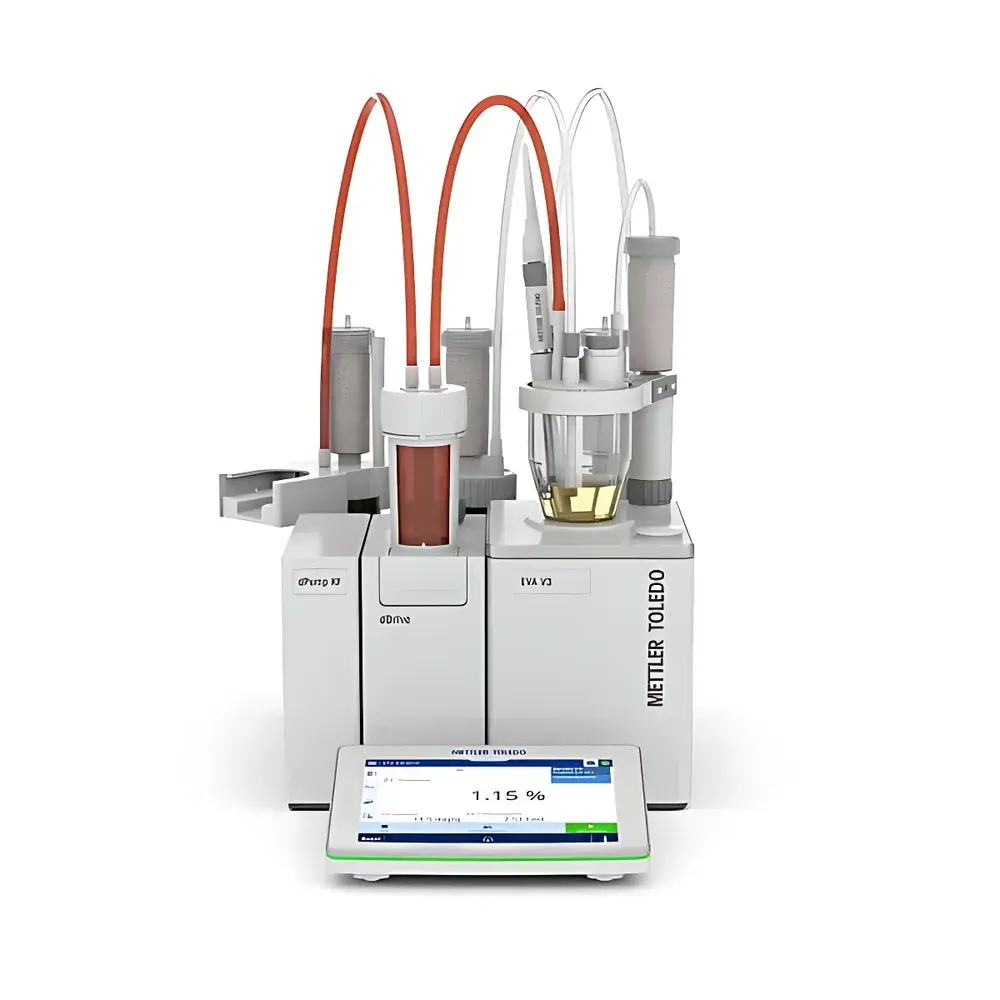
METTLER TOLEDO EVA V3 Volumetric Karl Fischer Titrator
| Brand | METTLER TOLEDO |
|---|---|
| Origin | Manufactured in China (for global distribution) |
| Manufacturer Type | Authorized Distribution Channel |
| Model | EVA V3 |
| Pricing Range | USD 24,000 – 27,000 (FOB) |
| Titration Principle | Volumetric Karl Fischer (KF) |
| Electrode Type | Dual-platinum generator and indicator electrodes |
| Reagent Delivery Precision | ±0.001 mL per 120,000-step motorized burette |
| Sample Throughput | Up to 30 samples per hour (with autosampler option) |
| Compliance | Fully compatible with FDA 21 CFR Part 11, ISO/IEC 17025, and GLP/GMP data integrity requirements |
Overview
The METTLER TOLEDO EVA V3 is a high-precision volumetric Karl Fischer (KF) titrator engineered for reliable, trace-level moisture determination in pharmaceuticals, polymers, petrochemicals, and fine chemicals. It operates on the classical coulometric-free volumetric KF principle—where iodine is delivered stoichiometrically from a standardized KF reagent via a motorized burette—and quantifies water content based on the electrochemically verified endpoint detection using dual-platinum electrodes. Unlike coulometric systems, the EVA V3 excels in samples containing >100 ppm water, offering superior linearity, repeatability, and robustness across heterogeneous matrices such as viscous oils, hygroscopic powders, and solvent-based formulations. Its architecture integrates real-time current monitoring and Fast Feedback Algorithm (FFA) control logic, which dynamically maintains optimal reagent concentration at the titration cell interface—thereby minimizing titration time without compromising endpoint sharpness or stoichiometric fidelity.
Key Features
- Motorized 120,000-step burette delivering ±0.001 mL precision per dispensing event—ensuring sub-microliter reproducibility across extended operational cycles.
- Dual-platinum electrode system with adaptive polarization voltage control for stable, drift-resistant endpoint detection—even in low-conductivity solvents (e.g., chloroform, toluene).
- Integrated solvent exchange module enabling fully automated solvent purging and cell conditioning between runs—reducing analyst exposure to toxic reagents (e.g., pyridine-free KF reagents) and eliminating manual rinsing steps.
- Touchscreen HMI with customizable workflow shortcuts, multi-language support (EN/DE/FR/ES/ZH), and context-aware guidance for method setup, calibration, and validation.
- Rugged mechanical design featuring corrosion-resistant fluid path components (PTFE, PEEK, borosilicate glass), IP54-rated enclosure, and thermal-stable cell housing for ambient temperature fluctuations (15–30 °C).
Sample Compatibility & Compliance
The EVA V3 accommodates solid, liquid, and gaseous samples via optional accessories—including oven samplers (up to 250 °C), gas diffusion cells, and syringe injectors—enabling moisture analysis in APIs, excipients, lithium battery electrolytes, and catalysts. All hardware and software modules comply with international regulatory frameworks: full audit trail logging, electronic signature enforcement, and user-role-based access control align with FDA 21 CFR Part 11 and EU Annex 11 requirements. Method validation reports generated by LabX™ satisfy ICH Q2(R2) guidelines, while raw data retention, metadata embedding (operator ID, timestamp, environmental conditions), and immutable result archiving meet ISO/IEC 17025 laboratory accreditation criteria.
Software & Data Management
LabX™ software serves as the central platform for method development, instrument control, and compliant data handling. It supports template-driven SOP execution, automated calculation of %H₂O, ppm, and absolute mass water content—with configurable uncertainty propagation per ISO/IEC Guide 98-3. All titration curves, raw electrode potential signals, and reagent consumption logs are stored in encrypted SQLite databases with SHA-256 hashing. Data export options include PDF analytical reports (with digital signatures), CSV for LIMS integration, and XML for enterprise ERP synchronization. Remote diagnostics, firmware update scheduling, and instrument health dashboards are accessible via secure TLS 1.2–enabled web interface.
Applications
- Pharmaceutical QC: Water content verification in lyophilized proteins, tablet granules, and sterile vials per USP and Ph. Eur. 2.5.12.
- Electrolyte formulation: Quantification of residual water in LiPF₆-based battery electrolytes—critical for SEI layer stability and cycle life prediction.
- Polymer manufacturing: Moisture monitoring in PET, PA6, and PC resins prior to extrusion to prevent hydrolytic degradation.
- Food & feed testing: Direct KF analysis of spices, dairy powders, and animal feedstuffs without derivatization or sample pre-drying.
- Chemical synthesis: In-process control of anhydrous reaction media (e.g., Grignard, organolithium) where water <50 ppm is mandatory.
FAQ
What distinguishes volumetric KF titration from coulometric KF?
Volumetric KF uses a pre-standardized reagent delivered via burette and is optimal for samples with water content >100 ppm; coulometric KF generates iodine electrolytically and is preferred for ultra-trace (<10 ppm) analysis.
Can the EVA V3 be integrated into a networked lab environment?
Yes—it supports Ethernet (TCP/IP), USB device mode, and OPC UA protocol for seamless connectivity with LIMS, MES, and centralized LabX™ server deployments.
Is method validation documentation included with the system?
All factory-installed methods include IQ/OQ documentation templates, performance qualification checklists, and traceable calibration certificates per ISO/IEC 17025.
How does the Fast Feedback Algorithm (FFA) improve titration kinetics?
FFA continuously adjusts burette delivery rate based on real-time current response at the indicator electrode—maintaining near-saturation reagent concentration at the reaction interface to accelerate redox equilibrium without overshoot.
What maintenance intervals are recommended for long-term accuracy?
Burette calibration every 6 months, electrode polishing quarterly, and annual verification of cell seal integrity and solvent drying efficiency—procedures documented in the included Maintenance Logbook module within LabX™.
Related Products





