

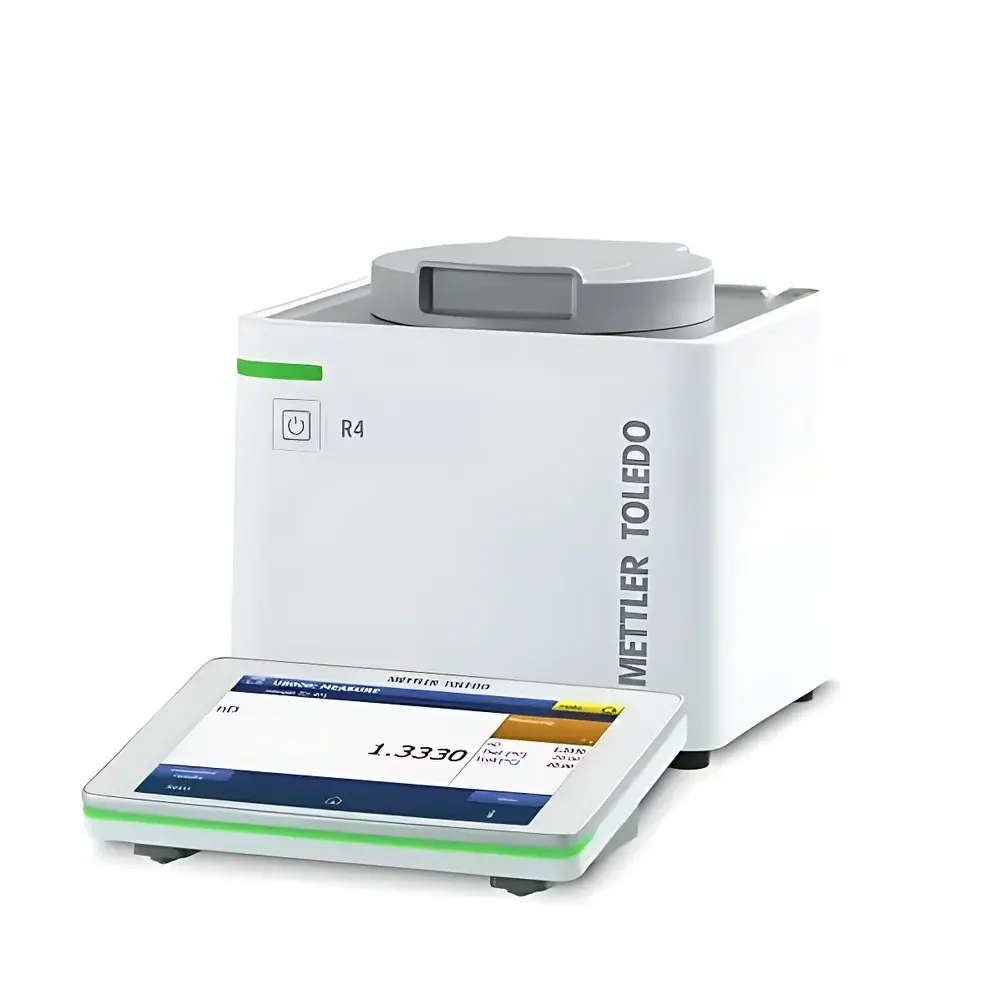
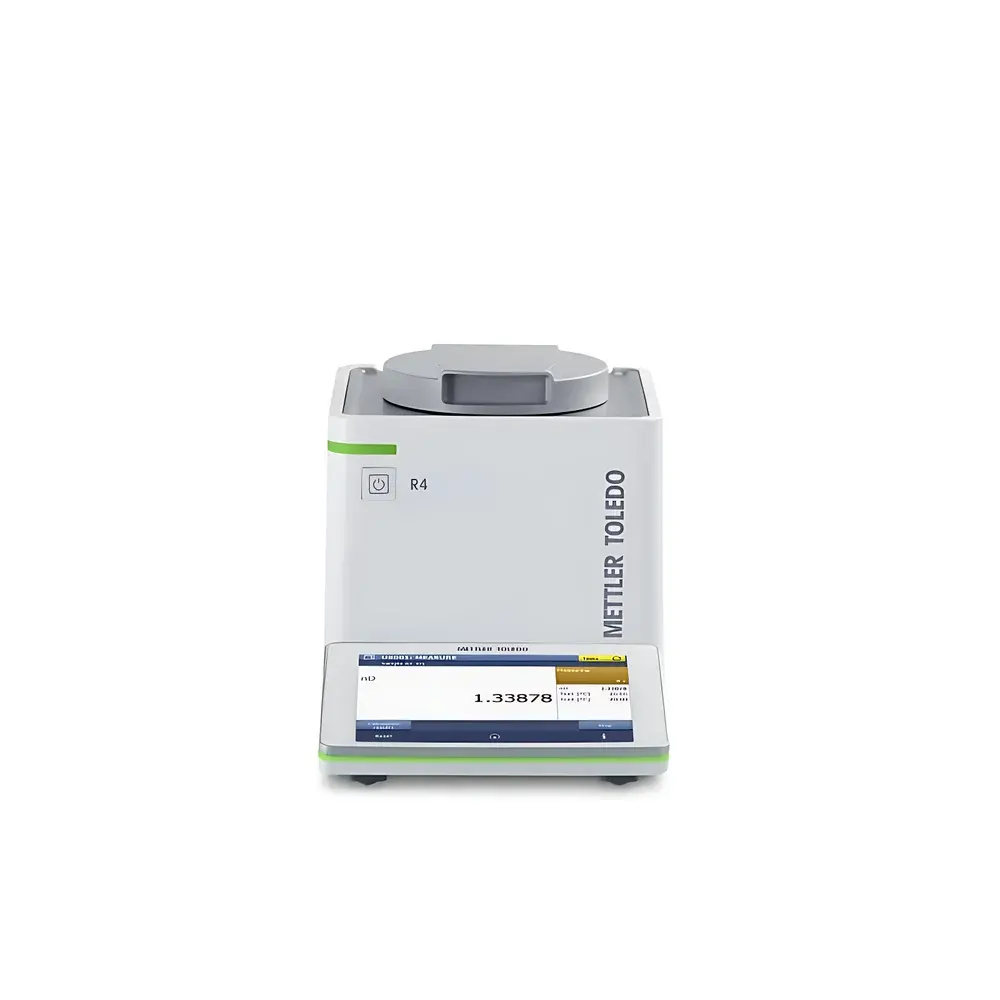
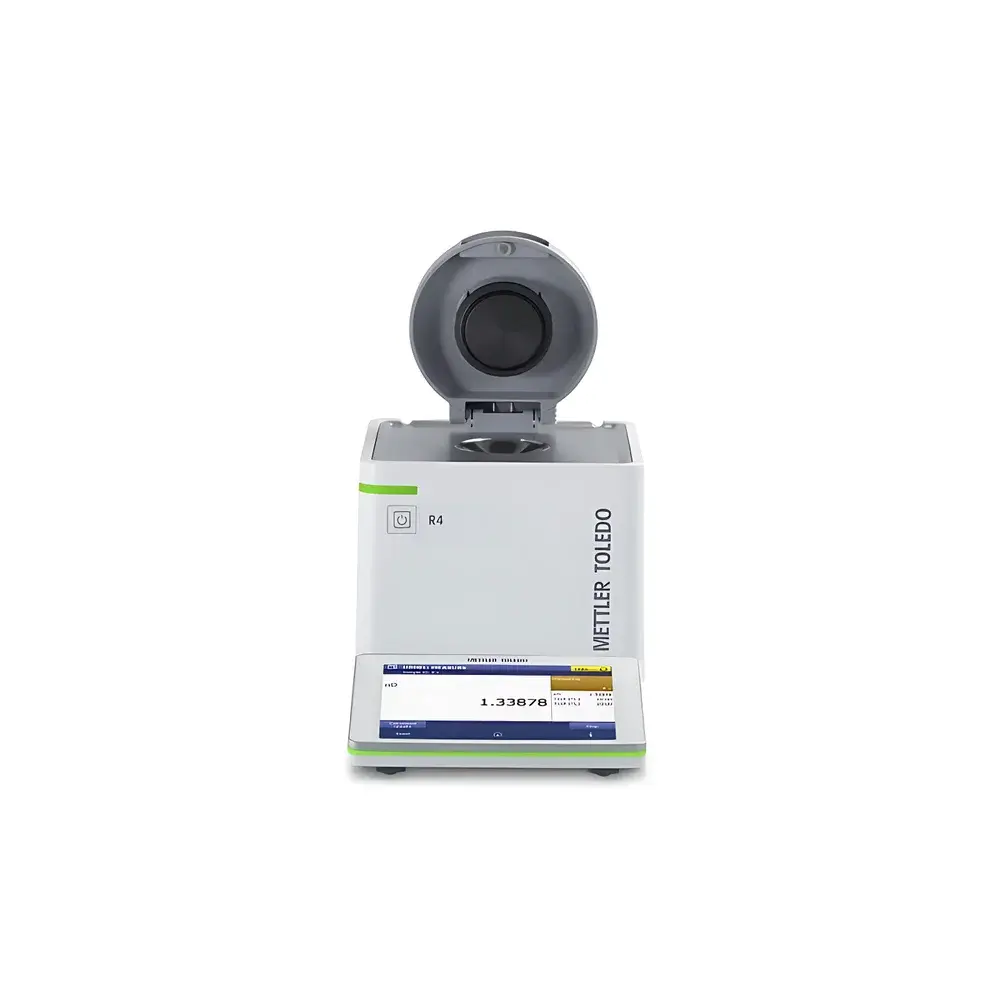
METTLER TOLEDO Excellence Refractometer R4/R5
| Brand | METTLER TOLEDO |
|---|---|
| Origin | Switzerland |
| Product Type | Benchtop Refractometer |
| Temperature Control | Yes |
| Digital Display | Yes |
| Measurement Range | 0–100 % w/w (Brix or refractive index equivalent) |
| Accuracy | ±0.05 % w/w |
| Compliance | FDA 21 CFR Part 11 ready (with LabX software) |
Overview
The METTLER TOLEDO Excellence Refractometer R4/R5 is a high-precision benchtop instrument engineered for accurate, repeatable determination of refractive index and related derived parameters—including Brix (% w/w), sucrose concentration, and other concentration-dependent optical properties. Based on the principle of total internal reflection at the sample-prism interface, the R4/R5 employs a high-stability LED light source and a precision temperature-controlled sapphire prism to deliver metrological-grade measurements traceable to NIST standards. Designed for routine quality control and R&D laboratories in food & beverage, pharmaceuticals, chemicals, and cosmetics, the instrument meets stringent requirements for reproducibility, operator independence, and regulatory compliance. Its optical architecture minimizes drift and ensures long-term stability—even during extended measurement sequences or under variable ambient conditions.
Key Features
- One Click™ intuitive touchscreen interface with large color display—reduces training time and eliminates manual entry errors
- Integrated Peltier temperature control (±0.1 °C stability) ensuring precise thermal regulation across the full operating range (10–40 °C)
- Real-time status indicators (ready/busy/waiting) provide immediate visual feedback on instrument readiness
- Configurable pass/fail limits with color-coded results (e.g., green for in-spec, red for out-of-spec) enabling rapid QC decision-making
- Modular platform architecture—designed for seamless integration with METTLER TOLEDO density meters (e.g., DM41/DM50), pH/conductivity modules, and colorimeters via shared sample handling and LabX control
- Robust sapphire measuring surface resistant to abrasion and chemical corrosion—suitable for viscous, abrasive, or aggressive samples
Sample Compatibility & Compliance
The R4/R5 accommodates a broad spectrum of liquid and semi-liquid samples—from low-viscosity aqueous solutions to high-viscosity syrups, emulsions, and suspensions—without requiring dilution or filtration in most cases. Optional automatic sample changers (e.g., SC1 or SC3) support unattended analysis of up to 48 samples per run, minimizing human intervention and improving throughput consistency. The system complies with international standards including ISO 21745:2020 (refractometry), ASTM D1218 (refractive index of hydrocarbons), and USP (refractometric assay). When operated with LabX software, it fulfills FDA 21 CFR Part 11 requirements for electronic records and signatures, supporting audit trails, user access levels, and electronic signature workflows essential for GMP/GLP environments.
Software & Data Management
LabX laboratory software serves as the central data management and instrument control hub for the R4/R5. It enables method-driven operation, automated report generation (PDF/CSV), and secure storage of raw measurement data—including timestamps, operator IDs, environmental logs, and calibration history. All data entries are timestamped and immutable once recorded, satisfying ALCOA+ principles (Attributable, Legible, Contemporaneous, Original, Accurate, Complete, Consistent, Enduring, Available). LabX also supports SOP enforcement through locked method templates and configurable electronic approvals—critical for regulated industries undergoing internal or external audits.
Applications
- Food & Beverage: Brix quantification in fruit juices, soft drinks, jams, and dairy products; monitoring sugar inversion and fermentation progress
- Pharmaceuticals: Excipient concentration verification, syrup formulation QC, and API solubility screening
- Chemicals: Glycol concentration in antifreeze, ethylene glycol/water mixtures, and solvent purity assessment
- Cosmetics: Emulsion phase stability evaluation, active ingredient dosing verification, and viscosity-correlated concentration checks
- Academic & Research Labs: Teaching fundamental optical property relationships; method development for novel sample matrices
FAQ
What is the minimum sample volume required for measurement?
Typical volume is 0.5 mL for standard operation; reduced to 0.15 mL when using the micro-cell option.
Does the R4/R5 support automatic calibration verification?
Yes—via integrated calibration check with certified reference standards (e.g., water, sucrose solutions) and configurable frequency alerts.
Can the instrument be connected to a LIMS or ERP system?
Yes—through LabX’s ODBC, REST API, or direct export interfaces compatible with major laboratory informatics platforms.
Is temperature compensation applied automatically during measurement?
Yes—the built-in Peltier element maintains prism temperature within ±0.1 °C, and all readings are referenced to the calibrated temperature point.
How does the R4/R5 ensure measurement traceability?
Each unit ships with a factory calibration certificate traceable to national metrology institutes (e.g., METAS, NIST); optional UKAS-accredited calibration services are available.





