
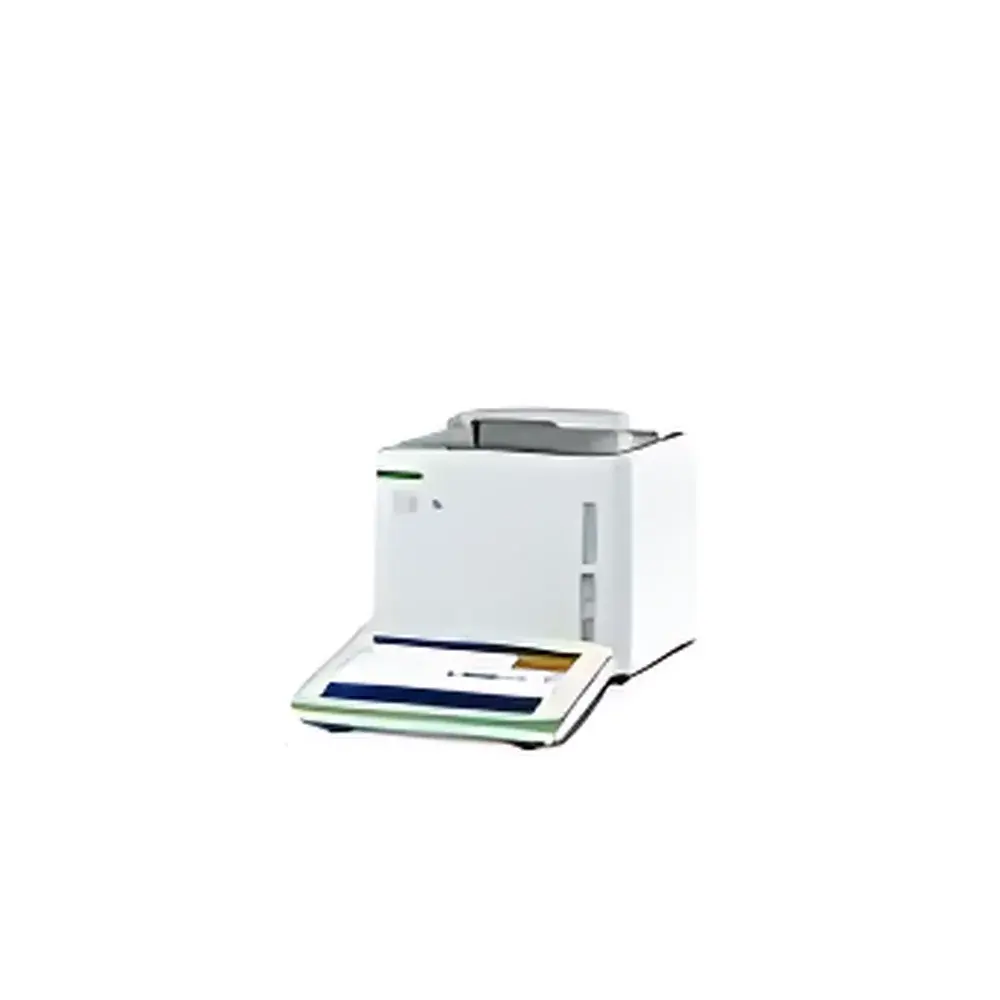
METTLER TOLEDO Excellence Refractometer R4 / R5
| Brand | METTLER TOLEDO |
|---|---|
| Origin | Switzerland |
| Instrument Type | Benchtop Refractometer |
| Temperature Control | Yes |
| Digital Display | Yes |
| Refractive Index (nD) Range | 1.3200–1.7000 |
| Brix Range | 0–100% w/w |
| nD Accuracy | ±0.0001 (near calibration point), ±0.00002–±0.00004 (full range) |
| nD Repeatability | ±0.00005 (R4), ±0.00001 (R5) |
| nD Resolution | 0.0001 (R4), 0.00001 (R5) |
| Brix Accuracy | ±0.05% (R4), ±0.014% (R5) |
| Brix Repeatability | ±0.05% (R4), ±0.01% (R5) |
| Temperature Range | 5–100 °C (R4), 5–75 °C (R5) |
| Temp. Accuracy | ±0.1 °C (5–100 °C, R4), ±0.03 °C (15–50 °C, R5), ±0.05 °C (5–75 °C, R5) |
Overview
The METTLER TOLEDO Excellence Refractometer R4 and R5 are high-precision benchtop instruments engineered for accurate, traceable, and temperature-controlled measurement of refractive index (nD) and related derived concentrations—including Brix, Oechsle, HFCS, invert sugar, acid/alkali values, salinity, and freeze point depression. Based on the principle of total internal reflection at the prism-sample interface, these instruments employ a high-stability LED light source and a precision sapphire measuring prism to deliver robust optical performance across diverse liquid and semi-liquid matrices. Designed in accordance with ISO 21748 (Refractometry—Guidance for the use of refractometers), ASTM D1218 (Standard Test Method for Refractive Index of Hydrocarbon Liquids), and USP (Refractometry), the R4/R5 series supports compliance-critical workflows in pharmaceutical QC, food & beverage R&D, chemical manufacturing, and academic research laboratories.
Key Features
- High-resolution digital refractometry with 5-digit nD display (R5: 0.00001 resolution; R4: 0.0001 resolution)
- Integrated Peltier temperature control (±0.03 °C stability over 15–50 °C for R5; ±0.1 °C over full 5–100 °C range for R4)
- One Click™ operation enabling standardized, operator-independent measurement sequences with visual pass/fail feedback directly on the touchscreen
- Modular method configuration supporting up to 30 user-defined concentration tables or polynomial equations (e.g., for proprietary formulations or non-standard solutes)
- Sapphire prism with chemical resistance and long-term dimensional stability—validated for >10,000 measurements under GLP/GMP conditions
- Automatic prism cleaning detection and real-time error diagnostics integrated into firmware
- Compliance-ready audit trail with time-stamped measurement records, user ID logging, and change history (21 CFR Part 11–compatible when paired with LabX software)
Sample Compatibility & Compliance
The R4 and R5 accommodate aqueous solutions, syrups, oils, organic solvents, emulsions, and viscous suspensions—provided they are optically transparent or semi-transparent within the visible spectrum (589 nm). Sample volume requirement is ≤0.5 mL; automatic surface detection eliminates air-gap errors. Both models meet IEC 61010-1 safety standards and carry CE, UKCA, and UL certifications. For regulated environments, instrument qualification (IQ/OQ/PQ) documentation packages are available, and firmware supports electronic signatures, data integrity controls, and secure user role management aligned with FDA 21 CFR Part 11 and EU Annex 11 requirements.
Software & Data Management
Standalone operation is fully supported via the built-in graphical touchscreen interface. For networked labs, optional LabX™ PC software enables centralized method deployment, remote monitoring, automated report generation (PDF/CSV), and seamless integration with LIMS or ERP systems. All raw nD, temperature, and derived concentration values are stored with metadata (operator, timestamp, method ID, calibration status). Data export includes full audit trail logs with hash-verified integrity checks. Firmware updates are digitally signed and validated prior to installation to ensure cryptographic authenticity and regulatory continuity.
Applications
- Pharmaceutical: Excipient concentration verification, solvent purity assessment, API crystallization endpoint detection
- F&B: Brix standardization in fruit juices, honey grading, syrup consistency control, dairy product solids analysis
- Chemical: Solvent recovery monitoring, acid/base titration support, polymer solution concentration tracking
- Academic Research: Thermodynamic property modeling, binary mixture phase behavior studies, refractive index–density correlation validation
- Quality Assurance: In-process release testing per SOPs, stability study sample tracking, vendor material certification
FAQ
What is the difference between the R4 and R5 models?
The R5 offers higher metrological performance: 0.00001 nD resolution, ±0.00001 repeatability, tighter temperature accuracy (±0.03 °C in mid-range), and extended Brix accuracy (±0.014%). It also supports more advanced calibration protocols and deeper LabX integration.
Can the instrument measure opaque or turbid samples?
No—refractometry requires optical transmission through the sample-prism interface. Highly scattering or particulate-laden samples must be filtered or centrifuged prior to analysis.
Is external calibration required before each use?
No. The instruments feature automatic internal reference verification using a stabilized glass standard. Full calibration with certified sucrose or water standards is recommended per ISO/IEC 17025 intervals (e.g., daily or per batch, depending on criticality).
How is temperature control achieved?
Via solid-state Peltier elements integrated into the prism block, coupled with high-precision Pt1000 sensors and closed-loop PID regulation—ensuring thermal equilibrium within ±0.01 °C/min drift during measurement.
Does the system support Good Manufacturing Practice (GMP) documentation?
Yes—when operated with LabX software and configured with appropriate user roles and electronic signatures, the R4/R5 fully supports ALCOA+ data integrity principles and satisfies GMP audit requirements for analytical instrumentation.





