
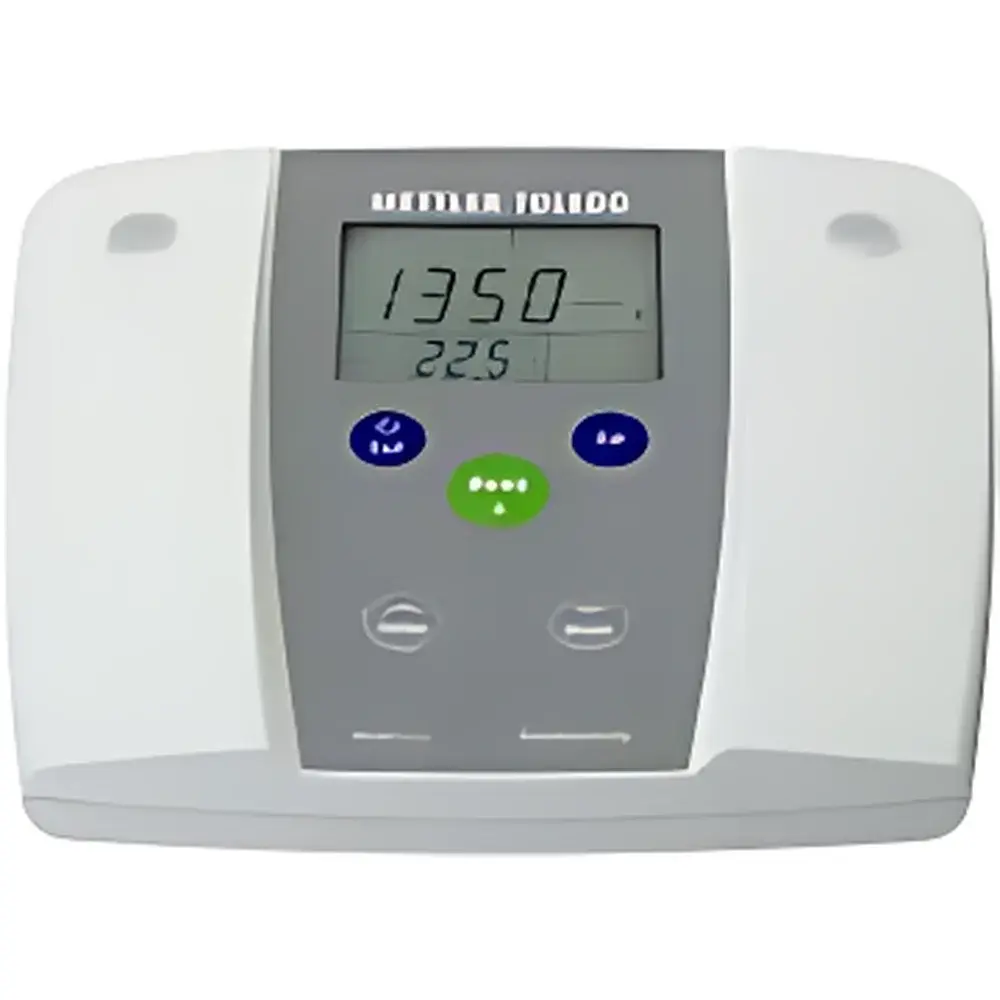
METTLER TOLEDO FE30 FiveEasy™ Conductivity Meter
| Brand | METTLER TOLEDO |
|---|---|
| Origin | Switzerland |
| Model | FE30 |
| Temperature Range | 0.0–100.0 °C |
| Temperature Resolution | 0.1 °C |
| Temperature Accuracy | ±0.3 °C |
| Conductivity Range | 0.00 µS/cm to 199.9 mS/cm |
| TDS Range | 0.00 mg/L to 199.9 g/L |
| Conductivity Accuracy | ±0.5% of reading |
| Display | LCD |
| Power Supply | External AC adapter |
| Operating Environment | 5–40 °C, 5–80% RH |
| Compliance | Designed for GLP-compliant workflows |
Overview
The METTLER TOLEDO FE30 FiveEasy™ Conductivity Meter is a compact, benchtop electrochemical instrument engineered for precision and operational simplicity in routine conductivity and total dissolved solids (TDS) measurements. Based on four-electrode or two-electrode conductometric principles—depending on the connected sensor—the FE30 measures solution conductivity by applying an alternating current across the electrode cell and calculating conductance from the resulting voltage drop. The instrument applies linear temperature compensation (LTC) using either fixed or user-selectable reference temperatures (e.g., 20 °C or 25 °C), ensuring consistent comparability across samples measured at varying ambient conditions. Its architecture reflects over six decades of METTLER TOLEDO’s electrode design expertise, delivering robust performance in environments where reliability, repeatability, and ease of use are prioritized over advanced programmability.
Key Features
- Intuitive five-button interface: Dedicated keys for measurement start/stop, calibration recall, mode selection, and menu navigation—enabling operation without training or manual consultation.
- Simultaneous real-time display: LCD screen shows conductivity or TDS value, measured temperature, endpoint status (auto-recognized), temperature compensation mode, and calibration status—all in a single field of view.
- Automated calibration workflow: Supports one- or two-point calibration with automatic recognition of standard solutions (e.g., 1413 µS/cm, 12.88 mS/cm); stores last calibration data with timestamp and slope information for audit readiness.
- Auto-endpoint detection: Internal algorithm identifies signal stabilization within user-defined tolerance, eliminating subjective judgment and reducing inter-operator variability.
- Linear temperature compensation: Configurable reference temperature (default 25 °C) and coefficient (α = 2.0 %/°C, adjustable per application requirements) ensure traceable and standardized reporting.
- Modular sensor compatibility: Designed for seamless integration with METTLER TOLEDO’s LE703 stainless-steel conductivity cell (included in FE30K kit) and optional InLab® series electrodes—including cells optimized for ultrapure water, high-salinity brines, or viscous media.
Sample Compatibility & Compliance
The FE30 accommodates aqueous samples across broad industrial and regulatory contexts—from potable water and wastewater effluents to beverage formulations and pharmaceutical process water. Its conductivity range (0.00 µS/cm to 199.9 mS/cm) supports applications spanning deionized water QC (≤1 µS/cm), municipal drinking water (50–800 µS/cm), seawater simulation (~50 mS/cm), and concentrated electrolyte solutions. While the FE30 itself is not certified for hazardous area use, its design aligns with general laboratory safety standards (IEC 61010-1). Data integrity features—including timestamped calibration logs and non-editable measurement records—support adherence to Good Laboratory Practice (GLP) documentation requirements. Though not 21 CFR Part 11–enabled out-of-the-box, the instrument’s deterministic behavior and immutable calibration history facilitate retrospective validation in regulated environments.
Software & Data Management
The FE30 operates as a standalone instrument without proprietary software dependency. All measurement and calibration data reside locally on the device and are accessible via front-panel review. For laboratories requiring electronic record retention, optional RS232 output (via accessory cable) enables ASCII-formatted data export to LIMS or spreadsheet platforms. No firmware updates or cloud connectivity are required—minimizing IT overhead and cybersecurity exposure. Calibration events are stored with date/time stamps, electrode ID (if encoded), slope (%), offset (µS/cm), and reference temperature—providing auditable evidence for internal quality reviews or external inspections.
Applications
- Environmental monitoring: Conductivity screening of surface water, groundwater, and treated effluent per ISO 7888 or ASTM D1125 protocols.
- Food & beverage QA: Batch verification of rinse water conductivity in CIP systems; sugar solution concentration estimation via TDS correlation.
- Education & teaching labs: Robust entry-level platform for electrochemistry fundamentals, including Kohlrausch’s law and ion mobility concepts.
- Pharmaceutical water systems: Monitoring of purified water (PW) and water for injection (WFI) conductivity against USP <645> limits—when paired with appropriate low-conductivity cells and temperature-controlled sample handling.
- Industrial process support: Quick-check verification of cleaning solution concentration, boiler feedwater purity, or desalination plant permeate quality.
FAQ
Does the FE30 support automatic temperature compensation with user-defined coefficients?
Yes—the instrument allows manual input of the temperature compensation coefficient (α) ranging from 0.0 to 4.0 %/°C, enabling alignment with material-specific or method-defined correction models.
Can the FE30 store multiple calibration histories?
No—it retains only the most recent calibration event. For extended log retention, users must manually record or export data via RS232.
Is the LE703 electrode suitable for measuring ultrapure water?
The LE703 is optimized for general-purpose use (100 µS/cm to 20 mS/cm). For sub-1 µS/cm measurements, METTLER TOLEDO recommends InLab® Trace or InLab® Ultra electrodes with sealed, low-noise cell geometry.
What power source does the FE30 require?
It operates exclusively via included external AC/DC adapter (100–240 V AC input; 12 V DC output); no internal battery or USB power capability is provided.
Does the FE30 meet IP rating requirements for wet-lab environments?
The unit carries no formal IP rating; it is intended for indoor benchtop use under controlled humidity (5–80 % RH) and should be protected from direct liquid contact or condensation.





