
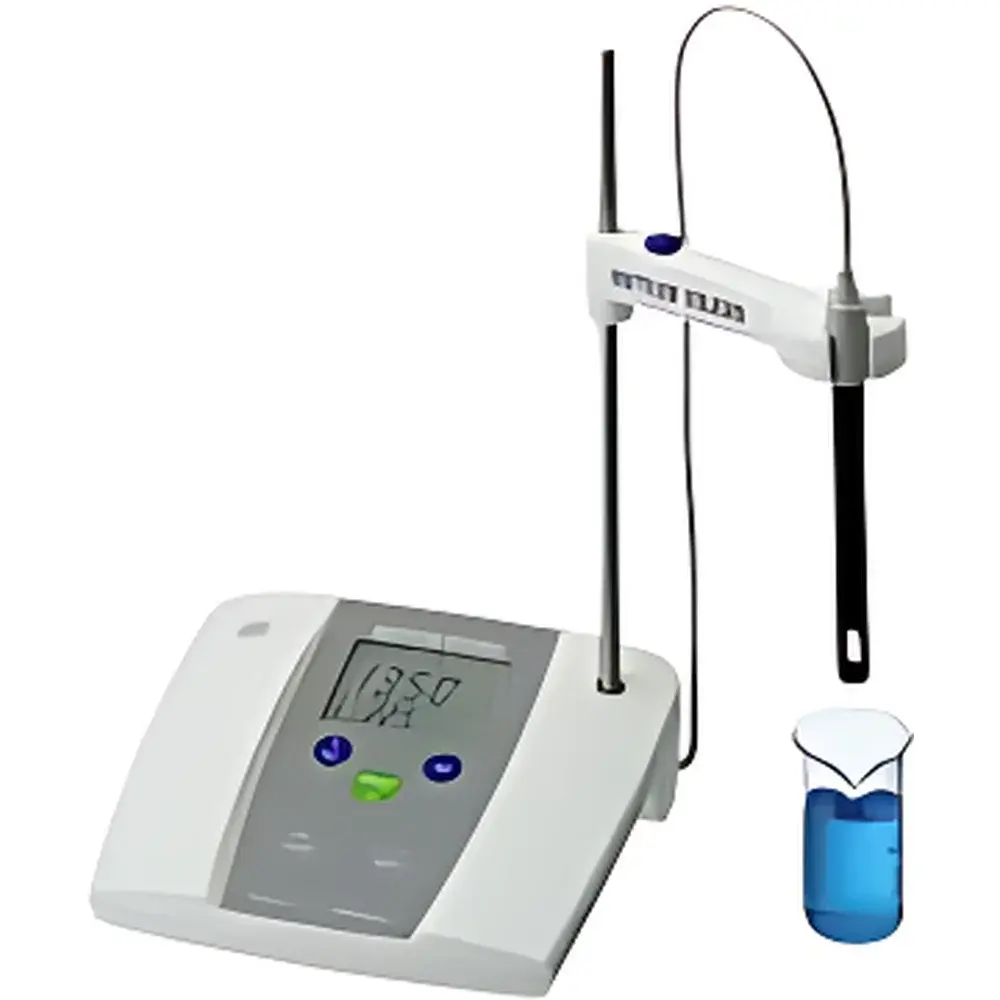
METTLER TOLEDO FiveEasy FE30 and FiveGo FG3 Conductivity Meters
| Brand | METTLER TOLEDO |
|---|---|
| Origin | Shanghai, China |
| Model | FE30, FG3 |
| Conductivity Range | 0.00 µS/cm to 199.9 mS/cm |
| Resolution | 0.01 µS/cm to 0.1 mS/cm (auto-ranging) |
| Accuracy | ±0.5% of reading |
| Temperature Range | 0.0–100.0 °C |
| Temp. Resolution | 0.1 °C |
| Temp. Accuracy | ±0.3 °C |
| TDS Range | 0.0 mg/L to 199.9 g/L |
| Calibration | Single-point with three pre-programmed standards (84 µS/cm, 1413 µS/cm, 12.88 mS/cm) |
| Data Storage | 30 readings (FG3 only) |
| Ingress Protection | IP54 (FG3) |
| Power Supply | AC adapter (FE30) |
| Form Factor | Benchtop (FE30), Portable (FG3) |
Overview
The METTLER TOLEDO FiveEasy FE30 and FiveGo FG3 are benchtop and portable conductivity meters engineered for precision, reproducibility, and operational simplicity across regulated and non-regulated laboratory and field environments. Both instruments operate on the principle of two-electrode AC conductometric measurement, applying a low-frequency alternating current to minimize polarization effects and electrode fouling—ensuring stable, drift-free readings in aqueous solutions ranging from ultrapure water to high-conductivity industrial brines. Designed for routine quality control and process monitoring, the FE30 and FG3 comply with fundamental metrological requirements for conductivity measurement as defined in ISO 7888, ASTM D1125, and USP . Their architecture supports Good Laboratory Practice (GLP) and Good Manufacturing Practice (GMP) workflows through traceable calibration, temperature-compensated measurements, and built-in instrument diagnostics.
Key Features
- Intuitive one-button operation for calibration, measurement initiation, and mode switching—reducing operator training time and procedural variability.
- Auto-ranging conductivity measurement with adaptive resolution (0.01 µS/cm at low ranges up to 0.1 mS/cm at high ranges), eliminating manual range selection errors.
- Integrated temperature compensation using either automatic (NTC sensor) or manual input; supports linear and non-linear (e.g., NaCl-based) compensation algorithms per ISO 7888 Annex B.
- Real-time electrode condition indicator—monitors cell constant stability and alerts users to potential contamination, aging, or physical damage.
- Built-in quick-start guide accessible directly from the home screen—providing context-sensitive instructions without external documentation.
- FE30: Benchtop design with AC-powered operation, optimized for fixed-location use in QC labs, R&D facilities, and educational settings.
- FG3: IP54-rated rugged housing with battery-powered operation (4×AAA or NiMH), enabling reliable deployment in wastewater sampling sites, cooling tower inspections, and bioprocess skid validation.
Sample Compatibility & Compliance
The FE30 and FG3 support standard two-electrode conductivity cells (e.g., InLab® 731-ISM, InLab® Basic) with cell constants of 0.1 cm⁻¹, 1.0 cm⁻¹, and 10 cm⁻¹—covering applications from deionized water (≤1 µS/cm) to seawater (≈50 mS/cm) and concentrated electrolyte solutions. All measurements adhere to temperature-referenced reporting at 25 °C unless otherwise specified—a requirement aligned with pharmacopeial standards (USP , EP 2.2.38). The single-point calibration protocol uses NIST-traceable standards (84 µS/cm, 1413 µS/cm, 12.88 mS/cm), ensuring metrological traceability. While not natively 21 CFR Part 11 compliant, both instruments support audit-ready documentation when paired with METTLER TOLEDO LabX® software (optional upgrade) for electronic signatures, user access control, and full data integrity logging.
Software & Data Management
The FE30 does not feature internal data storage but enables real-time output via analog voltage or RS232 interface for integration into SCADA or LIMS systems. The FG3 stores up to 30 measurement records—including conductivity, TDS, temperature, date/time stamp, and calibration status—locally with timestamped metadata. Both models export data in plain ASCII format for post-processing in Excel or statistical analysis platforms. For enhanced compliance, LabX software provides automated report generation, trend analysis, calibration history tracking, and electronic signature capability—fully supporting ALCOA+ principles (Attributable, Legible, Contemporaneous, Original, Accurate) required under FDA and EMA guidelines.
Applications
These meters serve critical roles across multiple sectors: in pharmaceutical manufacturing, they verify conductivity of purified water (PW) and water-for-injection (WFI) per USP ; in food & beverage, they monitor rinse water quality and brine concentration in sterilization cycles; in power generation, they assess condensate purity and boiler feedwater contamination; in environmental labs, they quantify salinity and total dissolved solids in surface and groundwater samples; and in academic research, they provide robust baseline conductivity data for electrochemical studies and solution chemistry experiments.
FAQ
Can the FE30 and FG3 measure resistivity?
No—they are dedicated conductivity/TDS meters. Resistivity is the reciprocal of conductivity and must be calculated externally if required.
Is temperature compensation mandatory for accurate results?
Yes. Conductivity is highly temperature-dependent; all reported values should be referenced to 25 °C using either automatic or manually entered temperature data.
Do these meters support multi-point calibration?
No. They implement single-point calibration with three pre-configured standard options, consistent with routine QC verification per ISO 7888 and ASTM D1125.
What is the maximum allowable cell constant deviation before recalibration?
The electrode condition indicator provides qualitative feedback; however, METTLER TOLEDO recommends verifying cell constant annually or after mechanical shock, cleaning, or exposure to aggressive solvents.
Are firmware updates available?
Yes—firmware can be updated via USB connection using free METTLER TOLEDO Instrument Manager software, ensuring continued compatibility with evolving regulatory expectations and connectivity standards.




