
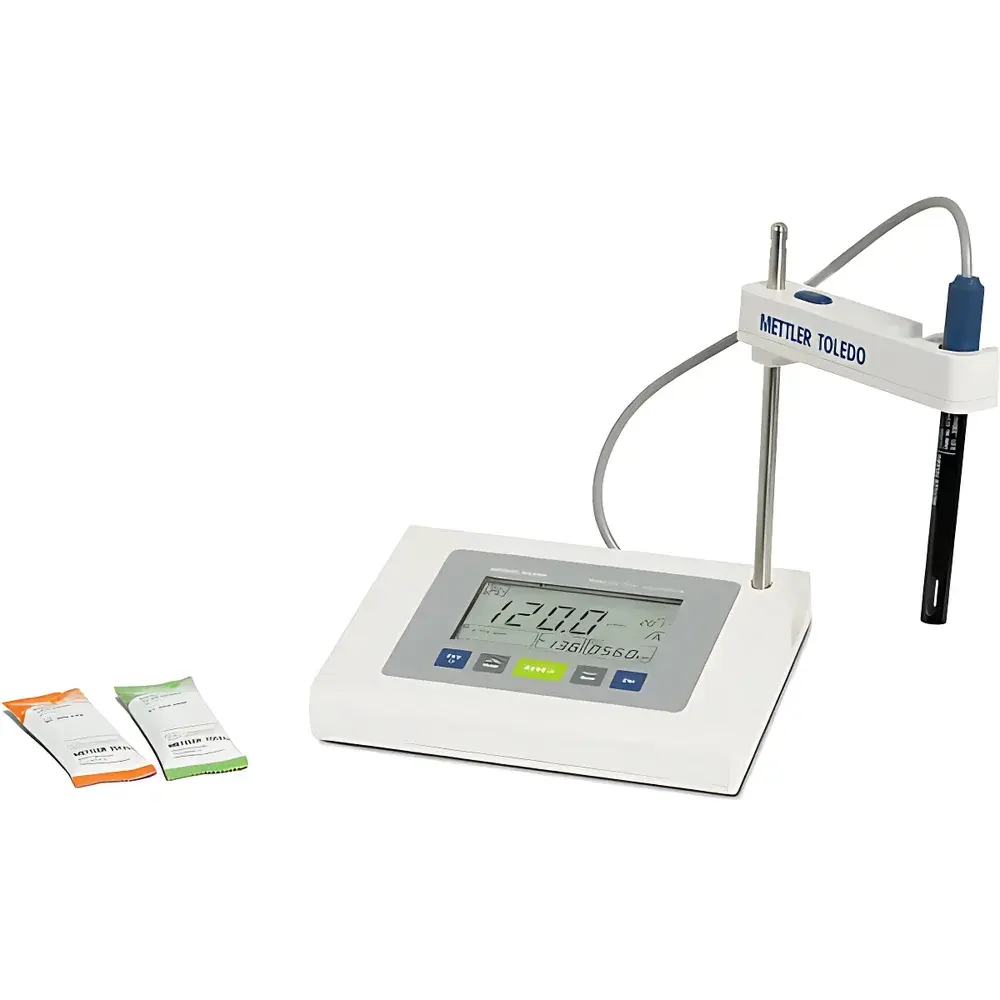
METTLER TOLEDO FiveEasyPlus™ Benchtop Conductivity Meter
| Brand | METTLER TOLEDO |
|---|---|
| Origin | Switzerland |
| Model | FiveEasyPlus™ Benchtop |
| Conductivity Range | 0.01 µS/cm to 500 mS/cm |
| Resolution (Conductivity) | 0.01 µS/cm (auto-ranging) |
| Accuracy (Conductivity) | ±0.5% of reading |
| Temperature Range | 0–105 °C |
| Temperature Resolution/Accuracy | 0.1 °C / ±0.3 °C |
| Temperature Compensation | Linear, 0.00–10.00 %/°C |
| Reference Temp | 20 °C or 25 °C |
| TDS Range | 0.01 mg/L to 300 g/L |
| Salinity Range | 0.00–42 psu |
| Data Storage | 200 measurement records + current calibration data |
| Interfaces | RS232 and USB |
| Electrode Included | LE703 (for aqueous samples, medium-to-high conductivity) |
| Calibration Standards Supplied | 1413 µS/cm and 12.88 mS/cm pre-filled pouches |
Overview
The METTLER TOLEDO FiveEasyPlus™ Benchtop Conductivity Meter is a precision-engineered electrochemical instrument designed for reliable, repeatable conductivity, TDS, salinity, and temperature measurements in routine laboratory and quality control environments. Built upon METTLER TOLEDO’s legacy of Swiss metrological excellence, the FiveEasyPlus™ employs four-wire conductivity measurement technology with automatic range selection and real-time temperature compensation—ensuring traceable accuracy across the full operational span from ultrapure water (0.01 µS/cm) to highly concentrated saline or industrial process solutions (up to 500 mS/cm). Its architecture conforms to fundamental principles of conductance measurement: application of an alternating current (AC) voltage across a defined electrode cell geometry, followed by precise determination of resulting current to calculate specific conductance (κ), corrected to standardized reference temperatures per ISO 7888 and ASTM D1125. The instrument is optimized for compliance-driven workflows in pharmaceutical, environmental, food & beverage, and academic laboratories where reproducibility, audit readiness, and ease of validation are essential.
Key Features
- Auto-ranging conductivity measurement from 0.01 µS/cm to 500 mS/cm with 0.01 µS/cm resolution at low ranges
- Integrated linear temperature compensation (0.00–10.00 %/°C) with selectable reference temperatures (20 °C or 25 °C), aligned with ISO 9001 and USP requirements
- Dual interface support: RS232 and USB ports enable direct data export to printers, LIMS, or PC-based analysis software without proprietary drivers
- Large backlit LCD display with intuitive icon-based navigation—simultaneously shows conductivity/TDS/salinity values, temperature, electrode status, calibration validity, and unit indicators
- Compact benchtop form factor with integrated electrode holder that folds neatly into the instrument’s side recess—minimizing footprint and improving lab ergonomics
- Built-in data management: stores up to 200 measurement records plus full calibration metadata (date, standard used, slope, offset, cell constant)
- Pre-calibrated LE703 conductivity cell included—optimized for aqueous samples with medium-to-high conductivity; compatible with optional high-precision cells (e.g., InLab® 731 for low-conductivity applications)
Sample Compatibility & Compliance
The FiveEasyPlus™ is validated for use with aqueous liquid samples across diverse matrices—including purified water, wastewater, brines, buffer solutions, and electrolyte formulations. It supports standardization against NIST-traceable KCl solutions (1413 µS/cm and 12.88 mS/cm) supplied in single-use pouches to eliminate cross-contamination and ensure consistent calibration integrity. The instrument meets key regulatory expectations for routine analytical instrumentation: its firmware implements non-volatile memory with timestamped calibration logs, supporting GLP/GMP documentation requirements. While not inherently 21 CFR Part 11 compliant out-of-the-box, its data export capability enables integration into validated electronic record systems when paired with appropriate audit trail and user access controls. Electrical safety complies with IEC 61010-1; EMC performance conforms to EN 61326-1.
Software & Data Management
Data capture and transfer are streamlined via native RS232 or USB connectivity—no additional software installation required for basic export. Measurement records include date/time stamp, measured value, temperature, selected unit, and electrode identification. When connected to a Windows PC, exported files are generated in plain-text CSV format, facilitating direct import into Excel, statistical analysis tools (e.g., JMP, Minitab), or LIMS platforms. Calibration history is retained independently and accessible on-screen at any time—supporting internal QA reviews and external audits. Optional METTLER TOLEDO LabX® Lite software (sold separately) extends functionality with automated report generation, trend analysis, and multi-instrument fleet monitoring.
Applications
- Pharmaceutical water system monitoring (PW, WFI) per USP and EP 2.2.38
- Environmental testing of surface water, groundwater, and effluent per EPA Method 120.1 and ISO 7888
- Food & beverage QC for syrup concentration, brine strength, and cleaning solution verification
- Academic teaching labs for electrochemistry fundamentals and solution property characterization
- Industrial process control of cooling tower water, boiler feedwater, and electroplating baths
FAQ
Does the FiveEasyPlus™ support automatic calibration recognition?
No—the instrument requires manual entry of standard conductivity values during calibration; it does not auto-detect standard concentrations via electrode ID.
Can the LE703 electrode be used for ultrapure water measurements?
No—the LE703 is optimized for conductivities above 10 µS/cm; for sub-µS/cm applications (e.g., Type I water), a dedicated low-conductivity cell such as the InLab® 731 with sealed double-junction design is recommended.
Is temperature compensation configurable per sample type?
Yes—users may select the temperature coefficient (0.00–10.00 %/°C) and reference temperature (20 °C or 25 °C) based on sample matrix and method requirements.
How is data security handled during USB export?
Data is exported as unencrypted CSV files; secure handling must be implemented at the host system level (e.g., encrypted drives, role-based access control) to meet organizational IT policies.
What maintenance is required for long-term accuracy?
Regular verification using certified standards, periodic cleaning of the LE703 cell with mild detergent or dilute HNO₃, and annual verification of temperature sensor drift against a calibrated reference thermometer are recommended best practices.




