
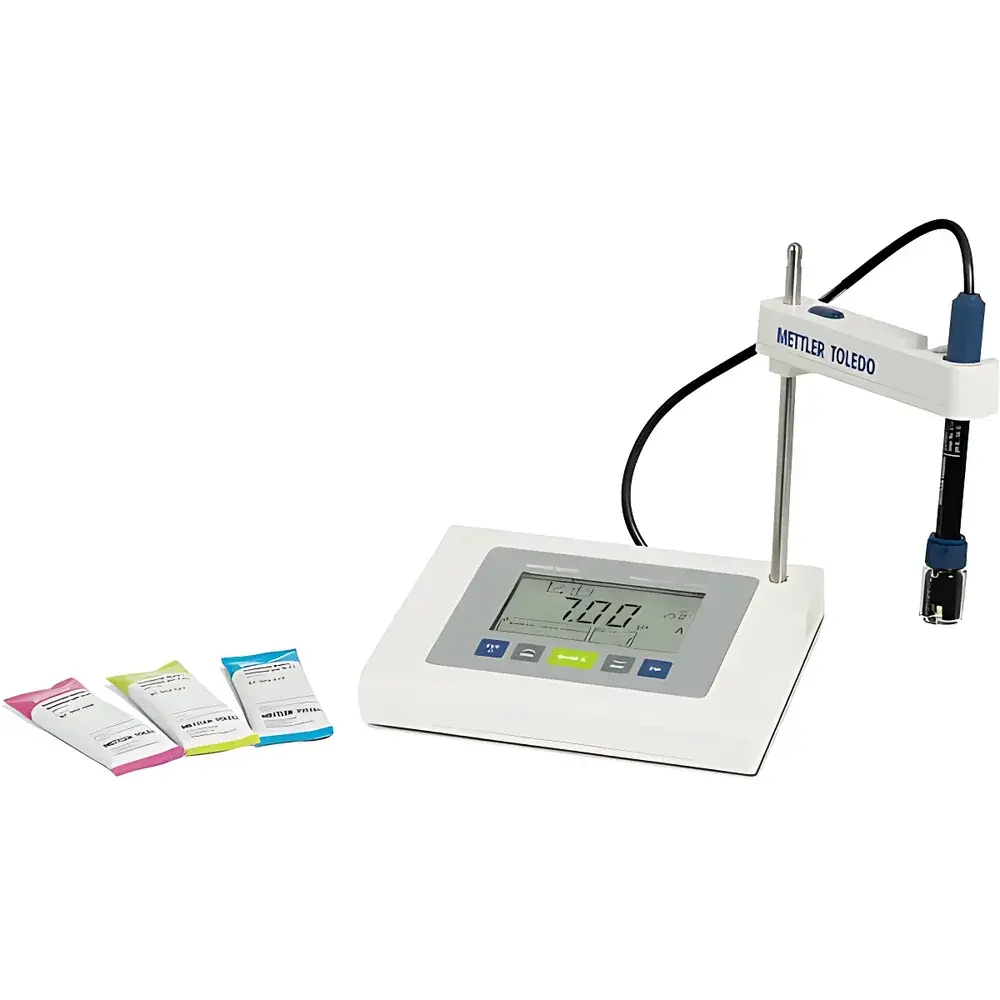
METTLER TOLEDO FiveEasyPlus™ Benchtop pH/mV Meter
| Brand | METTLER TOLEDO |
|---|---|
| Origin | Switzerland |
| Model | FiveEasyPlus™ |
| pH Range | −2.00 to 16.00 |
| pH Resolution/Accuracy | 0.01 / ±0.01 |
| Temperature Range | 0 to 105 °C |
| Temperature Resolution/Accuracy | 0.1 °C / ±0.3 °C |
| Temperature Compensation | Automatic (ATC) and Manual (MTC) |
| Data Storage | 200 measurement records + current calibration data |
| Buffer Sets | Predefined 4-point calibration sets |
| Interfaces | RS232 and USB |
| Electrode Compatibility | LE438, LE410, LE422, LE420, and other standard BNC-compatible pH electrodes |
| Display | Large backlit LCD with intuitive icon-based interface |
Overview
The METTLER TOLEDO FiveEasyPlus™ Benchtop pH/mV Meter is a precision electrochemical instrument engineered for routine pH and redox potential (mV) measurements in quality control laboratories, academic teaching environments, and industrial process support settings. Built upon METTLER TOLEDO’s legacy of metrological rigor, the FiveEasyPlus™ employs high-stability analog signal conditioning and digital signal processing to deliver consistent, traceable results across diverse aqueous and semi-aqueous matrices. Its core architecture follows standardized potentiometric measurement principles per ISO 3696, ASTM E70, and USP , utilizing a reference electrode and measuring electrode pair to determine hydrogen ion activity relative to defined buffer standards. Designed for operational continuity in regulated environments, the instrument supports GLP-compliant workflows through audit-ready calibration logging, timestamped data capture, and non-editable measurement records.
Key Features
- Large, backlit graphical LCD display with context-sensitive icons—clearly indicating real-time pH/mV values, electrode status (e.g., slope, offset), temperature, calibration progress, and battery level.
- Compact benchtop form factor with integrated electrode holder that stows flush against the instrument’s side panel—optimizing lab bench space without compromising ergonomic access.
- Dual communication interfaces: RS232 for direct printing to serial label or thermal printers; USB for seamless connection to Windows-based PCs running METTLER TOLEDO LabX® Light or generic spreadsheet applications via virtual COM port emulation.
- Robust calibration management supporting up to five-point pH calibration with automatic recognition of IUPAC- and NIST-traceable buffer sets (pH 1.68, 4.01, 6.86, 7.00, 9.18, 10.01, 12.45); mV calibration includes zero-point and slope verification.
- Automatic temperature compensation (ATC) using Pt1000 or NTC thermistors, plus manual temperature input (MTC) for fixed-point immersion or non-ATC electrode configurations.
- Built-in data integrity safeguards: 200 measurement records stored with date/time stamps, electrode ID (if encoded), calibration parameters, and environmental conditions—exportable as CSV for archival or regulatory review.
Sample Compatibility & Compliance
The FiveEasyPlus™ accommodates a broad spectrum of sample types within its specified pH (−2.00 to 16.00) and temperature (0 to 105 °C) operating ranges. It is routinely deployed for aqueous solutions, buffered standards, pharmaceutical formulations, food extracts, wastewater effluents, emulsions, suspensions, and TRIS-based biological buffers. When paired with application-specific electrodes—including the LE438 (general-purpose gel-filled), LE410 (micro-volume for PCR tubes), LE422 (low-ionic-strength water), and LE420 (oil-in-water emulsions)—the system maintains measurement fidelity under challenging conditions such as low conductivity, high viscosity, or protein fouling. All operational protocols align with ISO/IEC 17025 requirements for testing laboratories, and the instrument’s firmware design facilitates adherence to FDA 21 CFR Part 11 when used in conjunction with validated LabX® software and controlled user access protocols.
Software & Data Management
Data generated by the FiveEasyPlus™ is structured for interoperability and regulatory readiness. Each stored record contains pH/mV value, temperature, electrode slope (%), asymmetry potential (mV), calibration date/time, buffer IDs used, and operator ID (if enabled via external authentication). Export via USB yields time-stamped CSV files compatible with LIMS integration, statistical process control (SPC) tools, or electronic lab notebooks (ELN). While the meter operates independently without software, optional LabX® Light provides centralized device configuration, remote calibration validation, PDF report generation, and automated backup—supporting audit trails required under GMP and GLP frameworks. All firmware updates are digitally signed and delivered via METTLER TOLEDO’s secure support portal.
Applications
- Quality assurance of raw materials and finished products in pharmaceutical, chemical, and food manufacturing—per USP , EP 2.2.3, and JP 2.03.
- Educational laboratories conducting foundational electrochemistry experiments—emphasizing Nernst equation validation, buffer behavior, and electrode response kinetics.
- Environmental monitoring labs performing wastewater pH compliance checks aligned with EPA Method 150.1 and ISO 10523.
- R&D groups characterizing formulation stability across pH gradients, including liposomal suspensions, colloidal dispersions, and surfactant systems.
- Biotechnology facilities verifying TRIS-HCl, phosphate, and acetate buffer preparation accuracy prior to cell culture or enzyme assay use.
FAQ
Does the FiveEasyPlus™ support GLP-compliant data handling?
Yes—when configured with timestamped logging, user-defined operator IDs, and calibrated electrode tracking, it meets core GLP data integrity expectations. Full 21 CFR Part 11 compliance requires integration with LabX® software and institutional procedural controls.
Can I use non-METTLER TOLEDO pH electrodes with this meter?
Yes—the instrument features a standard BNC input and accepts any pH electrode with compatible output impedance and voltage range (±1999.9 mV), though optimal performance and auto-detection require METTLER TOLEDO SmartElectrodes.
Is temperature compensation mandatory during pH measurement?
No—manual temperature entry (MTC) is supported for static-temperature applications or when using non-ATC electrodes; however, ATC is strongly recommended for measurements where sample temperature fluctuates or deviates from 25 °C.
How frequently should I calibrate the instrument?
Calibration frequency depends on application criticality and regulatory requirements; daily calibration is typical for QC labs, while educational or low-throughput settings may follow weekly or pre-use verification protocols per SOP.
What happens to stored data during power loss or battery replacement?
All 200 measurement records and calibration history are retained in non-volatile memory—even during full power-down or battery swap—ensuring no data loss under normal maintenance conditions.





