
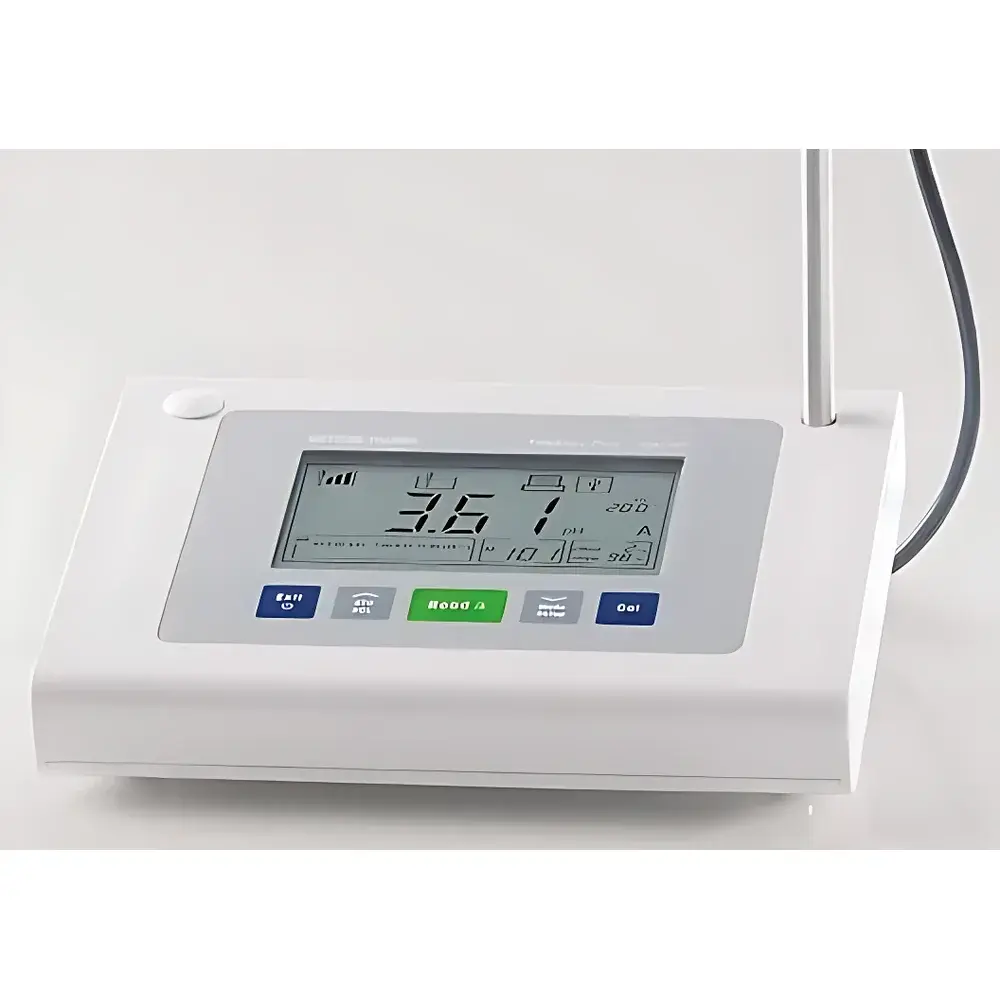
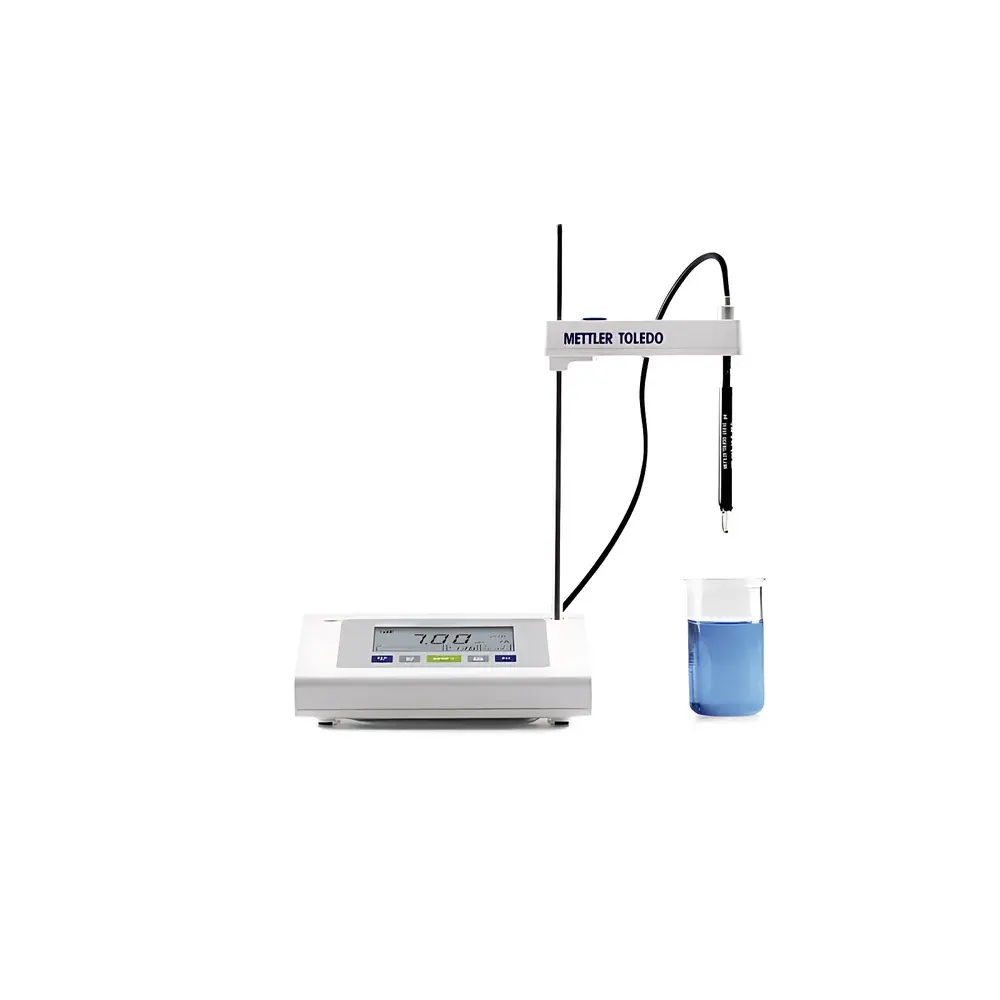
METTLER TOLEDO FiveEasyPlus™ FE28 Benchtop pH/mV Meter
| Brand | METTLER TOLEDO |
|---|---|
| Origin | Switzerland |
| Model | FE28 |
| Instrument Type | Benchtop |
| Parameter Types | pH and mV |
| Measurement Range | –2.00 to 16.00 pH |
| Resolution | 0.01 pH / 0.1 mV |
| Accuracy | ±0.01 pH |
| Calibration | Manual 1–3 point calibration with standard buffers (e.g., pH 4.01, 7.00, 10.01) |
| Connectivity | RS232 and USB interfaces |
| Display | Large backlit LCD with icon-based status indicators |
| Electrode Holder | Integrated retractable holder |
| Compliance | Designed in accordance with IEC 61010-1 for laboratory electrical safety |
Overview
The METTLER TOLEDO FiveEasyPlus™ FE28 is a benchtop pH/mV meter engineered for precision, repeatability, and operational simplicity in routine electrochemical analysis. Built upon METTLER TOLEDO’s legacy of metrological excellence, the FE28 employs high-stability analog-to-digital conversion and temperature-compensated electrode signal processing to deliver consistent pH and redox (mV) measurements across diverse sample matrices. Its measurement principle relies on potentiometric detection using glass combination electrodes or separate reference/sensing electrodes, with automatic temperature compensation (ATC) enabled via optional integrated or external Pt1000 sensors. Designed specifically for QC labs, teaching laboratories, and production environments where regulatory traceability and daily reliability are essential, the FE28 meets foundational requirements for GLP-compliant documentation when paired with compatible printers or data management software.
Key Features
- Intuitive user interface with large, backlit LCD display featuring context-sensitive icons—clearly indicating measured value, electrode status (slope, offset), calibration progress, and ATC activation.
- Compact footprint optimized for limited bench space; includes a built-in, slide-out electrode holder that retracts flush into the instrument’s side panel when not in use.
- Dual-parameter capability: simultaneous pH and mV readouts with independent range selection and unit toggling.
- Manual 1–3 point calibration protocol supporting standard NIST-traceable buffer sets (e.g., pH 4.01, 7.00, 10.01); slope and offset diagnostics displayed in real time during calibration.
- Dual communication interfaces—RS232 and USB—for direct connection to thermal printers or Windows-based PCs; supports ASCII-formatted data export without proprietary drivers.
- Rugged housing compliant with IEC 61010-1 Edition 3 for protection against overvoltage, transient surges, and accidental spill ingress (IP20 rating).
Sample Compatibility & Compliance
The FE28 is suitable for aqueous and mildly buffered solutions encountered in pharmaceutical QC, water quality testing, food & beverage process control, and academic instruction. It accommodates standard BNC-input combination pH electrodes (e.g., LE438, InLab® Expert Pro) and ORP electrodes with millivolt output. While not intrinsically certified for hazardous areas, its design aligns with general-purpose laboratory safety standards. The instrument supports documentation practices aligned with ISO/IEC 17025 clause 7.7 (result reporting) and provides sufficient metadata (date/time stamp, calibration ID, electrode ID if entered manually) to support internal audit trails. Though not FDA 21 CFR Part 11–validated out-of-the-box, its data export functionality enables integration into validated LIMS or ELN systems where electronic records are governed by organizational SOPs.
Software & Data Management
No embedded software suite is included; instead, the FE28 leverages open-protocol serial/USB communication for seamless interoperability. Raw measurement data—including timestamp, pH/mV values, temperature, and calibration identifiers—is transmitted as plain-text ASCII frames. This architecture facilitates ingestion into third-party tools such as Microsoft Excel, LabArchives, or custom Python/Matlab scripts for statistical process control (SPC) or trending analysis. Optional METTLER TOLEDO LabX® Light software (sold separately) can be deployed to automate report generation, enforce calibration schedules, and maintain electronic logbooks—enhancing compliance readiness for GMP-aligned workflows.
Applications
- Quality control of raw materials and finished products in pharmaceutical manufacturing (e.g., USP pH verification of injectables and ophthalmic solutions).
- Monitoring of buffer preparation and media stability in cell culture and bioprocessing labs.
- Teaching electrochemical fundamentals—including Nernst equation validation and electrode response characterization—in undergraduate chemistry curricula.
- Routine environmental testing of wastewater effluents, drinking water sources, and soil leachates per ASTM D1293 and EPA Method 150.1.
- Food acidity assessment (e.g., titratable acidity correlation, shelf-life studies) in R&D and production QA labs.
FAQ
Does the FE28 support automatic temperature compensation?
Yes—when connected to an optional Pt1000 temperature probe (e.g., LE438-T or InLab® Temperature Pro), the FE28 applies real-time ATC using the Nernstian temperature coefficient.
Can calibration data be exported along with measurement results?
Calibration parameters (slope, offset, buffer IDs) are displayed on-screen and may be manually recorded; full calibration logs require external capture via RS232/USB during active calibration mode.
Is the FE28 compatible with non-METTLER TOLEDO electrodes?
Any BNC-output pH or ORP electrode meeting standard impedance and output voltage specifications (≤ 10¹² Ω input impedance, ±1500 mV range) will function, though optimal performance is validated with METTLER TOLEDO InLab® series electrodes.
What is the recommended recalibration frequency?
Per ISO 7027 and CLSI C30-A3 guidelines, recalibration is advised before each analytical session, after electrode cleaning, or following significant ambient temperature shifts (>2°C).
Does the instrument store historical measurements internally?
No—the FE28 does not feature onboard memory; all data persistence depends on external recording via printer or host PC.




