
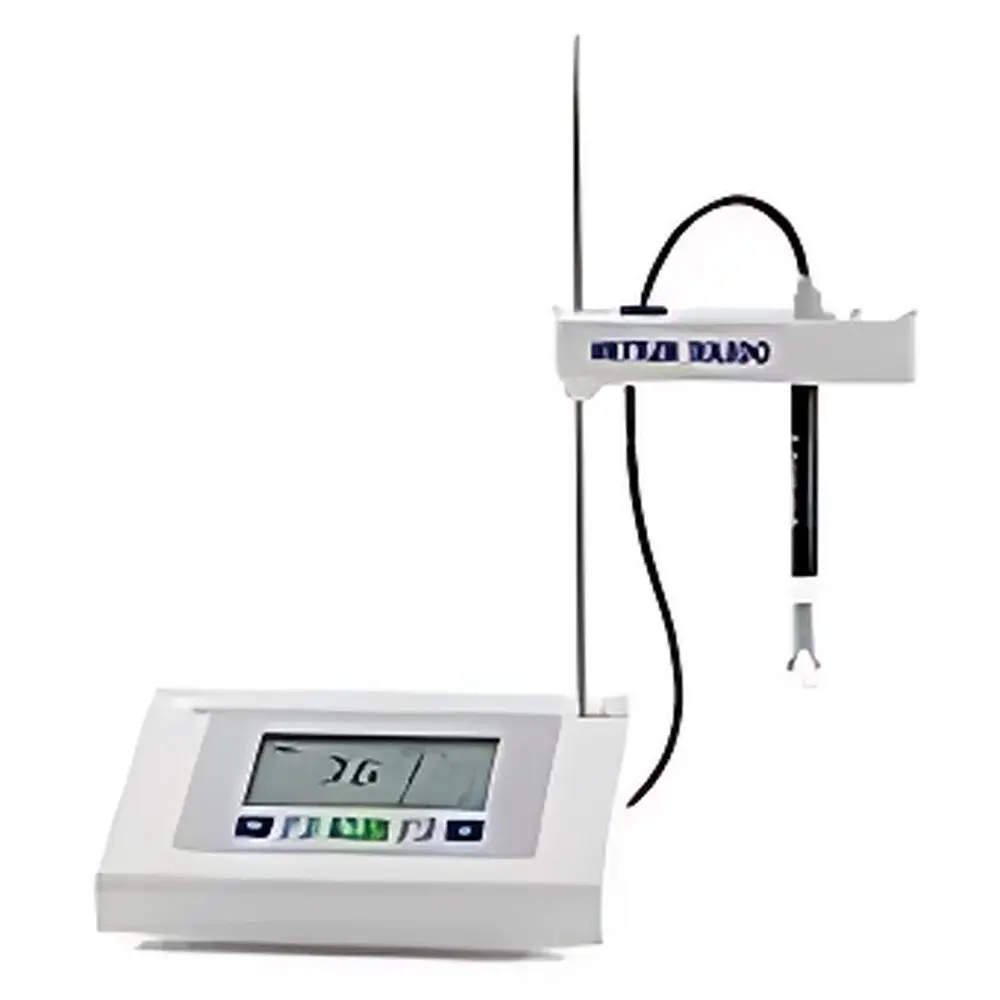
METTLER TOLEDO FiveEasyPlus™ pH/mV Benchtop Meter
| Brand | METTLER TOLEDO |
|---|---|
| Origin | Switzerland |
| Model | FiveEasyPlus™ pH/mV |
| Form Factor | Benchtop |
| Application Environment | Laboratory |
| pH Measurement Range | -2.00 to 16.00 |
| mV Measurement Range | ±2000 mV |
| Conductivity Range | -2.00 to 16.00 mS/cm (as configurable parameter) |
| Salinity Range | 0.00–42.00 psu |
| Temperature Range | 0.0 to 105.0 °C |
| Temperature Resolution/Accuracy | 0.1 °C / ±0.3 °C |
| pH Resolution/Accuracy | 0.01 / ±0.01 |
| Data Storage Capacity | 200 measurement records + current calibration data |
| Calibration Points | Up to 5-point pH calibration |
| Temperature Compensation | Automatic (ATC) and Manual (MTC) |
| Interface | RS232 and USB |
| Predefined Buffer Sets | 4 standard groups (e.g., DIN, NIST, US, TECH) |
| Electrode Compatibility | Universal BNC + reference input |
| Audible Signal | Yes |
| Display | High-contrast monochrome LCD with icon-based status indicators |
Overview
The METTLER TOLEDO FiveEasyPlus™ pH/mV Benchtop Meter is a rigorously engineered electrochemical instrument designed for routine pH, mV, and temperature measurements in regulated laboratory environments. Built upon METTLER TOLEDO’s legacy of metrological traceability and Swiss precision manufacturing, the device operates on potentiometric measurement principles—detecting the potential difference between a sensing electrode (e.g., glass or combination electrode) and a stable reference electrode in aqueous or semi-aqueous media. Its architecture supports both direct millivolt (redox) readings and high-fidelity pH quantification across an extended range (–2.00 to 16.00), enabling reliable characterization of strongly acidic, alkaline, or buffered systems—including TRIS-based formulations, emulsions, suspensions, and wastewater matrices. The instrument complies with fundamental requirements of ISO/IEC 17025 for testing laboratories and provides foundational support for GLP-compliant workflows through auditable calibration history and stable sensor interface design.
Key Features
- High-resolution pH measurement with 0.01 resolution and ±0.01 accuracy at 25 °C—validated per IUPAC-recommended calibration protocols.
- Benchtop form factor with space-efficient footprint (180 × 190 × 65 mm) and integrated side-mounted electrode holder for clutter-free bench organization.
- Dual connectivity: RS232 and USB interfaces enable direct data export to printers, LIMS, or spreadsheet applications without proprietary software dependencies.
- Intuitive icon-driven LCD display with real-time visualization of measured values, electrode impedance status, calibration progress, and temperature compensation mode (ATC/MTC).
- Configurable 4-predefined buffer sets (DIN, NIST, US, TECH) and up to 5-point calibration routines to accommodate diverse sample chemistries and regulatory expectations.
- Audible confirmation tones for key operations—including calibration completion and out-of-range alerts—enhancing operator situational awareness during high-throughput workflows.
Sample Compatibility & Compliance
The FiveEasyPlus™ pH/mV meter accommodates a broad spectrum of sample types common in QC, environmental, pharmaceutical, and academic laboratories: aqueous buffers, biological suspensions, dairy emulsions, industrial effluents, and low-volume samples in PCR tubes or microcentrifuge vials (when paired with micro-electrodes such as LE422). It supports manual or automatic temperature compensation using Pt1000 or NTC sensors, ensuring thermally corrected readings across 0.0–105.0 °C. While not intrinsically compliant with FDA 21 CFR Part 11, the instrument’s deterministic behavior, non-volatile calibration memory, and timestamped data logging provide a defensible foundation for audit-ready documentation when deployed within validated SOPs. It meets essential performance criteria outlined in ASTM D1293 (pH of water) and ISO 7888 (electrical conductivity of water), and its electrical safety conforms to IEC 61010-1.
Software & Data Management
Data integrity is maintained via on-device storage of up to 200 measurement records—including date/time stamps, measured values, temperature, electrode ID (if encoded), and active calibration parameters. All entries are immutable once stored; no editing or deletion capability exists to preserve forensic integrity. Export is performed via ASCII text files (.csv or .txt), ensuring compatibility with third-party statistical analysis tools (e.g., JMP, Minitab) and laboratory information management systems (LIMS). No cloud dependency or vendor-specific drivers are required—USB operation uses standard CDC ACM class enumeration, while RS232 output adheres to ASCII protocol with configurable baud rates (9600–115200). Audit trail functionality is implemented at the procedural level: users must manually record calibration events in bound logbooks per GLP guidelines, as the device does not embed electronic signatures or role-based access control.
Applications
- Pharmaceutical QC: Monitoring pH stability of parenteral solutions, buffer preparation verification, and cleaning validation rinse water testing.
- Environmental Testing: Field-deployable lab verification of surface water, wastewater influent/effluent, and soil leachate per EPA Method 150.1.
- Food & Beverage: Acidification control in dairy fermentation, shelf-life studies of acidic beverages, and TRIS-buffered enzyme assay optimization.
- Academic Research: Teaching potentiometry fundamentals, calibrating custom electrodes, and validating ion-selective sensor responses.
- Industrial Process Support: Routine checks of cooling tower water chemistry, boiler feedwater alkalinity, and plating bath pH control.
FAQ
Does the FiveEasyPlus™ pH/mV meter support GLP-compliant calibration documentation?
Yes—while it lacks electronic signature capability, its immutable calibration memory, timestamped records, and adherence to multi-point NIST-traceable buffer protocols align with GLP documentation requirements when integrated into a controlled SOP framework.
Can it measure conductivity or salinity without additional hardware?
No—the base FiveEasyPlus™ pH/mV model requires optional conductivity modules (e.g., InLab® Cond Pro) and corresponding sensors to perform conductivity or salinity measurements; the displayed ranges reflect configurable parameter availability, not built-in transducers.
Is electrode diagnostics available beyond impedance indication?
The meter displays real-time electrode impedance as a qualitative health indicator but does not perform advanced diagnostics such as slope calculation, asymmetry potential estimation, or junction resistance profiling—these require higher-tier SevenCompact™ or SevenExcellence™ platforms.
What is the maximum sample volume compatible with standard electrode configurations?
With the included LE438 electrode, minimum recommended sample volume is 5 mL in standard beakers; for micro-applications (e.g., PCR tubes), the LE422 micro-electrode reduces this to ≤100 µL while maintaining metrological reliability.
Are firmware updates field-installable?
Firmware upgrades are performed exclusively via METTLER TOLEDO service centers using calibrated diagnostic tools; end users cannot modify firmware, preserving measurement integrity and regulatory consistency.





