
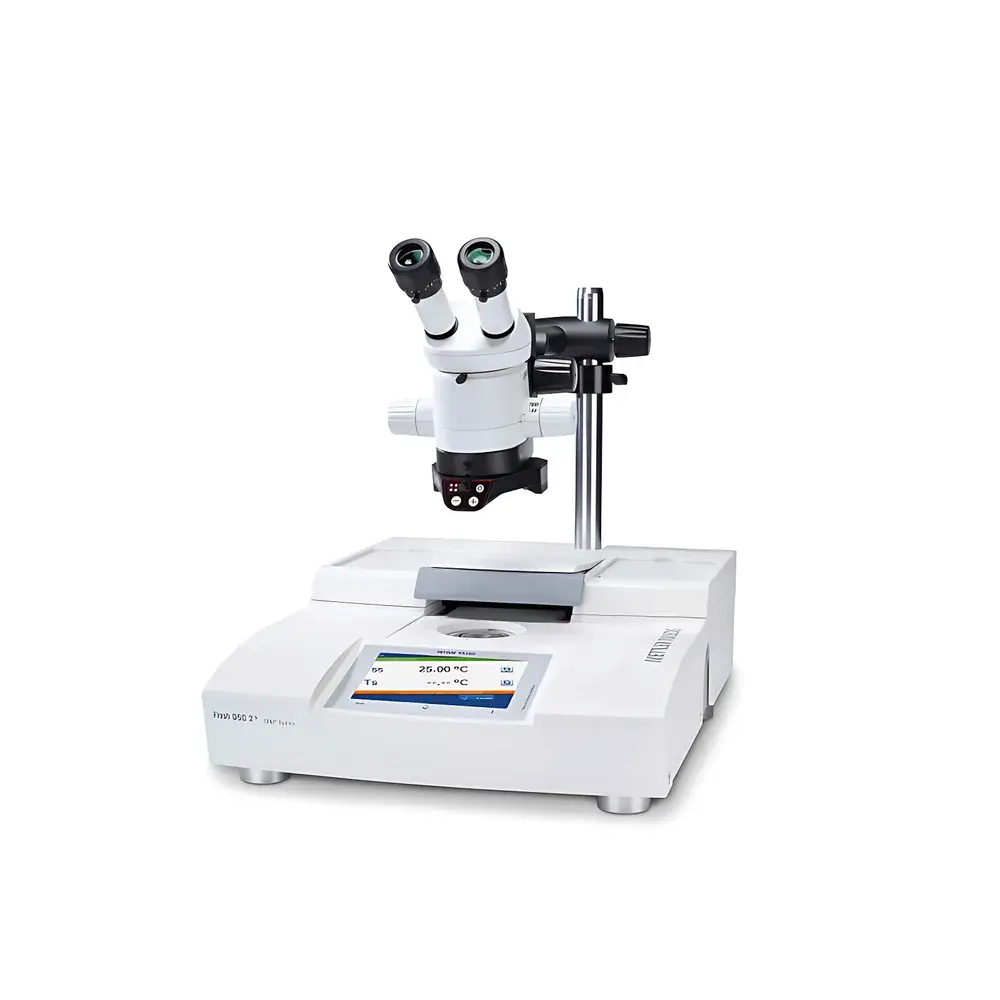
METTLER TOLEDO Flash DSC 2+ Ultra-Fast Differential Scanning Calorimeter
| Brand | METTLER TOLEDO |
|---|---|
| Origin | Switzerland |
| Instrument Type | DSC |
| Temperature Range | –95 °C to 1000 °C |
| Temperature Accuracy | ±0.1 °C |
| Heating/Cooling Rate | 6–3,000,000 K/min (UFS 1 sensor) or 6–2,400,000 K/min (UFH 1 sensor) |
| Simultaneous Sample Measurement | Multiple |
| Compliance | Designed for GLP/GMP environments with audit-trail-capable software |
Overview
The METTLER TOLEDO Flash DSC 2+ is an ultra-fast differential scanning calorimeter engineered for nanoscale thermal analysis under extreme heating and cooling conditions. Unlike conventional DSC systems operating at rates up to ~100 K/min, the Flash DSC 2+ leverages proprietary chip-based sensor architecture and dynamic power compensation to achieve controlled ramp rates spanning seven orders of magnitude—from 6 K/min up to 3 × 10⁶ K/min. This capability enables direct interrogation of transient thermal events that occur on millisecond-to-microsecond timescales, including non-equilibrium crystallization, vitrification, solid-state polymer rearrangements, and rapid phase transformations in metallic alloys and inorganic glasses. Its operational range from –95 °C to 1000 °C supports both cryogenic studies of low-Tg polymers and high-temperature investigations of refractory materials, making it a foundational tool for kinetic thermodynamics, nucleation theory validation, and process-relevant thermal stability assessment.
Key Features
- Ultra-broad heating/cooling rate coverage: 6–3,000,000 K/min (UFS 1) or 6–2,400,000 K/min (UFH 1), enabling isolation of primary thermal transitions from secondary relaxation or reorganization artifacts
- MultiSTAR chip sensor platform: Microfabricated silicon-based sensors with integrated heaters and thermometers; samples are deposited directly onto the active sensing area for minimal thermal lag and maximal signal fidelity
- Dynamic power compensation control: Real-time adjustment of input power maintains precise temperature tracking during extreme ramping, minimizing baseline drift and thermal inertia effects
- Dual-sensor compatibility: Interchangeable UFS 1 (ultra-fast scanning, optimized for kinetics) and UFH 1 (ultra-high heating, optimized for endothermic peak resolution) sensors mounted on electrically conductive ceramic substrates
- Multi-sample capability: Supports sequential or parallel analysis of multiple microgram-scale specimens via automated sample positioning and thermal history management
- Robust thermal shielding and vacuum-compatible chamber: Ensures stable thermal environment and eliminates convective interference across the full temperature range
Sample Compatibility & Compliance
The Flash DSC 2+ accommodates solid powders, thin films, fibers, metallic ribbons, and bulk microsamples (typically 1–500 ng), with minimal preparation requirements. Its chip-based design eliminates crucible-related artifacts and enables direct contact measurement—critical for studying interfacial thermal behavior and surface-dominated transitions. The system complies with international standards governing thermal analysis instrumentation, including ISO 11357 (Plastics — Differential Scanning Calorimetry), ASTM E794 (Melting and Crystallization Temperatures by DSC), and USP (Thermal Analysis). When operated with STARe software in secure mode, it supports 21 CFR Part 11 compliance through electronic signatures, audit trails, user access controls, and data integrity logging—meeting GLP and GMP documentation requirements for regulated R&D and quality control laboratories.
Software & Data Management
STARe Evaluation Software (v15.x or later) provides comprehensive control, real-time visualization, and advanced kinetic modeling. It includes dedicated modules for isoconversional analysis (Friedman, Kissinger-Akahira-Sunose), nucleation/growth modeling (Avrami, Ozawa), and heat capacity deconvolution. All raw data—including time-resolved voltage signals, power compensation profiles, and temperature derivatives—are stored in vendor-neutral HDF5 format with embedded metadata (instrument ID, calibration history, operator, timestamp). Data export supports CSV, ASCII, and universal thermal analysis interchange formats (TAIF). Networked deployment allows centralized instrument monitoring, remote method validation, and integration into LIMS environments via OPC UA or RESTful API interfaces.
Applications
- Crystallization kinetics of semi-crystalline polymers (e.g., PP, PET, PEEK) under processing-relevant cooling conditions
- Vitrification behavior and fictive temperature determination in chalcogenide and oxide glasses
- Decomposition onset and reaction enthalpy quantification in energetic materials and battery cathode precursors
- Phase transformation mapping in shape-memory alloys (NiTi, CuAlMn) and high-entropy alloys
- Thermal stability screening of pharmaceutical amorphous dispersions and co-amorphous systems
- Calibration-free specific heat capacity (Cp) measurement using step-heating protocols
FAQ
What distinguishes Flash DSC from conventional DSC instruments?
Flash DSC achieves heating/cooling rates exceeding 10⁶ K/min—orders of magnitude faster than standard DSC—enabling suppression of time-dependent structural relaxation and access to metastable states.
Can Flash DSC 2+ measure absolute heat capacity?
Yes, using the step-heating method with calibrated reference chips, it delivers Cp values without external calibration standards.
Is the system compatible with inert or reactive gas atmospheres?
The chamber supports purge gases (N₂, Ar, He) and optional vacuum operation; reactive atmospheres require custom sealing and are evaluated case-by-case per material compatibility.
How is temperature accuracy validated across such an extreme range?
Traceable calibration uses certified ITS-90 reference points (e.g., In, Sn, Zn, Al, Ag melting transitions) and in-situ chip sensor characterization at multiple ramp rates.
Does the software support automated kinetic modeling workflows?
Yes—STARe includes preconfigured kinetic analysis templates with uncertainty propagation, model selection criteria (AIC, BIC), and batch-processing for multi-condition datasets.



