
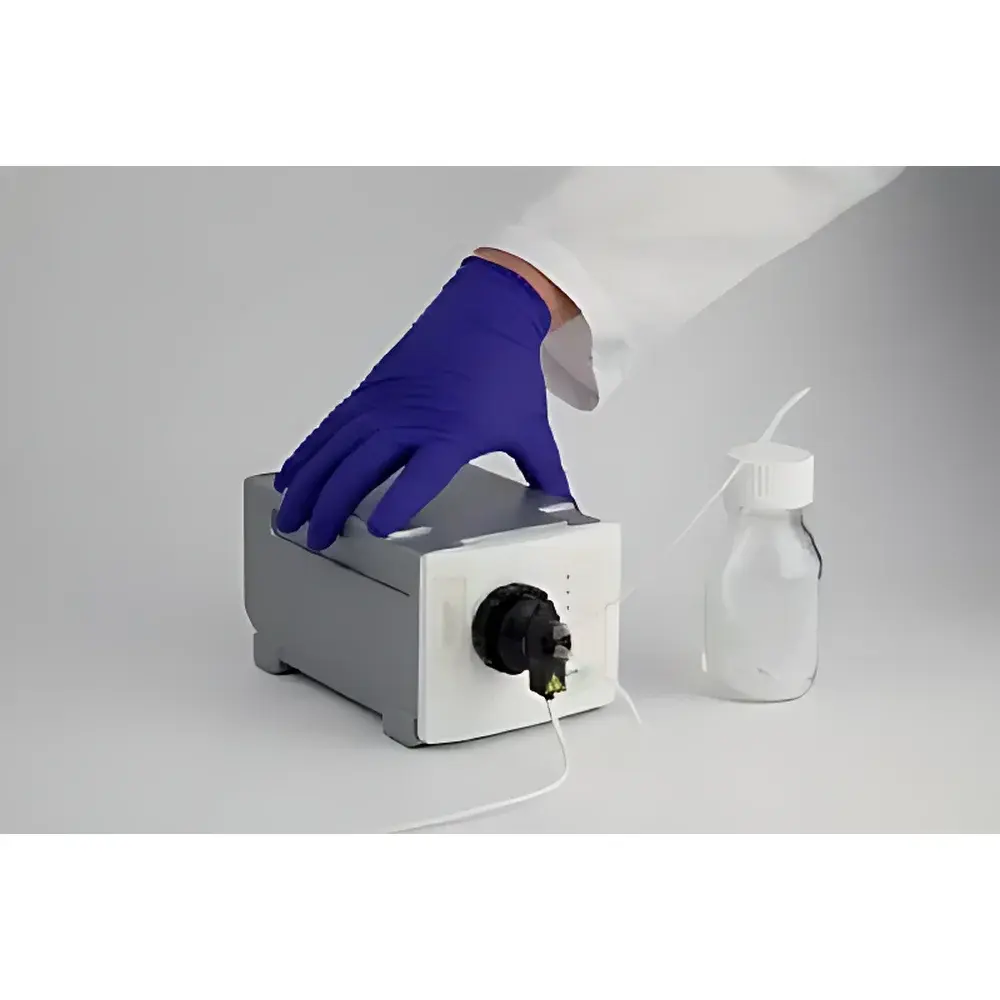
METTLER TOLEDO FlowIR™ Real-Time In-Line FTIR Flow Reactor Analysis System
| Brand | METTLER TOLEDO |
|---|---|
| Origin | USA |
| Manufacturer Type | Authorized Distributor |
| Origin Category | Imported |
| Model | FlowIR™ |
| Product Type | Continuous Flow Analyzer |
| Spectral Range | 4000–650 cm⁻¹ |
| Detector | DTGS |
| Pressure Range | Ambient to 7 bar (standard), up to 30 bar (high-pressure option) |
| Temperature Range | Ambient to 120 °C |
| Internal Cell Volume | 10 µL or 50 µL |
| Integrated Temperature Sensor | Yes |
| Dimensions (W×D×H) | 137 × 241 × 116 mm |
| Weight | 2.6 kg |
Overview
The METTLER TOLEDO FlowIR™ Real-Time In-Line FTIR Flow Reactor Analysis System is an engineered solution for continuous, non-invasive molecular monitoring of chemical reactions in flow chemistry environments. Based on Fourier Transform Infrared (FTIR) spectroscopy, the system leverages the intrinsic vibrational absorption signatures of functional groups—such as C=O, O–H, N–H, and C–N—to deliver quantitative and qualitative compositional data directly within the process stream. Unlike offline analytical methods (e.g., HPLC or GC), which introduce sampling delays, dilution artifacts, and operator-dependent variability, FlowIR™ operates in situ and in real time, enabling second-scale spectral acquisition without flow interruption or manual intervention. Its compact, modular design allows integration into benchtop flow reactors—whether commercially available (e.g., Vapourtec, Syrris, Uniqsis) or custom-built—and supports operation under ambient to elevated pressure (up to 30 bar) and temperature (up to 120 °C), making it suitable for a wide range of homogeneous, heterogeneous, and catalytic transformations.
Key Features
- Real-time, in-line molecular fingerprinting: Captures full mid-IR spectra (4000–650 cm⁻¹) at user-defined intervals (down to sub-second resolution), enabling dynamic tracking of reactants, intermediates, and products without sample extraction.
- Minimal footprint & stackable architecture: Compact dimensions (137 × 241 × 116 mm) and low mass (2.6 kg) allow multiple units to be installed side-by-side or vertically stacked inside standard fume hoods—ideal for parallel reaction screening or multi-step cascade monitoring.
- High-sensitivity DTGS detector: Engineered for robust signal-to-noise performance in low-volume flow cells (10 µL or 50 µL), supporting detection of sub-millimolar concentrations and facilitating kinetic profiling even at dilute conditions.
- Modular sensor head with integrated temperature sensing: Removable flow cell enables rapid cleaning and material compatibility customization (e.g., Hastelloy, sapphire, or chemically resistant polymers); embedded Pt100 sensor provides synchronized thermal feedback for reaction enthalpy correlation and thermal stability assessment.
- Universal hardware and software interoperability: Compatible with standard 1/16″ or 1/8″ tubing interfaces; supports analog (4–20 mA, 0–10 V) and digital (Ethernet/IP, Modbus TCP) communication protocols for seamless integration into LabVIEW, DeltaV, or third-party process control systems.
Sample Compatibility & Compliance
The FlowIR™ system is validated for use with organic solvents (e.g., THF, MeOH, DCM, DMF), aqueous media, and reactive reagents commonly employed in modern flow synthesis—including organometallics, acid chlorides, and diazo compounds. Its pressure-rated wetted path (7 bar standard, 30 bar optional) accommodates gas-liquid reactions (e.g., hydrogenations, carbonylations) and supercritical fluid applications. All optical and fluidic components comply with ISO 9001 manufacturing standards. While not intrinsically rated for ATEX/IECEx Zone 1 environments, the unit may be deployed in Class I Division 2 settings when installed per NFPA 70 and local electrical codes. Data integrity features—including audit-trail-enabled software logging, electronic signatures, and time-stamped spectral metadata—support alignment with FDA 21 CFR Part 11, EU Annex 11, and GLP/GMP documentation requirements when used in regulated development workflows.
Software & Data Management
FlowIR™ is operated via METTLER TOLEDO’s dedicated iC IR software suite, which provides intuitive method setup, real-time spectral visualization, multivariate curve resolution (MCR), and peak integration tools optimized for kinetic modeling. Spectra are stored in vendor-neutral .SPA or .CSV formats, ensuring compatibility with MATLAB, Python (SciPy, scikit-learn), and commercial chemometrics platforms (e.g., Pirouette, Unscrambler). The software supports automated baseline correction, atmospheric compensation (H₂O/CO₂ subtraction), and library-based identification using the built-in NIST/EPA/NIH IR spectral database. All acquisition parameters, calibration records, and user actions are logged with immutable timestamps and operator IDs—enabling full traceability for internal audits or regulatory submissions.
Applications
- Reaction kinetics and mechanism elucidation in photoredox, electrochemical, and enzymatic flow processes
- Residence time distribution (RTD) analysis and mixing efficiency quantification via tracer decay monitoring
- Endpoint detection and adaptive control of telescoped multi-step syntheses
- Process analytical technology (PAT) implementation for Quality by Design (QbD) in API route scouting and scale-up
- In-line verification of reagent stoichiometry, catalyst activation, and impurity formation (e.g., dimerization, hydrolysis)
FAQ
Can FlowIR™ be used with corrosive or highly viscous streams?
Yes—optional flow cell materials include Hastelloy C-276 and sapphire windows, and pump-compatible configurations support viscosities up to 500 cP when paired with appropriate syringe or HPLC-grade pumps.
Is calibration required before each experiment?
No routine recalibration is needed; factory-applied wavenumber and absorbance calibrations are stable over time. Users perform a single background scan (dry or solvent-only) prior to each run to account for optical path variations.
How does FlowIR™ handle bubbles or particulates in the flow stream?
The 10 µL and 50 µL flow cells feature polished internal surfaces and tapered inlet/outlet geometries to minimize bubble trapping; optional inline filters (0.2 µm) and degassing modules are recommended for particulate- or gas-prone reactions.
Does the system support automated reaction optimization?
When coupled with compatible flow controllers and scripting interfaces (e.g., Python API), FlowIR™ spectral output can serve as real-time feedback for closed-loop adjustment of flow rates, temperature, or reagent ratios—enabling autonomous reaction space navigation.
What service and support options are available globally?
METTLER TOLEDO offers extended warranty packages, on-site installation qualification (IQ), operational qualification (OQ), preventive maintenance contracts, and application-specific training delivered by certified flow chemistry specialists across North America, EMEA, and APAC regions.
Related Products



