
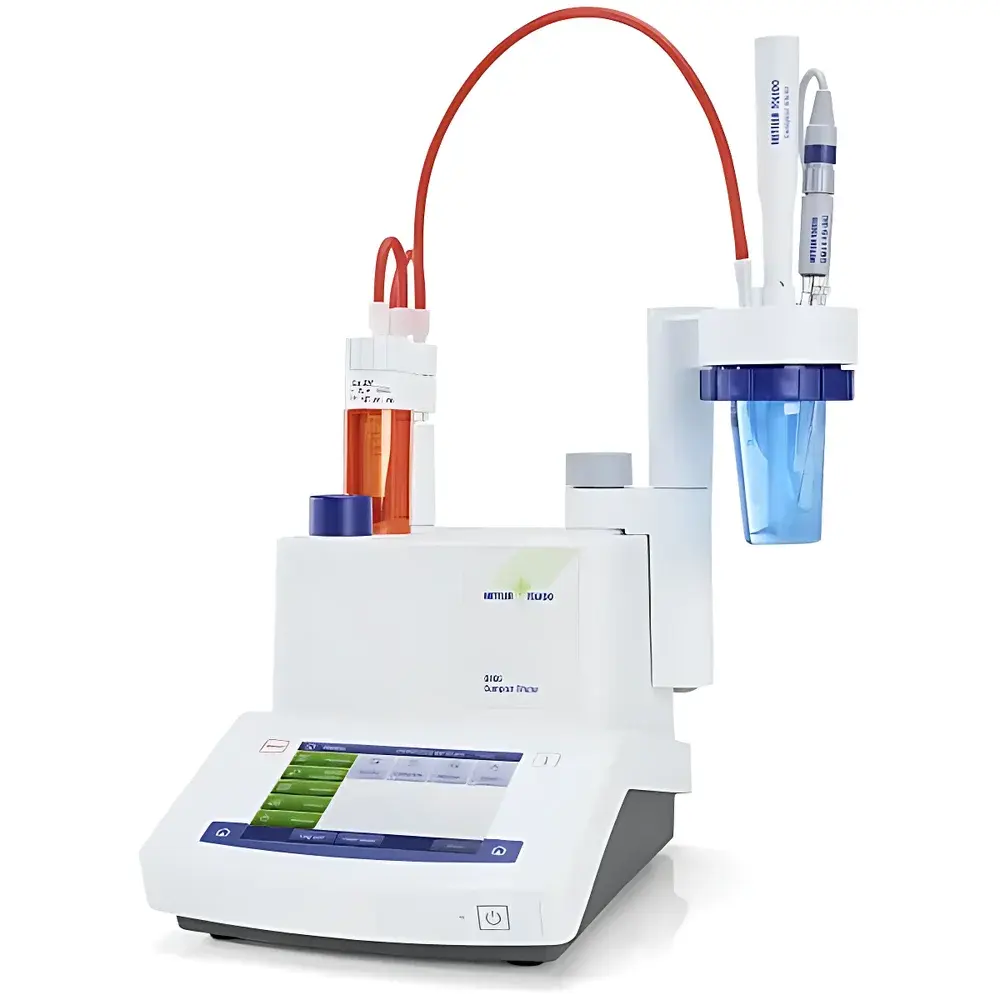
METTLER TOLEDO G10S/G20S Smart Series Automatic Potentiometric Titrator
| Brand | METTLER TOLEDO |
|---|---|
| Origin | Switzerland |
| Model | G10S / G20S |
| User Levels | 4-tier password-protected access |
| Touchscreen | Color capacitive touchscreen with One Click™ interface |
| Electrode Recognition | RFID-enabled smart electrode identification |
| Burette Recognition | Auto-detection of burette type, titrant identity, and titer via embedded RFID chip |
| Solvent Manager | Integrated solvent management module |
| Automation Support | Compatible with Rondolino autosampler (up to 9 samples) |
| Method Storage | >20 pre-validated METTLER TOLEDO methods built-in |
| Sample Series Capacity | Up to 120 samples per series |
| Parameter Customization | Up to 12 configurable parameters per method |
| User Shortcuts | Up to 12 personalized One Click™ shortcuts per user |
| Connectivity | USB host (printer, flash drive), Ethernet, PDF export |
| Software Integration | LabX® Titration PC Software (Express edition) |
| Language Support | Chinese, English, German, French, Spanish, Italian, Russian, Polish, Korean, Portuguese |
| Compliance Features | GLP-compliant audit trail, electronic signatures, secure data export (PDF/CSV), 21 CFR Part 11 readiness via LabX |
| Dimensions (W×D×H) | Compact benchtop design — optimized for space-constrained QC labs |
Overview
The METTLER TOLEDO G10S and G20S Smart Series Automatic Potentiometric Titrators are precision-engineered instruments designed for routine and regulated potentiometric titration in quality control, pharmaceutical, food & beverage, chemical, and academic laboratories. Based on the fundamental principle of potentiometric endpoint detection—measuring the potential difference between a reference and indicator electrode as titrant is incrementally added—the G10S/G20S platforms deliver high reproducibility, traceable results, and full compliance with analytical workflow requirements. Unlike legacy titrators relying on manual calibration or ambiguous endpoint algorithms, these instruments integrate real-time electrode diagnostics, automatic titrant characterization, and intelligent solvent handling to minimize operator dependency and method variability. The modular architecture supports both standalone operation and seamless integration into networked lab environments, making them suitable for ISO/IEC 17025-accredited testing facilities and GMP-regulated production QA/QC workflows.
Key Features
- One Click™ intuitive interface: A 7-inch color capacitive touchscreen enables rapid navigation, context-sensitive guidance, and single-touch execution of common tasks—including method launch, titration start, and report generation.
- RFID-based smart recognition: Electrodes and burettes equipped with embedded RFID chips are automatically identified upon connection; titrant name, concentration, expiry date, and calibration history are retrieved and logged without manual entry.
- Built-in titrant management: The integrated solvent manager regulates solvent delivery, blank correction, and post-titration rinsing cycles—reducing carryover and enhancing inter-sample consistency.
- Four-level user administration: Role-based access control (Operator, Supervisor, Administrator, Auditor) enforces procedural integrity through password protection, action logging, and permission-specific UI visibility.
- Compact, space-optimized design: Benchtop footprint under 300 mm × 400 mm allows deployment in crowded fume hoods or shared analytical workstations without compromising ergonomics or serviceability.
- Dual hardware configurations: The G10S features an internal burette drive mechanism; the G20S adds support for external burette drivers and advanced automation peripherals—including the Rondolino autosampler for unattended batch processing of up to 9 samples with automatic electrode washing and positioning.
Sample Compatibility & Compliance
The G10S/G20S systems accommodate a broad range of aqueous and non-aqueous matrices, including acids, bases, redox-active species, precipitation systems (e.g., chloride by argentometry), and complexometric titrations (e.g., Ca²⁺/Mg²⁺ with EDTA). Compatibility extends to standard glass-bodied and solid-contact electrodes, pH, ion-selective (ISE), redox (Pt), and polarographic sensors—all supported via auto-sensing analog input channels. From a regulatory standpoint, the instruments meet essential requirements for GLP and GMP environments: all user actions, parameter changes, and result calculations are captured in a tamper-evident, time-stamped audit trail. When paired with LabX® Titration software, full 21 CFR Part 11 compliance—including electronic signatures, system validation templates, and secure networked data archiving—is achievable. Methods adhere to ASTM E202, ISO 8587, and USP guidelines where applicable.
Software & Data Management
Data integrity is enforced at every stage—from acquisition to archival. Internal storage retains raw titration curves, derivative plots, equivalence point calculations, and metadata (operator ID, timestamp, environmental conditions) in encrypted binary format. Export options include PDF reports (with customizable templates), CSV datasets for LIMS ingestion, and direct printing via USB-connected printers (including METTLER TOLEDO’s certified P25 thermal printer). LabX® Titration Express software provides centralized method deployment, remote instrument monitoring, automated backup, and statistical process control (SPC) charting. All exported files embed digital signatures and hash verification to satisfy ALCOA+ principles (Attributable, Legible, Contemporaneous, Original, Accurate).
Applications
These titrators serve validated applications across multiple sectors: acid number determination in lubricants (ASTM D974), peroxide value in edible oils (AOCS Cd 8b-90), chloride content in water (ISO 9297), total alkalinity in wastewater, Kjeldahl nitrogen in foodstuffs, and residual titrant quantification in API synthesis. In pharmaceutical manufacturing, they support assay validation per ICH Q2(R2), dissolution testing support, and cleaning verification studies. Academic users leverage the open method editor for teaching fundamental electrochemical concepts—including Gran plot analysis, inflection point detection, and multi-step titration modeling.
FAQ
Does the G10S/G20S support non-aqueous titrations?
Yes—both models accept standard non-aqueous electrodes and permit solvent selection, blank compensation, and endpoint algorithm tuning for acetic anhydride, glacial acetic acid, or ethanol-based systems.
Can I import legacy methods from older METTLER TOLEDO titrators?
Method migration is supported via LabX® software; .mth files from T50/T70/T90 platforms can be converted and validated in accordance with your lab’s change control SOP.
Is calibration verification traceable to national standards?
While the instrument itself does not perform primary calibration, it records calibration certificate IDs, dates, and responsible personnel—enabling full traceability when used with NIST-traceable pH buffers or certified reference materials.
What happens if the RFID tag on a burette is damaged?
The system defaults to manual titrant definition mode with full parameter override; however, RFID failure triggers an alert and logs the event in the audit trail for review.
How frequently must the Rondolino autosampler be maintained?
Routine maintenance—such as tubing inspection, syringe cleaning, and cup alignment verification—is recommended every 200 sample runs or quarterly, whichever occurs first, per the manufacturer’s PM schedule.





