
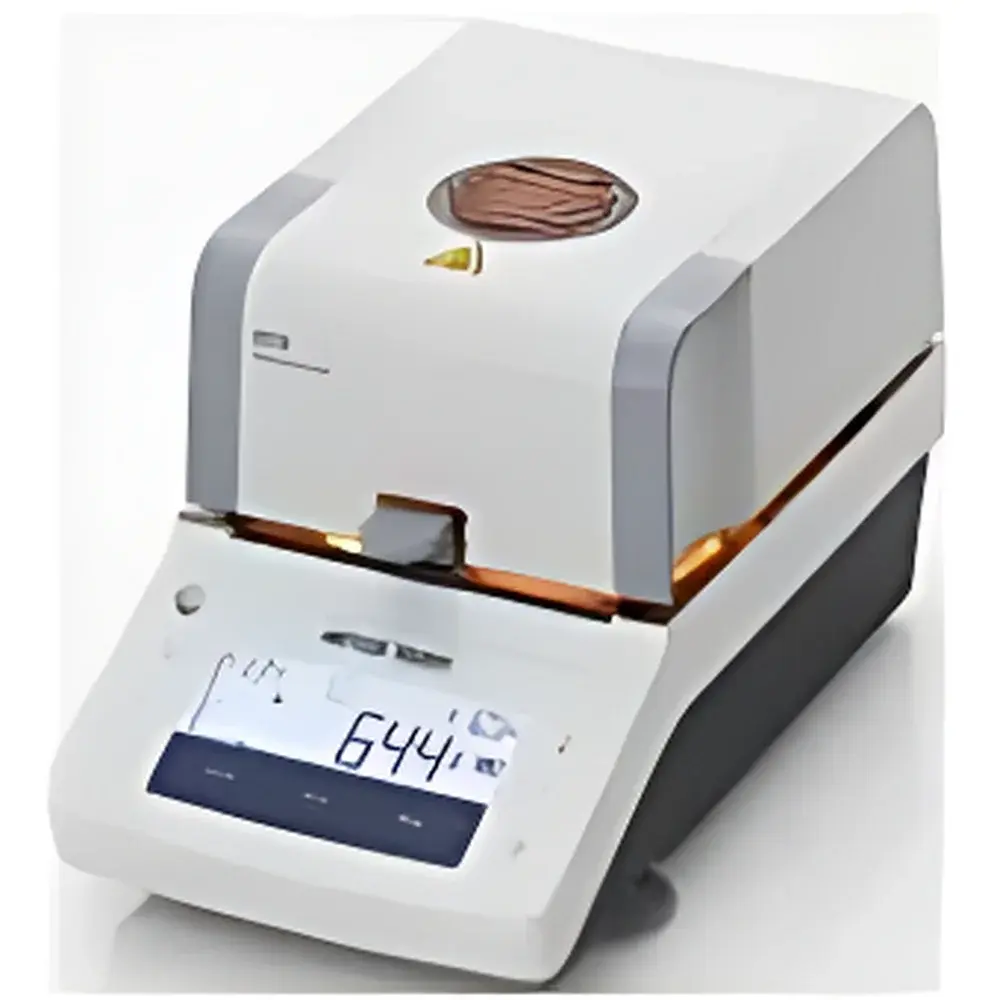
METTLER TOLEDO HE53 Halogen Moisture Analyzer
| Brand | METTLER TOLEDO |
|---|---|
| Origin | Switzerland |
| Model | HE53 |
| Heating Source | Halogen Lamp |
| Maximum Capacity | 54 g |
| Moisture Content Readability | 0.01 % (1 mg) |
| Repeatability (2 g sample) | 0.15 % (SD) |
| Repeatability (10 g sample) | 0.05 % (SD) |
| Drying Temperature Range | 50–160 °C |
| Temperature Increment | 1 °C |
| Predefined Drying Programs | Standard, Rapid |
| Method Storage | 1 method |
| Result Storage | 1 result |
| Display Modes | ATRO moisture %, ATRO solids %, mass (g), moisture %, solids % |
| Interface | RS232 |
| Language | English |
| Compliance | ASTM E1447, ISO 18810, USP <921>, GLP-compliant data handling |
Overview
The METTLER TOLEDO HE53 Halogen Moisture Analyzer is a precision thermal gravimetric instrument engineered for rapid, reliable determination of moisture content in solid and semi-solid samples via loss-on-drying (LOD) methodology. Utilizing a high-intensity halogen lamp as its heating source, the HE53 delivers uniform, controllable radiant heat across the sample surface—enabling faster drying kinetics and improved reproducibility compared to conventional infrared or convection-based systems. Designed for routine quality control and process monitoring, the analyzer operates on the fundamental principle that moisture loss is quantified as the mass difference before and after controlled thermal drying under defined temperature and time parameters. Its compact footprint, robust mechanical architecture, and intuitive single-button operation make it suitable for deployment in regulated laboratory environments, production floors, and R&D settings where traceable, auditable moisture data are required.
Key Features
- Precision readability of 0.01 % moisture content (equivalent to 1 mg mass resolution) — ensures detection of subtle moisture variations critical for raw material acceptance and finished product release.
- Adjustable drying temperature range from 50 °C to 160 °C in 1 °C increments — supports method development for thermally sensitive (e.g., dairy powders, pharmaceutical actives) and refractory (e.g., ceramics, polymers) matrices.
- Dual pre-programmed drying modes: Standard and Rapid — optimized for balanced accuracy and throughput; Rapid mode reduces cycle time without compromising statistical repeatability (0.05 % SD for 10 g samples).
- ATRO (Automatic Temperature and Time Optimization) display mode — provides real-time, normalized moisture and solids content calculations referenced to initial sample mass, eliminating manual post-processing errors.
- Backlit LCD with progress indicator and status icons — enables unambiguous visual feedback during drying, including active heating phase, stabilization, and endpoint detection.
- GLP-aligned operational design — includes automatic timestamping, method identification, and non-volatile result storage for audit-ready documentation.
Sample Compatibility & Compliance
The HE53 accommodates a broad spectrum of industrial and scientific materials—including foodstuffs (flours, spices, coffee), pharmaceutical excipients and tablets, chemical intermediates, plastics, and mineral powders—within its 54 g maximum weighing capacity. Sample pans are standardized stainless steel or aluminum, compatible with optional quartz or ceramic variants for high-temperature applications. The instrument conforms to internationally recognized moisture analysis standards, including ASTM E1447 (standard test method for moisture in organic solids by thermogravimetry), ISO 18810 (determination of moisture content in cereals and milled cereal products), and USP (Water Determination). Its RS232 interface supports integration into LIMS or MES platforms, and all measurement records—including operator ID, method name, drying parameters, and final results—can be exported for FDA 21 CFR Part 11–compliant review and archival.
Software & Data Management
While the HE53 operates as a standalone unit with embedded firmware, its RS232 serial port enables bidirectional communication with external PCs running METTLER TOLEDO’s optional LabX Lite software or third-party data acquisition tools. This allows for automated report generation, trend analysis across batches, and electronic signature-enabled result approval workflows. All stored results retain full metadata: date/time stamp, ambient temperature/humidity (if connected to environmental sensors), drying profile (ramp rate, hold time, final temperature), and statistical deviation metrics. Internal memory retains one complete result set with method configuration, supporting immediate verification without external dependencies. For laboratories operating under GMP or ISO/IEC 17025 requirements, the HE53 supports documented calibration procedures using certified reference weights and moisture standards (e.g., sodium tartrate dihydrate).
Applications
- Quality assurance of hygroscopic ingredients in food manufacturing (e.g., milk powder, starches, sugar blends)
- Release testing of active pharmaceutical ingredients (APIs) and excipients per ICH Q5C stability guidelines
- Moisture specification verification in polymer granules prior to extrusion or injection molding
- In-process control of dried herbal extracts and botanical powders in nutraceutical production
- Raw material inspection of catalysts, battery electrode materials, and ceramic precursors
- Educational use in analytical chemistry curricula for teaching gravimetric principles and method validation
FAQ
What is the recommended minimum sample mass for accurate moisture determination?
For optimal repeatability, METTLER TOLEDO recommends a minimum of 2 g for general applications; however, 10 g is preferred when high precision (<0.05 % SD) is required.
Can the HE53 be calibrated for traceable moisture measurements?
Yes—calibration is performed using certified reference standards (e.g., sodium tartrate dihydrate for 15.66 % moisture at 100 °C) and NIST-traceable weights, following internal SOPs aligned with ISO/IEC 17025 clause 6.5.
Is the halogen heating system safer than traditional IR emitters?
Halogen lamps provide faster thermal response and more uniform energy distribution than generic IR sources, reducing localized overheating and charring risks—particularly important for organic and low-thermal-stability samples.
Does the HE53 support multi-step drying protocols?
No—the HE53 implements single-stage heating profiles only; for multi-ramp or dynamic temperature programming, users should consider the higher-tier HG63 or HR83 models.
How is endpoint detection determined?
The instrument uses a programmable mass-change threshold (default: 1 mg over 60 s) to define drying completion, ensuring consistent termination criteria across operators and shifts.
Related Products






