
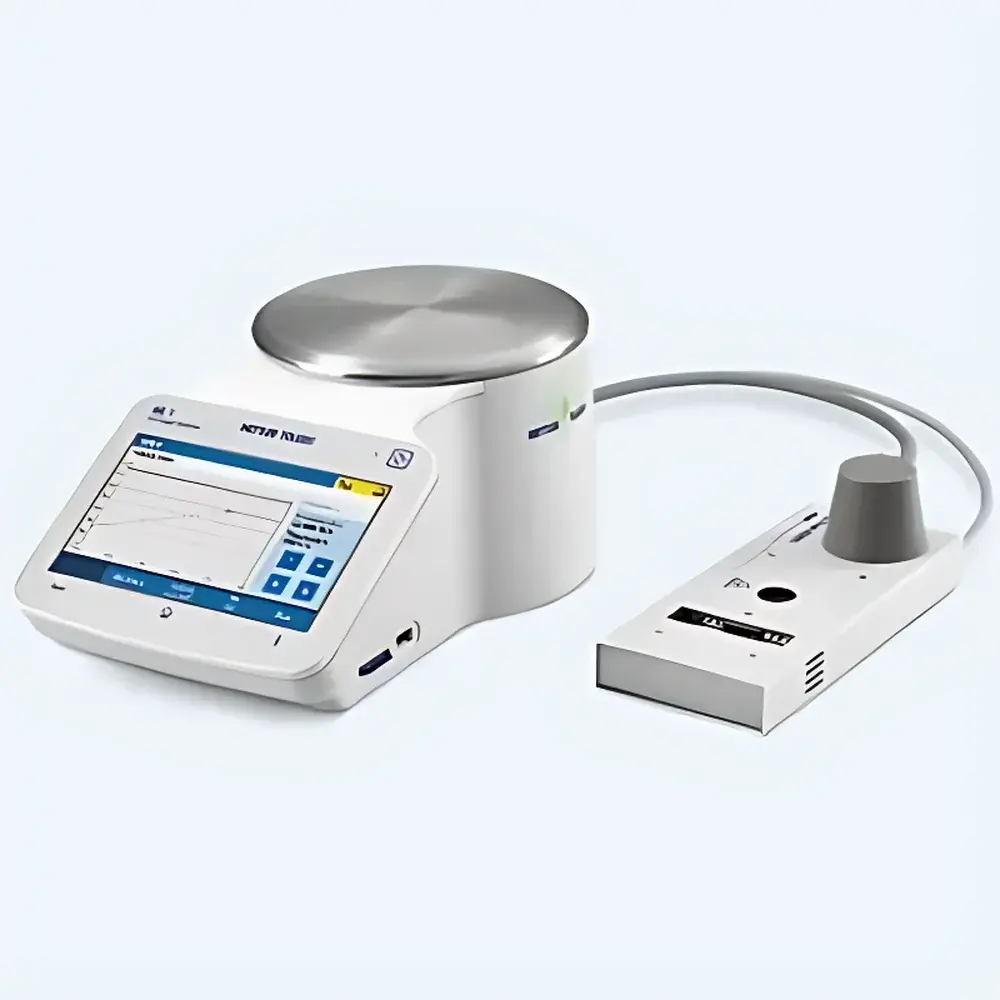
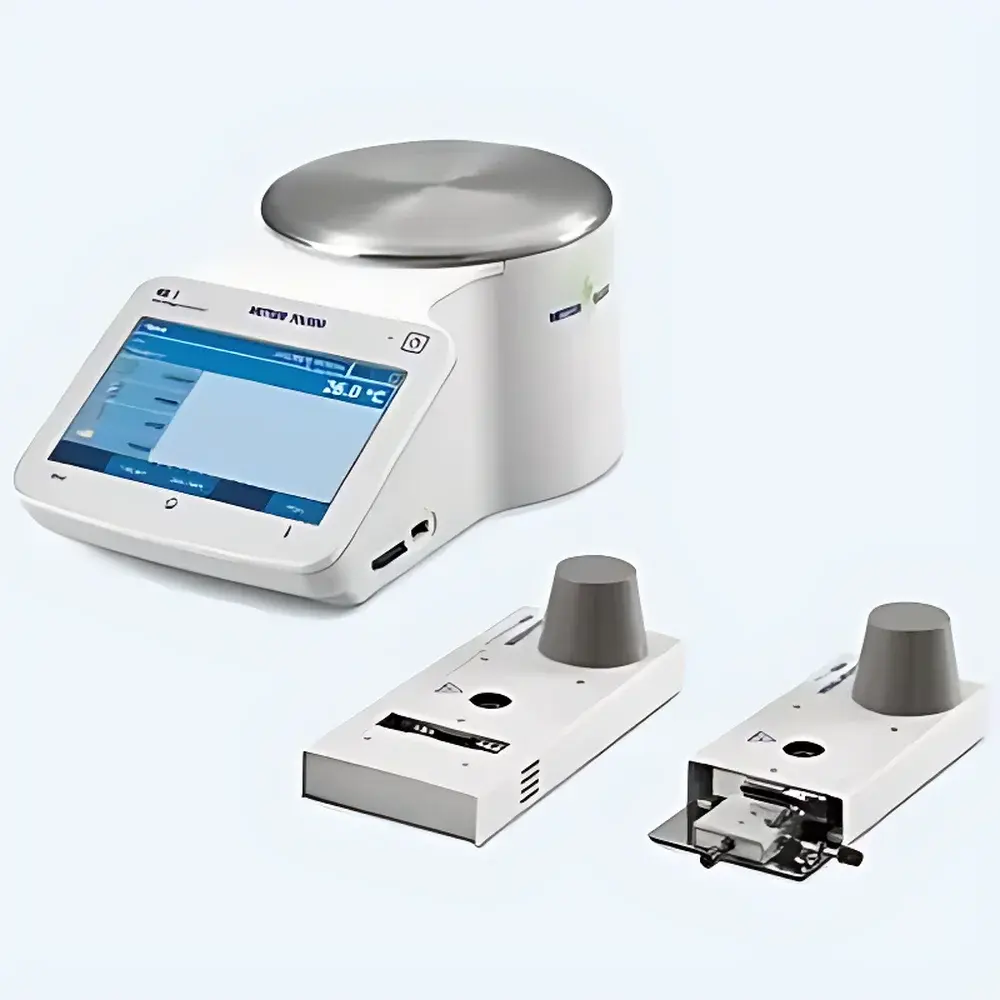
METTLER TOLEDO HS84 DSC Microscopy Hot Stage
| Brand | METTLER TOLEDO |
|---|---|
| Origin | Switzerland |
| Model | HS84 |
| Temperature Range | RT to 375 °C (optional cooling to –90 °C) |
| Heating/Cooling Rate | 0.1–20 K/min |
| Light Aperture | 2 mm |
| Sensor Type | DSC ceramic sensor with 56 thermocouple pairs |
| Sample Carriers | Glass slides, top cover glass, aluminum/glass/sapphire crucibles |
| Crucible Dimensions | Ø6 mm / 40 µL |
| Display | 7″ touch-sensitive VGA color screen |
| Supported Languages | English, German, French, Spanish, Chinese, Japanese, Korean, Russian |
| User Shortcuts | 12 per user |
| Compliance | ASTM F766, EN ISO 3146 |
Overview
The METTLER TOLEDO HS84 DSC Microscopy Hot Stage is an integrated thermal analysis platform engineered for in situ observation and quantitative heat flow measurement during controlled heating or cooling of solid and semi-crystalline samples. Unlike conventional hot stages that provide only visual monitoring, the HS84 implements a miniaturized differential scanning calorimetry (DSC) principle directly within the microscope stage—enabling simultaneous optical characterization and calibrated thermal signal acquisition. Its core architecture features a dual-zone resistive furnace with precision-matched upper and lower heating elements, ensuring exceptional temperature uniformity (< ±0.5 °C across 15 × 15 × 0.2 mm sample area) and minimal thermal lag. The system comprises two primary components: the HS1 control unit, which manages temperature programming, data acquisition, and real-time display; and the HS84 stage itself, housing a high-density ceramic DSC sensor array composed of 56 thermocouple pairs arranged in symmetrical reference–sample configuration. This design allows direct quantification of endothermic and exothermic transitions—including melting, crystallization, glass transition, polymorphic conversion, and decomposition—with sensitivity commensurate with benchtop DSC instruments.
Key Features
- True hybrid functionality: Combines high-resolution optical microscopy with calibrated DSC signal acquisition in a single compact stage
- Extended temperature range: Ambient to 375 °C standard; optionally extended to –90 °C using liquid nitrogen cooling accessory
- Precise thermal control: Programmable heating/cooling rates from 0.1 to 20 K/min with < ±0.1 K/min repeatability
- Optimized optical path: 2 mm central light aperture compatible with standard transmitted-light microscopes, FTIR, Raman spectrometers, and synchrotron beamlines
- Multi-material sample compatibility: Supports aluminum, borosilicate glass, and single-crystal sapphire crucibles (Ø6 mm, 40 µL volume) as well as standard glass slides and cover slips
- Intuitive human-machine interface: 7″ VGA touch screen with multilingual support (English, German, French, Spanish, Chinese, Japanese, Korean, Russian) and 12 customizable one-click shortcuts per user
- Robust mechanical design: Compact footprint (76 × 19 × 1 mm), low-profile construction suitable for inverted and upright microscopes, glovebox integration, and vacuum-compatible configurations
Sample Compatibility & Compliance
The HS84 accommodates a broad spectrum of thermally sensitive materials including pharmaceutical polymorphs, polymer blends, liquid crystals, battery electrode composites, and geological mineral specimens. Its modular crucible system enables method transfer between routine DSC and microscopy-DSC workflows without revalidation. All thermal measurements adhere to internationally recognized standards for thermal analysis instrumentation, specifically satisfying ASTM F766 (“Standard Test Method for Determining the Melting Point of Polymers by Differential Scanning Calorimetry”) and EN ISO 3146 (“Plastics — Determination of Temperature of Phase Transition of Polymeric Materials”). When operated under documented procedures, the system supports GLP-compliant data generation, including timestamped thermal traces, metadata logging (operator ID, ambient conditions, calibration status), and audit-ready export formats (CSV, ASCII, .qdx).
Software & Data Management
Data acquisition and analysis are managed via the HS1 control unit’s embedded firmware, which records synchronized video streams (via external camera trigger output) and DSC thermograms at up to 10 Hz sampling resolution. Raw thermal signals undergo real-time baseline correction and peak integration using proprietary algorithms optimized for small-sample mass effects. Exported datasets include full metadata headers compliant with FAIR principles (Findable, Accessible, Interoperable, Reusable). While the HS84 does not require external PC software for basic operation, optional integration with METTLER TOLEDO’s STARe evaluation software enables advanced kinetic modeling (e.g., Ozawa-Flynn-Wall, Kissinger), multi-step transition deconvolution, and comparative overlay of thermal events across multiple sample batches.
Applications
- Pharmaceutical solid-state characterization: Real-time tracking of hydrate dehydration, amorphous content crystallization, and polymorphic interconversion under controlled humidity and temperature
- Materials science: In situ observation of lamellar thickening in polyethylene, eutectic formation in metal alloys, and phase separation kinetics in block copolymers
- Forensics and quality control: Identification of counterfeit polymers or adulterated APIs through mismatched onset temperatures and enthalpy ratios
- Electrochemical research: Thermal stability assessment of solid electrolytes and cathode materials under simulated battery cycling conditions
- Geosciences: Quantitative determination of clay mineral dehydration sequences and metastable phase retention in metamorphic rock analogs
FAQ
Can the HS84 be used with non-METTLER TOLEDO microscopes?
Yes—the HS84 interfaces with any standard upright or inverted optical microscope equipped with a mechanical stage adapter plate and Köhler illumination alignment capability.
Is the DSC signal traceable to NIST-certified reference materials?
Calibration is performed using high-purity indium, tin, and zinc standards; full calibration reports—including uncertainty budgets per ISO/IEC 17025—are available upon request.
Does the system support automated temperature ramps with hold steps?
Yes—up to 99 programmable segments per method, including dynamic ramping, isothermal holds, and conditional triggers based on thermal event detection.
What is the minimum detectable enthalpy change?
Under optimal conditions (sapphire crucible, 5 mg sample, 10 K/min rate), the system achieves a detection limit of approximately 0.5 mJ, consistent with ISO 11357-1 sensitivity requirements.
Can data be exported in formats compatible with LIMS or ELN systems?
All thermograms and metadata export natively to CSV and ASCII; optional .qdx files support direct ingestion into METTLER TOLEDO LabX and third-party electronic lab notebook platforms via standardized API endpoints.



