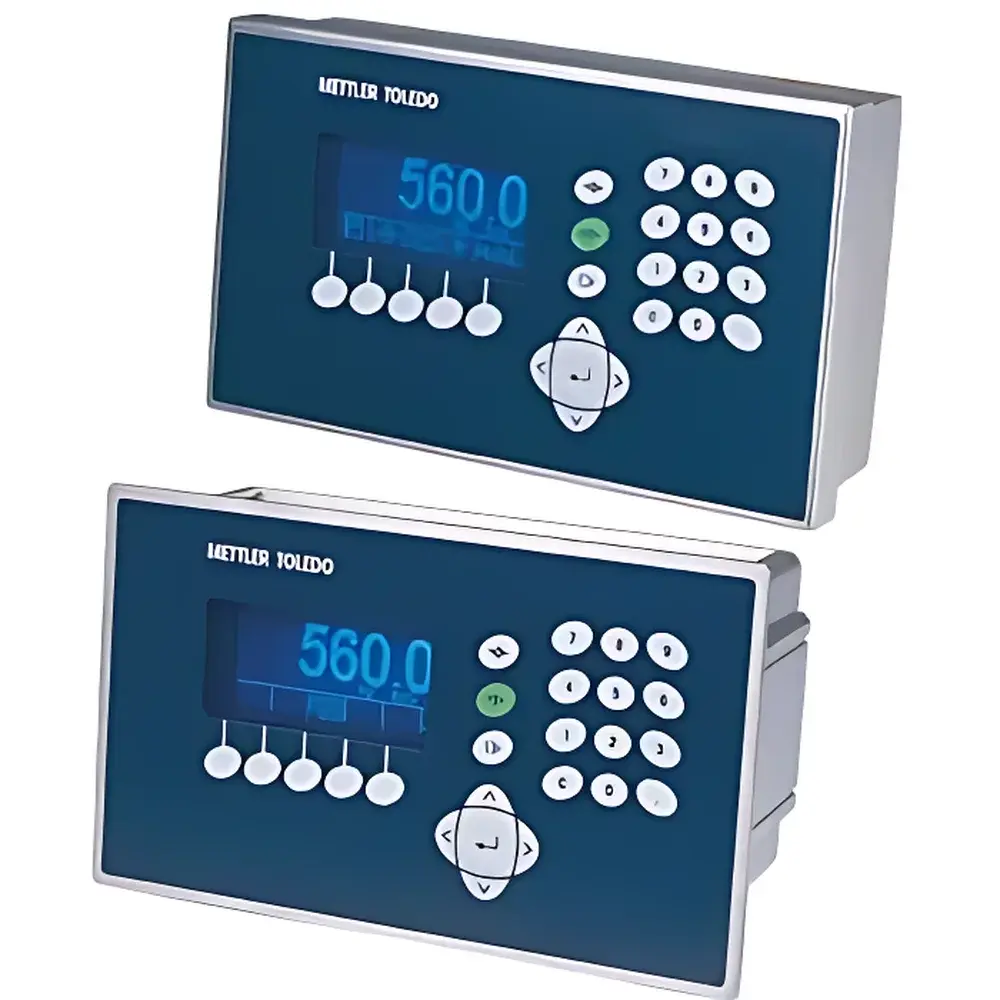
METTLER TOLEDO IND560 Weighing Terminal
| Brand | METTLER TOLEDO |
|---|---|
| Model | IND560 |
| Display | VFD Graphic Interface |
| Communication | Ethernet (RJ45), TCP/IP |
| Signal Processing | Sigma-Delta ADC with Adaptive Filtering |
| Data Storage | Battery-Backed Non-Volatile Memory |
| User Interface | SoftKey Programmable Buttons |
| Architecture | Embedded Database, Modular Application Firmware |
| Vibration Compensation | TraxDSP Technology |
| Compliance Support | GLP/GMP Audit Trail Ready, FDA 21 CFR Part 11 Compatible (via optional software configuration) |
Overview
The METTLER TOLEDO IND560 Weighing Terminal is an industrial-grade, embedded control unit engineered for high-reliability process weighing applications in automated production, batching, filling, and formulation systems. Designed as a dedicated weighing interface rather than a general-purpose display, the IND560 integrates precision analog signal conditioning, real-time digital signal processing, and deterministic control logic into a single ruggedized hardware platform. Its core architecture leverages a high-resolution sigma-delta analog-to-digital converter (ADC), coupled with METTLER TOLEDO’s proprietary TraxDSP vibration compensation algorithm — a deterministic digital signal processing technique that dynamically suppresses mechanical disturbances without compromising response time. Unlike conventional terminals relying on fixed averaging or delay-based filtering, the IND560 adapts its noise rejection profile in real time based on load dynamics and environmental conditions, enabling stable weight acquisition even on vibrating frames or near heavy machinery. The terminal operates as a deterministic node within industrial control networks, supporting deterministic data exchange via standard Ethernet/TCP/IP — not merely as a data logger, but as a programmable controller with configurable setpoints, event triggers, and I/O state management.
Key Features
- VFD (Vacuum Fluorescent Display) graphic interface with high-contrast, wide-viewing-angle rendering — optimized for factory-floor readability under variable lighting and ambient temperature conditions.
- Programmable SoftKey buttons allow context-sensitive function mapping, reducing operator training time and minimizing misoperation risk in multi-step processes.
- Battery-backed non-volatile memory stores up to 1,000 recipes, audit logs, calibration history, and batch reports — retained for ≥10 years without external power.
- Embedded relational database engine enables indexed retrieval of historical weight events, user actions, and system diagnostics — supporting traceability requirements per ISO 9001 and pharmaceutical GxP frameworks.
- Modular firmware architecture supports field-upgradable application modules: checkweighing, gross/net/tare control, multi-stage filling, loss-in-weight (LIW) feeding, and recipe-driven dispensing — all pre-validated per METTLER TOLEDO’s internal verification protocol.
- Industrial-grade Ethernet interface (RJ45, 10/100BASE-TX) with dual IP stack support: one for operational traffic (e.g., Modbus TCP, HTTP API), another for secure maintenance access (SSH/TLS).
Sample Compatibility & Compliance
The IND560 is not a standalone scale but a terminal designed for integration with METTLER TOLEDO load cells, weigh modules, and force transducers compliant with OIML R60, NTEP Class III/III L, and EC Type Approval standards. It supports both analog (mV/V) and digital (HBM, POWERCELL®) sensor inputs. For regulated environments, the terminal supports configurable electronic signature workflows and full audit trail generation — including timestamped records of parameter changes, calibration events, and user logins — aligning with FDA 21 CFR Part 11 requirements when deployed with validated software layers and access controls. All firmware revisions undergo formal change control per ISO 13485 and IEC 62304, with release documentation available upon request for quality system validation.
Software & Data Management
The IND560 communicates natively via industry-standard protocols: Modbus TCP (for PLC integration), HTTP RESTful API (for MES/SCADA ingestion), and MQTT (for IIoT edge deployment). METTLER TOLEDO’s free PC-based configuration tool — IND560 Setup Studio — provides offline parameter engineering, logic diagramming for control sequences, and encrypted firmware signing. All configuration files are digitally signed and version-controlled; unauthorized modifications trigger integrity alerts. Data export supports CSV, XML, and SPC-compliant formats (per ASTM E2774), with optional encryption-at-rest using AES-256. Remote diagnostics include live signal waveform capture, sensor health monitoring (e.g., zero drift, span stability), and predictive maintenance alerts based on long-term trend analysis.
Applications
- Automated batch dispensing in chemical and food manufacturing, where repeatability ≤0.005% of full scale is required across 10,000+ cycles.
- Dynamic checkweighing on high-speed packaging lines (up to 200 ppm), with configurable reject logic tied to upstream vision inspection systems.
- Loss-in-weight gravimetric feeders in polymer extrusion, ensuring mass flow stability within ±0.1% of target rate under variable hopper head pressure.
- GMP-compliant raw material issuance in pharmaceutical cleanrooms, with role-based access, electronic signatures, and 21 CFR Part 11–compliant audit trails.
- Multi-head combination weighers in snack food production, where IND560 synchronizes 12–16 heads with sub-50ms interlock timing.
FAQ
Does the IND560 support direct connection to Siemens S7 PLCs?
Yes — via native Modbus TCP or optional PROFINET gateway module (IND560-PN), certified for interoperability with SIMATIC S7-1200/1500 controllers.
Can historical weight data be exported without proprietary software?
Yes — through built-in HTTP GET endpoints returning JSON or CSV; no license or client installation required.
Is the VFD display suitable for outdoor or high-temperature environments?
The display operates from –10 °C to +50 °C ambient; optional heated front bezel kits extend low-temperature operation to –25 °C.
How is calibration traceability maintained?
Each calibration event is logged with operator ID, reference standard ID, environmental conditions, and deviation values — exportable as PDF reports compliant with ISO/IEC 17025.
What is the maximum number of user-defined recipes supported?
Up to 1,024 recipes, each supporting up to 32 parameters (setpoints, tolerances, timers, I/O mappings), stored in protected memory with SHA-256 checksum validation.