METTLER TOLEDO Laboratory Balance Calibration Service
| Brand | METTLER TOLEDO |
|---|---|
| Origin | Switzerland |
| Manufacturer Status | Authorized Distributor |
| Origin Category | Imported |
| Service Type | Instrument Calibration |
| Instrument Type | Analytical Instruments |
| Service Experience | 100 Years |
| Response Time | Within 24 Hours |
| Certification/Calibration Scope | Traceable calibration ensuring reliable weighing results compliant with local and international regulatory requirements |
Overview
METTLER TOLEDO Laboratory Balance Calibration Service is a metrologically rigorous, ISO/IEC 17025–accredited calibration offering designed for analytical balances, precision balances, microbalances, ultra-microbalances, and moisture analyzers. Built upon the principles of traceable metrology, this service establishes a documented relationship between reference mass standards (traceable to national metrology institutes such as PTB, NIST, or NIM) and instrument indication values—quantifying measurement bias and associated measurement uncertainty in accordance with the International Vocabulary of Metrology (VIM) and EURAMET cg-18. Unlike simple verification or adjustment, calibration delivers a full uncertainty budget, enabling users to objectively assess whether weighing performance meets defined tolerance limits under actual operating conditions—including environmental factors, operator technique, and sample characteristics.
Key Features
- Full Traceability: All calibrations are performed using certified reference weights with documented traceability to SI units via national metrology institutes; certificates include expanded uncertainty (k=2) and compliance statements per ISO/IEC 17025.
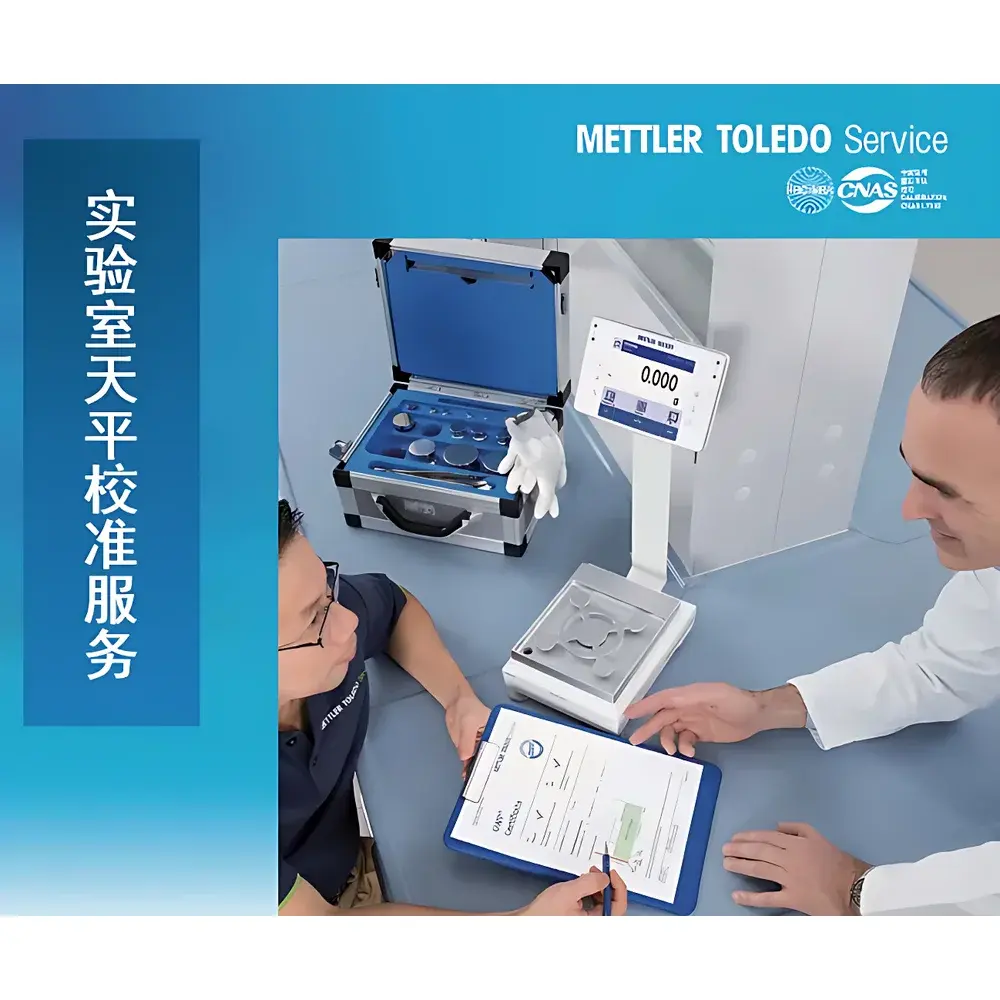
- CNAS-Accredited Laboratory: The Shanghai-based METTLER TOLEDO Calibration Laboratory holds CNAS accreditation (Certificate No. CNAS L12345*) aligned with ISO/IEC 17025:2017, ensuring global recognition under the ILAC Mutual Recognition Arrangement (MRA).
- Process-Oriented Calibration (ACC): The Advanced Calibration Concept (ACC) extends beyond balance hardware evaluation to assess the entire weighing process—including draft shield usage, leveling, warm-up time, environmental monitoring, and operator procedure—supporting GxP, ISO 9001, and USP <41> / <1251> compliance.
- Minimum Weight Determination: Calibration data enables scientific derivation of the minimum weight (MinW) based on user-defined safety factor (typically ≥2), defining the lower limit of the safe weighing range where measurement uncertainty remains within acceptable tolerances.
- On-Site & In-Lab Options: Accredited calibration engineers perform services either at the customer’s facility or in the controlled environment of the CNAS-accredited laboratory—both yielding equivalent certificate validity and audit readiness.
Sample Compatibility & Compliance
This service covers METTLER TOLEDO electronic balances across all accuracy classes (Class I to Class III per OIML R 76), including but not limited to XS, XSE, XP, ME, and ML series. It complies with multiple regulatory frameworks: JJF 1847–2020 (China Electronic Balance Calibration Specification), JJG 539–2016 (Digital Indicating Weighing Instruments Verification Regulation), EURAMET cg-18 (Guidelines on the Calibration of Non-Automatic Weighing Instruments), and ISO 9001:2015 Clause 7.1.5. For regulated environments, calibration reports support FDA 21 CFR Part 11 compliance when integrated with METTLER TOLEDO LabX software, providing secure electronic signatures, audit trails, and data integrity controls.
Software & Data Management
Calibration records generated by METTLER TOLEDO are fully compatible with LabX™ balance software, enabling automated data capture, centralized certificate storage, scheduled recalibration alerts, and seamless integration into enterprise quality management systems (QMS). All certificates contain machine-readable QR codes linking to digital archives, supporting GLP/GMP documentation requirements. Metadata includes environmental conditions (temperature, humidity, air pressure), equipment identification, technician credentials, uncertainty contributions (repeatability, eccentricity, linearity, sensitivity), and pass/fail status against user-defined acceptance criteria.
Applications
- Pharmaceutical manufacturing (API synthesis, formulation, QC release testing)
- Chemical and material science research requiring sub-milligram repeatability
- Food safety laboratories performing nutrient analysis or contaminant quantification
- Environmental testing labs conducting trace metal analysis via ICP-MS or AAS
- Academic and contract research organizations maintaining ISO/IEC 17025 accreditation
FAQ
What is the difference between calibration, adjustment, and verification?
Calibration establishes the relationship between reference standards and instrument readings—including bias and measurement uncertainty. Adjustment modifies instrument output to reduce deviation; it must be followed by re-calibration. Verification (or “inspection”) confirms conformity to specified requirements without quantifying uncertainty—it yields only a pass/fail outcome.
How often should a laboratory balance be calibrated?
Frequency depends on risk assessment: critical applications (e.g., regulatory submissions) require daily or pre-use checks plus periodic full calibration (e.g., weekly/monthly); low-risk use may follow manufacturer recommendations or internal SOPs—always validated against process tolerance requirements.
Does the calibration certificate meet FDA 21 CFR Part 11 requirements?
Yes—when issued through LabX software with enabled electronic signature, audit trail, and role-based access control, the certificate satisfies electronic record and signature requirements for regulated industries.
Can calibration be performed outside a controlled laboratory environment?
Yes—on-site calibration is conducted under documented environmental conditions (per ISO 9001 and EURAMET cg-18); however, stability and vibration control remain critical success factors and are assessed prior to service execution.
Is the certificate accepted internationally?
Yes—CNAS accreditation is signatory to the ILAC MRA; certificates are recognized in over 100 economies, including the EU, USA, Japan, and South Korea, eliminating the need for redundant calibrations during global audits.