METTLER TOLEDO Laboratory Equipment Calibration Service
| Brand | METTLER TOLEDO |
|---|---|
| Origin | Switzerland |
| Manufacturer Type | Authorized Distributor |
| Origin Category | Imported |
| Model | Laboratory Equipment Calibration Service |
| Service Type | Instrument Calibration |
| Instrument Types | General Laboratory Equipment |
| Industry Experience | 100 Years |
| Response Time | Within 24 Hours |
| Scope of Calibration | Comprehensive metrological verification and uncertainty evaluation for laboratory weighing instruments and ancillary measurement devices |
| Compliance Coverage | ISO/IEC 17025, ASTM E898, USP <41>, EU GMP Annex 11, FDA 21 CFR Part 11 (audit trail enabled), GLP/GMP traceability requirements |
Overview
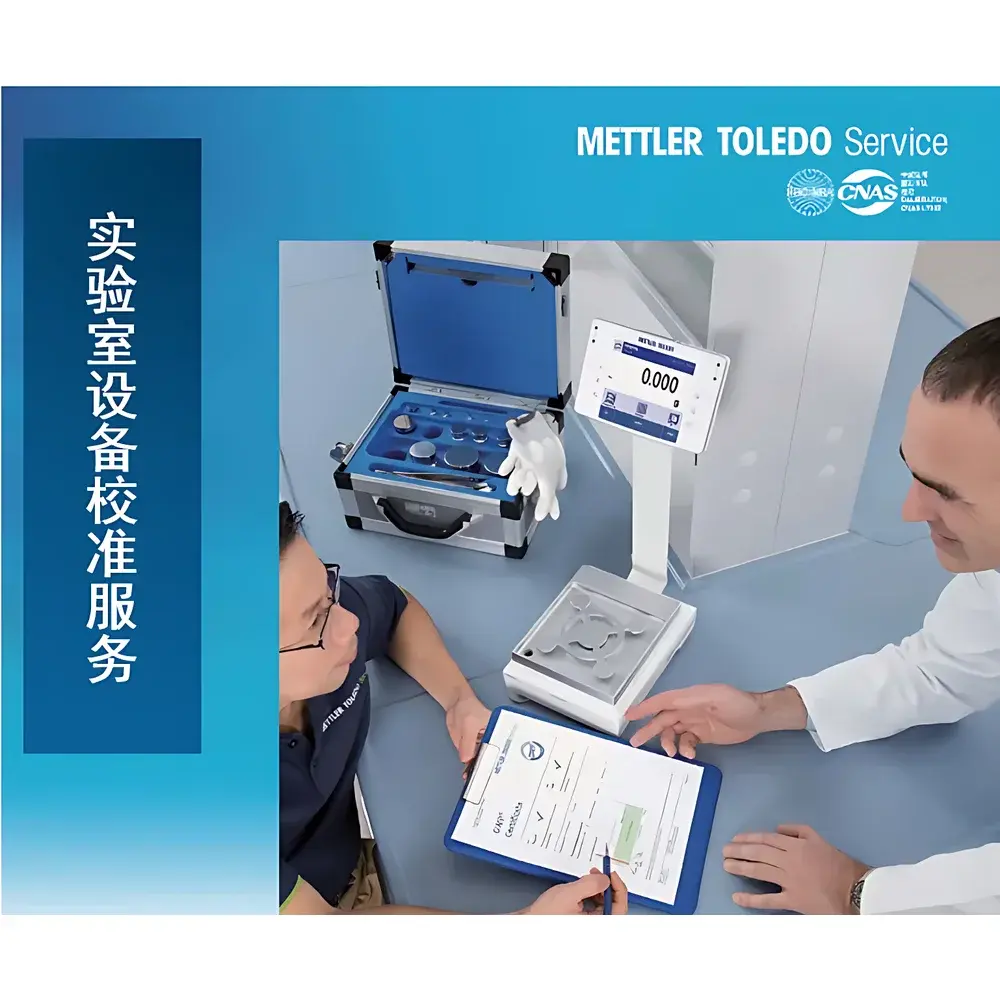
METTLER TOLEDO Laboratory Equipment Calibration Service is a metrologically rigorous, standards-driven calibration program engineered for precision weighing instruments and associated laboratory measurement systems. Rooted in the principles of traceable metrology, this service applies the internationally recognized definitions and methodologies outlined in the International Vocabulary of Metrology (VIM) and the Guide to the Expression of Uncertainty in Measurement (GUM). Calibration is performed not as a routine pass/fail check, but as a quantitative characterization of instrument performance—establishing the functional relationship between reference standard values and instrument indications, accompanied by a full uncertainty budget. This process enables laboratories to objectively verify conformance with regulatory and quality system requirements—including ISO/IEC 17025 accreditation, pharmaceutical GMP compliance (EU Annex 11, USP <41>), and FDA 21 CFR Part 11 data integrity mandates.
Key Features
- Traceable Calibration Certificates: Issued per ISO/IEC 17025 requirements, each certificate includes measurement results, expanded uncertainty (k=2), environmental conditions, reference standards used (with NIST or PTB traceability), and technician accreditation details.
- Measurement Uncertainty Evaluation: Full uncertainty budgeting per GUM methodology—accounting for repeatability, linearity, eccentricity, temperature drift, buoyancy effects, and standard stability—ensuring compliance with BIPM’s stipulation that “any calibration without uncertainty evaluation is incomplete.”
- Minimum Weight Determination: Scientifically derived minimum weight (MinW) based on user-defined tolerance limits (e.g., 0.1% or pharmacopeial允差), enabling safe operational range definition and eliminating sub-threshold weighing risks.
- Differentiated Metrological Actions: Clear separation of calibration (performance characterization), adjustment (parameter modification), and verification (conformance assessment)—aligned with VIM definitions to prevent procedural confusion and maintain audit integrity.
- 24-Hour Service Response: On-site or in-lab calibration scheduling initiated within one business day; emergency protocols available for critical QC/QA instrumentation.
- Regulatory-Ready Documentation: Electronic calibration records include time-stamped audit trails, digital signatures, and version-controlled reports—fully compliant with FDA 21 CFR Part 11 and EU GMP Annex 11 data governance expectations.
Sample Compatibility & Compliance
This service covers METTLER TOLEDO analytical balances, precision balances, moisture analyzers, density meters, pH meters, conductivity meters, and titrators—provided they fall within the manufacturer’s specified operating ranges and maintenance history. Calibration scope is defined per instrument class and application context (e.g., R&D, QC release testing, stability studies). All calibrations adhere to applicable international standards: ISO/IEC 17025 (general competence requirements), ASTM E898 (balance calibration procedures), USP <41> and <1251> (pharmaceutical weighing), and IEC 61000-4-30 (EMC-compliant instrumentation validation). Traceability is maintained to national metrology institutes (NMIs) including NIST (USA), PTB (Germany), and NPL (UK), with documented chain-of-custody for all reference standards.
Software & Data Management
Calibration data are managed via METTLER TOLEDO LabX® software integration or standalone eCal™ reporting modules. LabX enables automated data capture from connected instruments, real-time uncertainty calculation, electronic signature workflows, and scheduled recalibration alerts. All reports support PDF/A-1a archival format and include embedded metadata required for GLP/GMP audits. Audit trails record every data entry, modification, and approval event—including user ID, timestamp, and reason for change—satisfying FDA 21 CFR Part 11 electronic record requirements. Raw calibration datasets (including raw readings, environmental logs, and uncertainty components) are retained for ≥10 years and exportable in CSV or XML formats for third-party LIMS integration.
Applications
- Pharmaceutical manufacturing: Ensuring balance compliance with USP <41>, EU GMP Annex 11, and ICH Q7 for batch release and stability testing.
- Contract research organizations (CROs): Maintaining ISO/IEC 17025 accreditation through documented, uncertainty-based calibration evidence.
- Academic and government labs: Meeting NIH, NSF, and DOE instrumentation validation policies for grant-funded research.
- Food and beverage QA: Verifying accuracy of moisture, ash, and density measurements against AOAC and ISO 5725 standards.
- Chemical and materials testing: Supporting ISO 17025 method validation where weighing uncertainty directly impacts final result uncertainty (e.g., titration, gravimetric analysis).
FAQ
What is the difference between calibration, adjustment, and verification?
Calibration establishes the mathematical relationship between reference values and instrument indications, including uncertainty quantification. Adjustment modifies instrument behavior to align with standards—but is distinct from calibration and requires re-calibration afterward. Verification confirms whether an instrument meets pre-defined acceptance criteria (e.g., “pass/fail” against tolerances), often performed post-calibration.
Why must measurement uncertainty be reported with every calibration?
Per ISO/IEC 17025 Clause 7.8.3.1 and BIPM guidance, uncertainty is essential to interpret calibration results meaningfully. Without it, users cannot determine if measurement results meet required tolerances—especially critical for minimum weight determination and risk-based decision making.
Does this service cover non-METTLER TOLEDO instruments?
Yes—subject to technical feasibility, availability of suitable reference standards, and documented manufacturer specifications. Cross-brand calibration follows the same metrological rigor and reporting standards.
How frequently should laboratory balances be calibrated?
Frequency depends on usage intensity, risk assessment (e.g., GxP impact), environmental stability, and historical performance data—not fixed intervals. METTLER TOLEDO supports risk-based calibration scheduling using internal performance monitoring and statistical process control (SPC) tools.
Can calibration certificates be issued with ISO/IEC 17025 accreditation?
Yes—when performed by METTLER TOLEDO’s ISO/IEC 17025-accredited calibration laboratories (e.g., Zurich, Columbus, Shanghai), certificates bear the ILAC-MRA mark and full accreditation scope reference.
Related Products