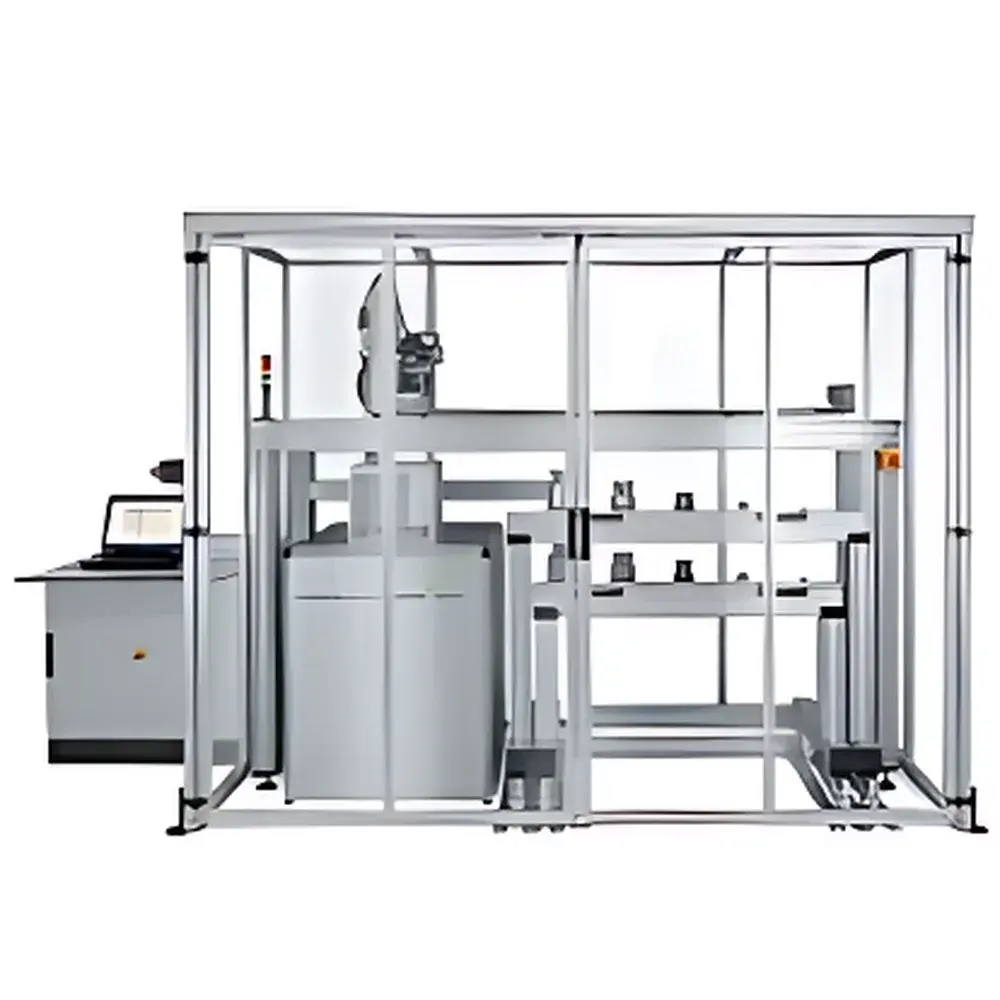
METTLER TOLEDO Mass Comparator
| Brand | METTLER TOLEDO |
|---|---|
| Origin | Switzerland |
| Type | Automatic or Manual Mass Comparator |
| Compliance | ISO/IEC 17025, OIML R111, ASTM E617 |
| Resolution | Up to 52 million digits (0.001 µg typical readability for 1 kg standard) |
| Traceability | Directly traceable to International Prototype Kilogram (IPK) and BIPM reference standards |
| Construction | Monolithic weighing cell with active temperature compensation and magnetic damping |
Overview
The METTLER TOLEDO Mass Comparator is a high-precision metrological instrument engineered for the direct comparison of mass standards in national metrology institutes (NMIs), calibration laboratories accredited to ISO/IEC 17025, and legal metrology service providers. Unlike conventional analytical balances, mass comparators operate on the principle of differential weighing—measuring the minute force difference between a certified reference mass and an unknown test artifact under controlled environmental conditions. This null-difference methodology eliminates systematic errors associated with absolute mass measurement and delivers traceability directly to the International System of Units (SI) via the BIPM’s CIPM MRA framework. The comparator’s monolithic electromagnetic force compensation sensor architecture ensures exceptional long-term stability, sub-microgram repeatability, and immunity to mechanical hysteresis—critical for maintaining continuity in the international mass scale.
Key Features
- Monolithic electromagnetic force compensation transducer with integrated temperature compensation and active magnetic damping for zero drift suppression
- Resolution up to 52 million digits (equivalent to 0.001 µg readability at 1 kg load), enabling detection of mass differences below 10−9 relative uncertainty
- Dual-mode operation: fully automated comparison sequences (via METTLER TOLEDO LabX® software) or manual single-point comparison with tactile keypad interface
- Hermetically sealed weighing chamber with laminar airflow control, anti-vibration granite base mounting option, and optional climate-controlled enclosure (±0.1 °C, <30% RH)
- Built-in internal calibration mass with automatic periodic verification per ISO 9001 and ILAC-G24 requirements
- Compliance-ready design supporting audit trails, electronic signatures, and 21 CFR Part 11–compliant data integrity protocols when paired with LabX
Sample Compatibility & Compliance
The comparator accommodates standard weights conforming to OIML R111 classes E1, E2, F1, and F2, as well as custom artifacts including silicon spheres, stainless steel cylinders, and platinum-iridium prototypes. All mechanical interfaces—including weight handling fixtures, tweezers, and vacuum lifting tools—are designed to minimize surface contamination and electrostatic perturbation. The system meets the stringent environmental and procedural requirements of ISO/IEC 17025:2017 Clause 6.4 (Equipment), OIML D 11 (Guidelines for Mass Comparators), and EU Directive 2014/32/EU (Measuring Instruments Directive). Calibration certificates issued using this comparator are accepted by EURAMET, APMP, and BIPM for inter-laboratory comparisons and CIPM key comparisons.
Software & Data Management
When integrated with METTLER TOLEDO LabX® Mass Comparison Software, the instrument supports full lifecycle management of mass calibration workflows—from test plan definition and uncertainty budgeting (in accordance with GUM and EURAMET cg-18) to automated report generation compliant with ISO 17025 Annex A3. LabX provides role-based access control, versioned method storage, real-time deviation alerts, and encrypted database archiving with immutable audit trails. All raw data—including environmental logs (temperature, humidity, barometric pressure), sensor diagnostics, and sequence timestamps—are stored in vendor-neutral CSV and XML formats. The system supports seamless integration with LIMS platforms via OPC UA or RESTful API, ensuring alignment with GLP and GMP documentation practices.
Applications
- Primary and secondary calibration of national mass standards against BIPM reference materials
- Periodic verification of working standards in legal metrology offices and national accreditation bodies
- Uncertainty analysis and drift monitoring of E1/E2 class weights used in pharmaceutical QC labs (per USP and Ph. Eur. 2.2.17)
- Intercomparison studies between NMIs participating in CIPM Key Comparisons (KC) and Regional Metrology Organization (RMO) trials
- Validation of mass transfer chains in aerospace component certification (e.g., turbine blade balancing weights) and semiconductor wafer handling systems
FAQ
What is the difference between a mass comparator and an analytical balance?
A mass comparator performs differential weighing between two physically similar masses to determine their relative difference with ultra-high resolution; it does not provide absolute mass values. An analytical balance reports absolute mass but lacks the stability and resolution required for metrological comparisons.
Is this comparator suitable for routine calibration of F2 class weights in an ISO 17025 lab?
Yes—the system is validated for F2 and higher classes per OIML R111 and includes built-in uncertainty calculation modules aligned with EURAMET cg-18 guidelines.
How is traceability maintained during operation?
Traceability is ensured through documented calibration against NMI-certified reference masses, regular internal verification cycles, and adherence to the BIPM Mutual Recognition Arrangement (CIPM MRA) framework.
Can the comparator be integrated into an existing LIMS environment?
Yes—LabX supports secure data export via standardized protocols (CSV, XML, OPC UA) and offers configurable API endpoints for bidirectional LIMS synchronization.
What environmental conditions are required for optimal performance?
Operation requires a vibration-isolated bench (ISO 25316 Class 1), ambient temperature stability ±0.5 °C/hour, and relative humidity between 40–60% to minimize electrostatic effects and thermal expansion errors.