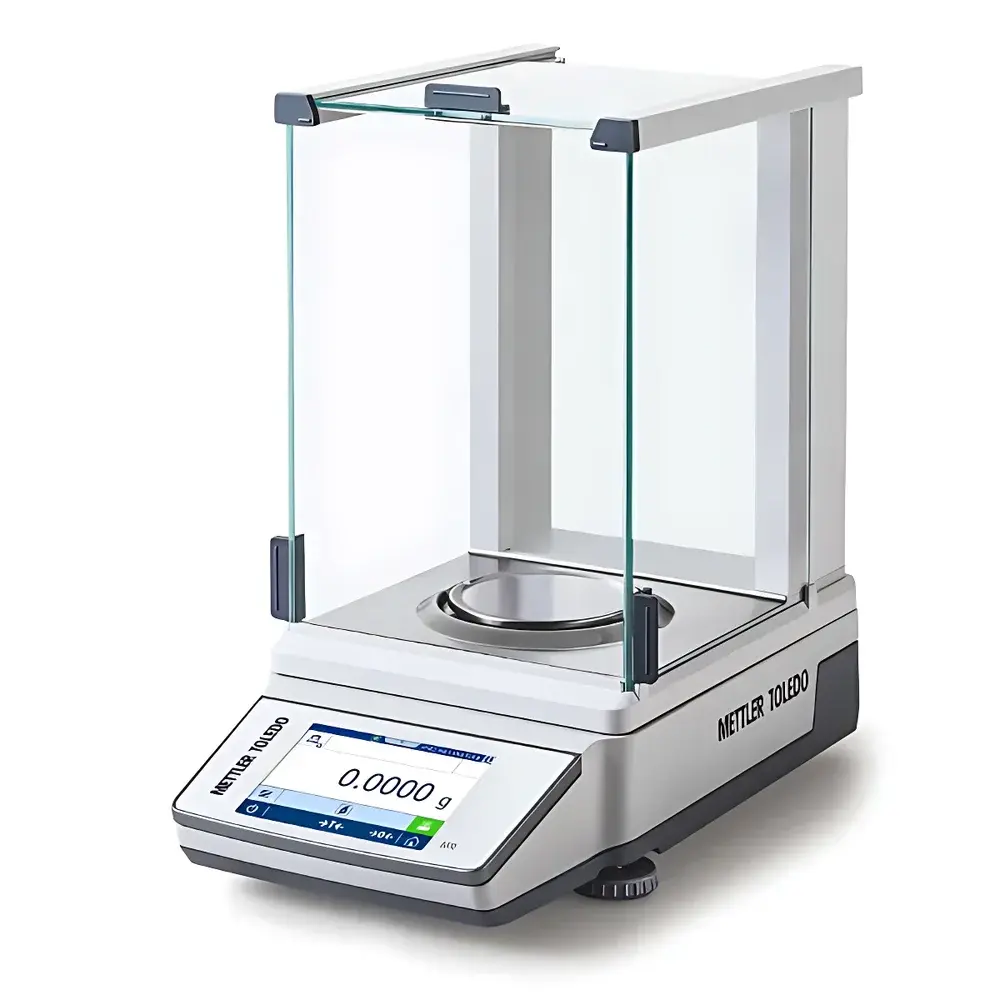
METTLER TOLEDO MR Series Analytical Balance
| Brand | METTLER TOLEDO |
|---|---|
| Origin | Switzerland |
| Model | MR Series (MR104, MR204, MR304) |
| Maximum Capacity | 120 g / 220 g / 320 g |
| Readability | 0.1 mg |
| Repeatability (5% load) | 0.08 mg (typical) |
| Linearity Error | 0.06 mg (typical) |
| Sensitivity Shift (nominal load) | 0.3–0.6 mg |
| Minimum Weight (USP <1251>, ±0.10% tolerance) | 60–160 mg |
| Stabilization Time | 2 s |
| Pan Diameter | 90 mm |
| Dimensions (W × D × H) | 209 × 351 × 354 mm |
| Weighing Principle | Electromagnetic Force Compensation (EMFC) |
| Calibration | FACT® Automatic Internal Calibration |
| Certifications | OIML R76, NTEP Class I |
| Interfaces | USB-A, USB-C, RS232, Ethernet |
| Software Compatibility | MT-SICS, EasyDirect™ |
Overview
The METTLER TOLEDO MR Series Analytical Balance is a high-precision laboratory instrument engineered for reproducible mass measurement in regulated and research-intensive environments. Built upon electromagnetic force compensation (EMFC) technology, the MR balances deliver exceptional stability and resolution at 0.1 mg readability across three capacity variants: MR104 (120 g), MR204 (220 g), and MR304 (320 g). Each model features a monolithic, all-metal housing designed to minimize thermal drift and mechanical hysteresis, while the integrated FACT® (Fully Automatic Calibration Technology) system ensures traceable accuracy through temperature-triggered internal recalibration—eliminating manual intervention without compromising metrological integrity. The balance operates in full compliance with international weighing standards including OIML R76 and NTEP Class I, supporting audit-ready workflows in pharmaceutical QC, academic chemistry labs, and materials science applications where uncertainty budgets must be rigorously controlled.
Key Features
- Electromagnetic force compensation (EMFC) sensor architecture delivering high linearity (<0.06 mg typical) and low sensitivity shift (0.3–0.6 mg under nominal load)
- FACT® automatic internal calibration with dual-temperature sensors—initiated at predefined intervals or on environmental change exceeding ±1.5 °C
- 4.5-inch capacitive touchscreen interface with intuitive icon-based navigation and multilingual support (English, German, French, Spanish, Chinese, Japanese, etc.)
- Robust QuickLock draft shield with tool-free assembly, optimized airflow design, and seamless integration into ISO 17025-compliant weighing stations
- Overload protection up to 500% of maximum capacity, safeguarding the EMFC mechanism against accidental mechanical stress
- Energy-saving mode compliant with EU Ecodesign Directive 2019/2021, reducing standby power consumption by >70% versus previous generations
Sample Compatibility & Compliance
The MR Series accommodates a broad range of sample types—from volatile organic compounds and hygroscopic powders to micro-vials and filter papers—thanks to its rapid 2-second stabilization time and low-noise weighing chamber. All models meet OIML R76-1:2017 and NTEP Certificate of Conformance for Class I accuracy, enabling legal-for-trade use in quality control laboratories subject to FDA 21 CFR Part 11, EU GMP Annex 11, and ISO/IEC 17025 requirements. Minimum weight determination follows USP methodology using k = 2 coverage factor; certified minimum weights are 60 mg (MR104) and 160 mg (MR204/MR304) at ±0.10% tolerance. The balance supports GLP/GMP-compliant user management with role-based access control, configurable sample and task IDs, and tamper-evident activity logging—including timestamped records of calibration events, parameter changes, and weighing sessions.
Software & Data Management
Data integrity is enforced via four standard communication interfaces: USB-A (for printer or flash drive), USB-C (for firmware updates), RS232 (legacy LIMS integration), and Ethernet (TCP/IP for networked lab environments). Optional Bluetooth 5.0 enables wireless pairing with mobile devices for remote monitoring. METTLER TOLEDO’s MT-SICS (Standard Interface for Communication Standards) ensures plug-and-play compatibility with major ERP and LIMS platforms, while EasyDirect™ software provides secure, browser-based data visualization, statistical process control (SPC) charts, and automated report generation—including PDF/CSV export with digital signature support. All electronic records comply with ALCOA+ principles (Attributable, Legible, Contemporaneous, Original, Accurate, Complete, Consistent, Enduring, Available) and support 21 CFR Part 11 audit trails with user authentication and electronic signature validation.
Applications
- Pharmaceutical formulation: active pharmaceutical ingredient (API) dispensing, reference standard preparation, and dissolution testing sample weighing
- Academic research: gravimetric analysis, stoichiometric reagent preparation, and catalyst loading in catalysis studies
- Materials science: powder density determination, coating mass uniformity assessment, and nanomaterial dispersion quantification
- Environmental testing: filter weighing for particulate matter (PM2.5/PM10) analysis per EPA Method 201A and ISO 12103-1
- Food safety labs: moisture content determination via loss-on-drying protocols compliant with AOAC 952.06 and ISO 665
FAQ
What regulatory standards does the MR Series comply with?
The MR Series conforms to OIML R76-1:2017, NTEP Class I, and meets the metrological requirements of ISO/IEC 17025, USP , and ASTM E898 for analytical weighing.
Is internal calibration traceable to national standards?
Yes—FACT® calibration uses factory-characterized internal weights certified to ISO/IEC 17025-accredited standards, with full traceability documented in the calibration certificate supplied with each instrument.
Can the MR balance integrate with our existing LIMS?
Absolutely—the balance supports MT-SICS protocol over Ethernet or RS232, enabling bidirectional data exchange with Thermo Fisher SampleManager, LabVantage, STARLIMS, and other validated LIMS platforms.
How is data security maintained during transfer?
All network communications use TLS 1.2 encryption; local storage employs AES-256 encryption for audit logs and weighing data, satisfying GDPR and HIPAA technical safeguards.
What maintenance is required beyond FACT® calibration?
No routine mechanical maintenance is needed; users are advised to perform periodic performance verification using certified external weights per ISO 17025 clause 6.4.3 and document results in the built-in activity log.