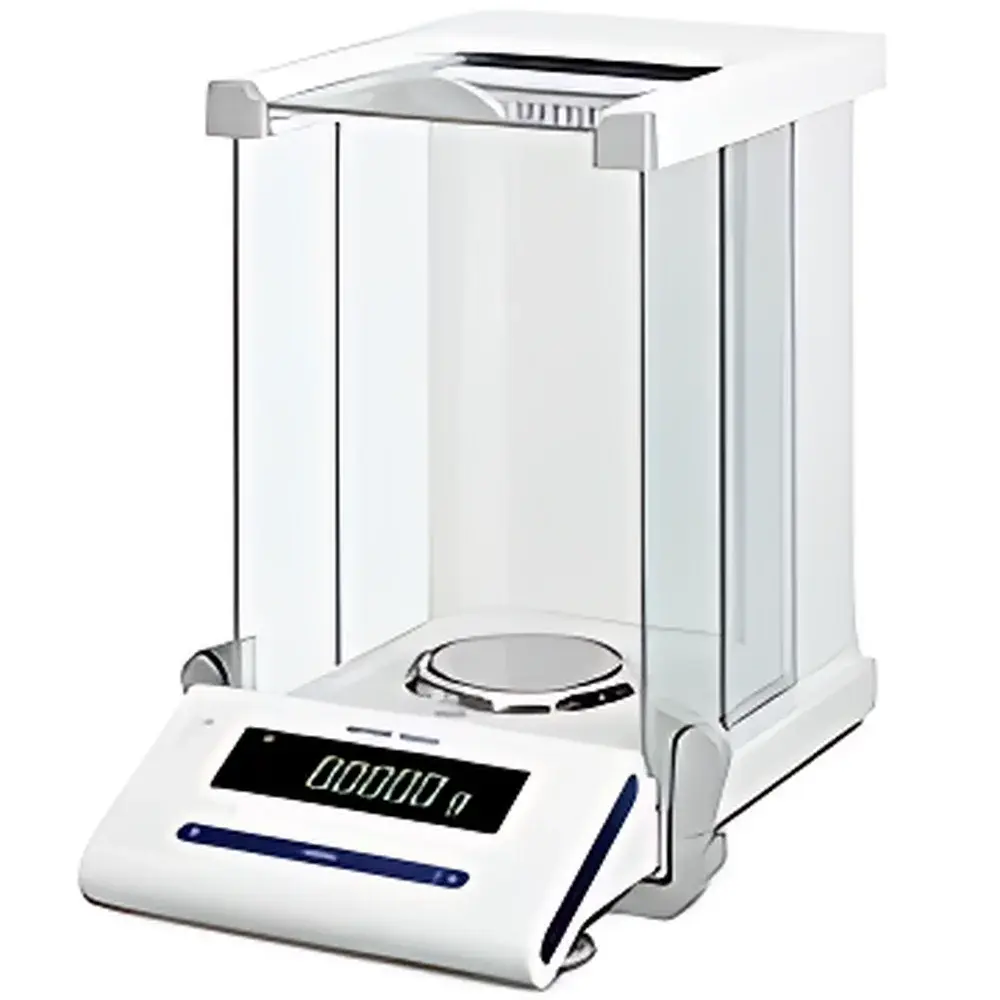
METTLER TOLEDO MS Semi-Micro Balance
| Brand | METTLER TOLEDO |
|---|---|
| Origin | Switzerland |
| Model | MS Semi-Micro Balance |
| Readability | 0.01 mg (10 µg) |
| Max Capacity | up to 220 g (dual-range models) |
| Repeatability (sd) | as low as 0.02 mg |
| Linearity Error | ≤ 0.2 mg |
| Pan Diameter | Ø80 mm |
| Calibration Technology | FACT (Fully Automatic Calibration Technology) with internal dual-weight system |
| Display | High-Contrast Display (HCD) |
| Draft Shield | QuickLock modular glass draft shield with ErgoDoor left/right reversible door mechanism |
| Connectivity | RS232 and USB interfaces |
| Built-in Applications | Weighing, Statistics, Piece Counting, Percentage Weighing, Density Determination, Dynamic Weighing, Checkweighing, Value Recall |
| Compliance | Designed and manufactured in accordance with ISO 9001, ISO/IEC 17025, and GLP/GMP documentation requirements |
Overview
The METTLER TOLEDO MS Semi-Micro Balance is a precision laboratory balance engineered for applications demanding high-resolution mass measurement in the 0.01 mg (10 µg) readability range. Designed and manufactured in Switzerland, it operates on electromagnetic force compensation (EMFC) principle — the industry-standard transduction method for analytical and semi-micro balances — ensuring stable, drift-resistant performance under variable environmental conditions. Its core architecture integrates high-resolution weighing technology (HRT), which employs dual internal calibration weights and advanced signal processing to maintain metrological integrity across its full operating range. The MS series is purpose-built for QC laboratories, pharmaceutical R&D, reference material preparation, and trace-level formulation where repeatability, linearity, and regulatory traceability are non-negotiable. All models comply with international weighing standards including OIML R76, USP , and ASTM E898, and are validated for use in environments governed by ISO/IEC 17025 and GxP frameworks.
Key Features
- FACT (Fully Automatic Calibration Technology): Enables temperature-triggered and time-scheduled internal recalibration without manual intervention — critical for maintaining accuracy during extended unattended operation or ambient fluctuations.
- High-Resolution Weighing Technology (HRT): Combines optimized load cell design, digital filtering, and dual internal reference masses to deliver consistent 0.01 mg readability with minimal sensitivity to vibration or air currents.
- QuickLock Draft Shield System: Modular, tool-free glass enclosure with ergonomic, reversible ErgoDoor mechanism — operable from either left or right side — facilitating rapid cleaning (including dishwasher-safe components) and minimizing cross-contamination risk in regulated workflows.
- Compact Ergonomic Design: Foldable draft shield doors reduce footprint; rear-mounted I/O ports relocated to the side for seamless integration into confined fume hood or benchtop setups.
- Intuitive Human Interface: High-contrast graphical display (HCD) with adjustable brightness and multi-language support ensures legibility under diverse lighting conditions; tactile keypad with context-sensitive function keys streamlines routine operations.
- Integrated Leveling System: Front-access leveling feet paired with illuminated bubble level indicator enable rapid, precise horizontal alignment — a prerequisite for metrological validity.
Sample Compatibility & Compliance
The MS Semi-Micro Balance accommodates samples up to 220 g (dual-range models) on its Ø80 mm stainless-steel pan, compatible with standard weighing boats, crucibles, and volumetric glassware. Its sealed electronics and IP54-rated housing provide resistance to dust and incidental liquid splashes — suitable for humid or solvent-rich environments. From a regulatory perspective, the balance meets essential requirements of ISO/IEC 17025 for calibration and uncertainty reporting, supports 21 CFR Part 11 compliance when used with METTLER TOLEDO LabX software (enabling electronic signatures, audit trails, and role-based access control), and aligns with pharmacopeial methods including USP (Balance Performance Verification) and EP 2.1.6. All units ship with factory calibration certificates traceable to national metrology institutes (e.g., METAS, NIST).
Software & Data Management
Native connectivity via RS232 and USB enables direct data export to Microsoft Excel, LIMS, or ELN platforms without proprietary drivers. When paired with LabX software, the MS balance supports automated SOP execution, real-time data archiving, customizable report generation, and full electronic record integrity — fulfilling ALCOA+ principles (Attributable, Legible, Contemporaneous, Original, Accurate, Complete, Consistent, Enduring, Available). Data encryption, user authentication, and change logging ensure compliance with GMP, GLP, and clinical trial data standards.
Applications
- Pharmaceutical dosage form development: Active pharmaceutical ingredient (API) dispensing, blend uniformity testing, and reference standard preparation.
- Chemical synthesis: Stoichiometric reagent weighing, catalyst dosing, and yield calculation at sub-milligram levels.
- Materials science: Powder density determination, thin-film mass characterization, and nanoparticle loading quantification.
- Environmental testing labs: Filter weighing for PM2.5/PM10 analysis, gravimetric moisture content assessment per ASTM D2234.
- Academic research: Isotope ratio sample preparation, micro-scale reaction monitoring, and calibration of pipettes and volumetric apparatus.
FAQ
What does “DU” stand for in model names like MS105DU?
“DU” indicates Dual-Range functionality — the balance provides two distinct readability modes (e.g., 0.01 mg / 0.1 mg) within a single unit, optimizing speed and resolution depending on sample mass.
Is FACT calibration sufficient for GLP-compliant environments?
Yes — FACT satisfies routine verification requirements; however, periodic external calibration using certified weights and documented uncertainty budgets remains mandatory for full GLP/GMP compliance.
Can the MS balance be integrated into a networked lab infrastructure?
Yes — via Ethernet-enabled LabX or third-party middleware, enabling centralized monitoring, remote diagnostics, and synchronized firmware updates across multiple instruments.
Does the balance support density determination of solids and liquids?
Yes — built-in density application uses Archimedes’ principle with user-defined immersion fluid density and temperature compensation, compliant with ISO 1183 and ASTM D792.
How often should the internal calibration be performed?
FACT initiates calibration automatically upon ±1.5 °C ambient change or at user-defined intervals (e.g., every 2–4 hours); manual initiation is also supported via front-panel key sequence.