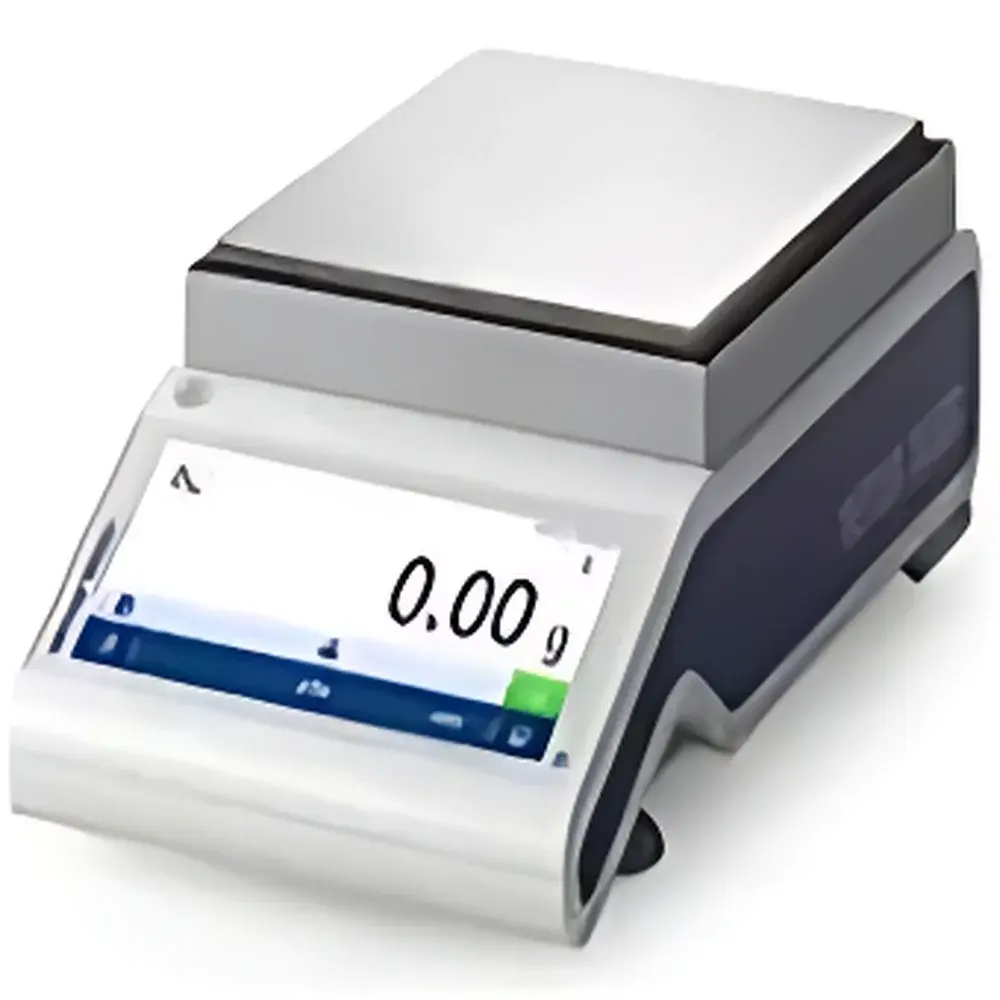
METTLER TOLEDO MS-TS Precision Balance
| Brand | METTLER TOLEDO |
|---|---|
| Origin | Switzerland |
| Model | MS-TS |
| Type | Precision Balance |
| Capacity | ≥5000 g |
| Readability | 0.001 g |
| Display | 7-inch full-color TFT touchscreen |
| Character height | 18 mm |
| Leveling system | 3 fixed feet + 2 locking leveling feet |
| Calibration | FACT fully automatic internal calibration |
| Sensor technology | MonoBloc single-module weighing cell |
| MinWeigh function | visual red alert when sample mass falls below user-defined minimum weighing value |
| Sample ID tracking | up to 4 identifiers per weighing (e.g., operator, sample ID, batch, date) |
| LevelControl | real-time tilt detection with on-screen leveling guidance |
| Overload protection | built-in mechanical and electronic protection |
Overview
The METTLER TOLEDO MS-TS Precision Balance is an industrial-grade analytical weighing instrument engineered for high-throughput laboratories, quality control environments, and regulated manufacturing facilities requiring consistent accuracy at readability levels of 0.001 g (1 mg) and capacities up to and exceeding 5000 g. Built upon METTLER TOLEDO’s MonoBloc single-module sensor architecture, the MS-TS delivers exceptional long-term stability, minimal drift, and high reproducibility under variable ambient conditions. Its measurement principle relies on electromagnetic force compensation (EMFC), where the restoring force required to maintain the load receptor at equilibrium is precisely quantified and converted into a mass reading traceable to SI units via internal metrological references. Designed for ISO/IEC 17025-compliant workflows and aligned with USP , ASTM E899, and GLP/GMP documentation requirements, the MS-TS supports audit-ready operation in pharmaceutical, chemical, food, and materials testing labs.
Key Features
- 7-inch full-color TFT touchscreen interface with 18 mm high-contrast numeric characters — optimized for glove-compatible operation (cotton, silicone, nitrile, or rubber gloves) and visibility under varied lighting conditions.
- FACT (Fully Automatic Calibration Technology) with motorized internal weights ensures uninterrupted accuracy across temperature fluctuations; calibration events are logged with timestamps and operator IDs.
- LevelControl system continuously monitors tilt angle and provides step-by-step visual guidance on screen to achieve optimal horizontal alignment — critical for minimizing gravitational error and ensuring repeatability.
- Robust mechanical design featuring three fixed support feet and two lockable leveling feet enables rapid, vibration-dampened setup on standard laboratory benches or production-line workstations.
- MinWeigh functionality dynamically calculates and enforces the minimum sample mass required to meet predefined uncertainty thresholds (e.g., ±0.1% relative standard deviation); non-compliant weighings trigger a persistent red warning on the display.
- Built-in overload protection safeguards the MonoBloc sensor from mechanical shock and overloading beyond rated capacity — extending service life and reducing downtime.
Sample Compatibility & Compliance
The MS-TS accommodates a broad range of sample forms including powders, granules, liquids in tared containers, solid components, and pre-weighed reference standards. Its draft shield compatibility (optional accessory) ensures stable readings for low-mass samples sensitive to air currents. The balance conforms to international regulatory frameworks including ISO 9001, ISO/IEC 17025, and FDA 21 CFR Part 11 when integrated with METTLER TOLEDO LabX software. All internal calibration records, user actions, and weighing events are time-stamped and stored with immutable audit trails — supporting compliance with GxP, ICH guidelines, and EU Annex 11 requirements.
Software & Data Management
When connected to LabX™ PC-based software (sold separately), the MS-TS enables full data integrity: electronic signatures, role-based access control, automated report generation (PDF/CSV), and seamless integration with LIMS or ERP systems via ODBC or OPC UA protocols. Local data storage retains ≥10,000 weighing records with metadata (operator ID, timestamp, method name, environmental conditions). All data exports comply with ALCOA+ principles (Attributable, Legible, Contemporaneous, Original, Accurate, Complete, Consistent, Enduring, Available) and support 21 CFR Part 11 compliance when configured with electronic signature modules.
Applications
- Raw material verification and incoming inspection in pharmaceutical API manufacturing.
- Formulation batch preparation and intermediate weight checks in solid dosage production.
- Calibration of volumetric glassware and pipette verification per ISO 8655.
- Moisture content determination via gravimetric loss-on-drying (LOD) protocols.
- Quality assurance testing of food additives, nutritional supplements, and agrochemicals.
- Reference standard preparation and dilution series setup in analytical chemistry labs.
FAQ
What is the minimum sample weight supported by the MS-TS for reliable results?
The MinWeigh function calculates the minimum weight based on your defined tolerance (e.g., 0.1% RSD) and current environmental stability. It is not a fixed value but dynamically updated using real-time noise analysis and calibration history.
Does the MS-TS support external barcode scanning for sample identification?
Yes — optional USB or Bluetooth barcode readers integrate directly with the touchscreen UI to auto-populate up to four customizable ID fields per weighing event.
Is FACT calibration traceable to national standards?
FACT uses factory-certified internal weights calibrated against primary standards maintained at METTLER TOLEDO’s accredited metrology laboratories (DAkkS ISO/IEC 17025 accredited), ensuring full traceability to BIPM SI definitions.
Can the MS-TS be validated according to IQ/OQ/PQ protocols?
Yes — METTLER TOLEDO provides comprehensive validation documentation packages, including test scripts, acceptance criteria, and raw data templates compliant with ASTM E2656 and EU GMP Annex 15.
How does LevelControl improve measurement reliability?
LevelControl detects deviations >0.2° from horizontal and initiates corrective feedback before weighing begins — eliminating systematic errors caused by uneven loading distribution and gravitational vector misalignment.