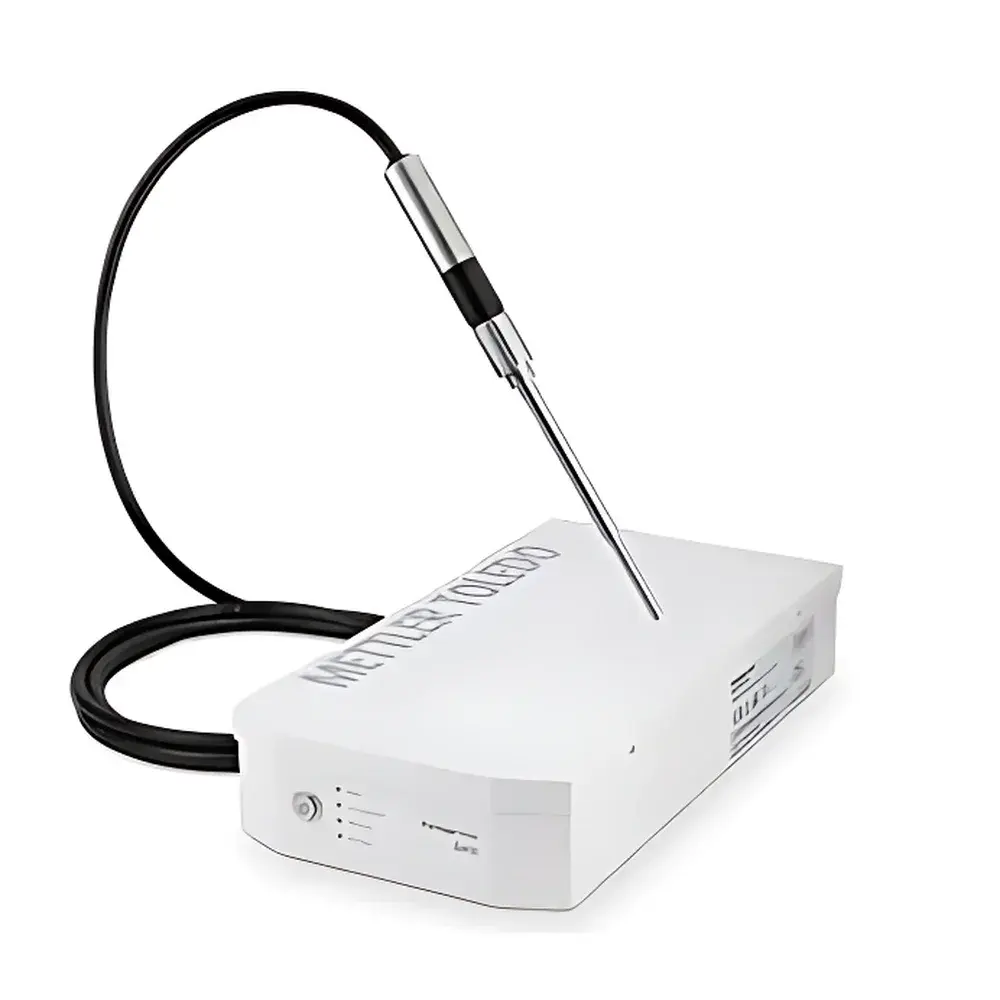
METTLER TOLEDO ParticleTrack G400/G600/G600B/G600EX Focused Beam Reflectance Measurement (FBRM) Online Particle Size and Shape Analyzer
| Brand | METTLER TOLEDO |
|---|---|
| Origin | Switzerland |
| Model | ParticleTrack G400 / G600 / G600B / G600EX |
| Measurement Principle | Focused Beam Reflectance Measurement (FBRM) |
| Particle Size Range | 0.5–2000 µm |
| Laser Class | Class 1 |
| Probe Pressure Rating | 3–300 barg (model-dependent) |
| Probe Temperature Rating | −80 to +150 °C (model-dependent) |
| Scan Speed | 2 m/s (1.2 m/s for 19 mm probe) |
| Probe Window Material | Sapphire |
| Sealing Material | Viton™ (G400), Kalrez® (G600 series) |
| Enclosure Rating | IP66 (G600B/G600EX) |
| Compliance | CE, NRTL, CB Scheme, FDA 21 CFR Part 11 (with iC Process software), GLP/GMP-ready |
Overview
The METTLER TOLEDO ParticleTrack series is an industrial-grade, in-line particle characterization platform based on Focused Beam Reflectance Measurement (FBRM) technology. Unlike traditional offline techniques—such as laser diffraction or dynamic light scattering—the ParticleTrack system employs a robust optical probe inserted directly into process streams (slurries, emulsions, crystallization vessels, or fluidized beds) to deliver real-time, undiluted measurement of chord length distributions. Each chord represents the projected dimension of a particle intersecting the focused laser beam; statistical aggregation of millions of chords per second enables derivation of time-resolved metrics including particle count, mean chord length, and distribution width. Critically, FBRM does not assume spherical geometry nor require optical transparency, making it uniquely suited for opaque, high-solids, or highly viscous systems common in pharmaceutical crystallization, polymer emulsion synthesis, and fine chemical manufacturing. The system operates without sample extraction, eliminating representativeness bias inherent in offline grab sampling and enabling true process understanding from laboratory development through pilot-scale validation to full-scale production.
Key Features
- FBRM-based in situ measurement with no sample dilution, filtration, or preparation required
- Multiple probe configurations optimized for distinct operational environments: G400 (lab-scale, benchtop host), G600 (pilot/production-ready, stainless-steel field enclosure), G600B (IP66-rated, general-purpose industrial unit), and G600EX (ATEX-certified for hazardous areas)
- Probe options include 14/9.5 mm, 19 mm, and 25 mm diameters with immersion lengths up to 1000 mm, compatible with C22 alloy, SS316, or electropolished wetted surfaces
- Sapphire optical windows with Viton™ (G400) or Kalrez® (G600 series) sealing ensure long-term chemical resistance and pressure integrity up to 300 barg (custom)
- Dual Chord Selection Method (CSM): Primary mode resolves fine changes in sub-10 µm populations; Macro mode enhances signal stability in coarse or agglomerated systems
- Integrated pneumatic or electronic scanning mechanisms maintain consistent 2 m/s scan velocity across all models (1.2 m/s for 19 mm probe variants)
- Comprehensive environmental ratings: operating temperature range from −80 °C to +150 °C (model-dependent); IP66 ingress protection for G600B/G600EX units
Sample Compatibility & Compliance
ParticleTrack probes are validated for continuous operation in chemically aggressive, abrasive, or thermally demanding environments typical of API crystallization, catalyst slurry handling, pigment dispersion, and battery electrode slurry processing. The sapphire window and corrosion-resistant wetted materials meet ASTM G152 (standard practice for accelerated weathering) and ISO 15142 (corrosion resistance of medical device alloys) benchmarks. All systems comply with CE marking requirements for electromagnetic compatibility (EMC Directive 2014/30/EU) and low-voltage safety (LVD Directive 2014/35/EU). The G600EX variant carries ATEX II 2G Ex db IIB T4 Gb and IECEx certification for Zone 1 gas environments. When deployed with iC Process software, the platform supports audit trail, electronic signatures, and data integrity features aligned with FDA 21 CFR Part 11, EU Annex 11, and PIC/S GMP guidelines—enabling use in regulated pharmaceutical and biotech manufacturing.
Software & Data Management
Data acquisition and visualization are managed via METTLER TOLEDO’s iC FBRM software (standard) and iC Process (optional add-on for enterprise integration). iC FBRM provides real-time trend plotting of chord count, L10/L40/L50/L90, and distribution shape parameters (e.g., Span = (L90−L10)/L50). It supports automated event detection—such as nucleation onset, agglomeration peaks, or breakage thresholds—via user-defined logic rules. iC Process extends functionality with OPC UA connectivity, batch record export (CSV, PDF), S88/S95-compliant recipe integration, and secure web-based remote monitoring. Both platforms log metadata including probe ID, calibration timestamp, ambient temperature, and air purge status—ensuring full traceability for GLP/GMP audits. Raw chord data is stored in proprietary .fbrm format and exportable for third-party statistical analysis (e.g., MATLAB, Python pandas).
Applications
- Pharmaceutical crystallization: Monitoring polymorphic transitions, supersaturation control, and endpoint determination during antisolvent addition or cooling cycles
- Chemical process optimization: Quantifying droplet coalescence in emulsion polymerization or detecting fouling onset in heat exchangers
- Food & beverage quality assurance: Tracking starch granule swelling kinetics or cocoa butter crystal habit evolution during tempering
- Materials science R&D: Characterizing nanoparticle aggregation dynamics in battery slurry mixing or ceramic precursor aging
- Environmental engineering: Assessing floc size distribution in wastewater flocculation basins under varying coagulant dosing
FAQ
How does FBRM differ from laser diffraction for in-process particle sizing?
FBRM measures chord lengths in flowing or static suspensions without requiring optical homogeneity or dilution; laser diffraction assumes Mie theory and requires transparent, dilute samples, limiting its applicability to real-time process streams.
Can ParticleTrack distinguish between particle shape changes and size changes?
While FBRM does not yield direct 2D/3D morphology, shifts in chord distribution skewness, kurtosis, or the ratio of macro-to-primary counts provide empirical indicators of shape evolution (e.g., needle-to-plate transition in crystallization).
Is calibration required before each use?
The system uses factory-calibrated optics and requires only periodic verification using NIST-traceable polystyrene latex standards; no user calibration is needed for routine operation.
What maintenance is necessary for long-term probe reliability?
Routine inspection of window clarity and seal integrity is recommended; automated air purge (standard on G600 series) minimizes fouling and condensation—extending service intervals beyond 12 months in stable processes.
Does ParticleTrack support integration with DCS or MES systems?
Yes—via iC Process with OPC UA server capability, enabling bidirectional communication with DeltaV, Emerson DeltaV, Honeywell Experion, or Siemens PCS7 for closed-loop control and batch record synchronization.