
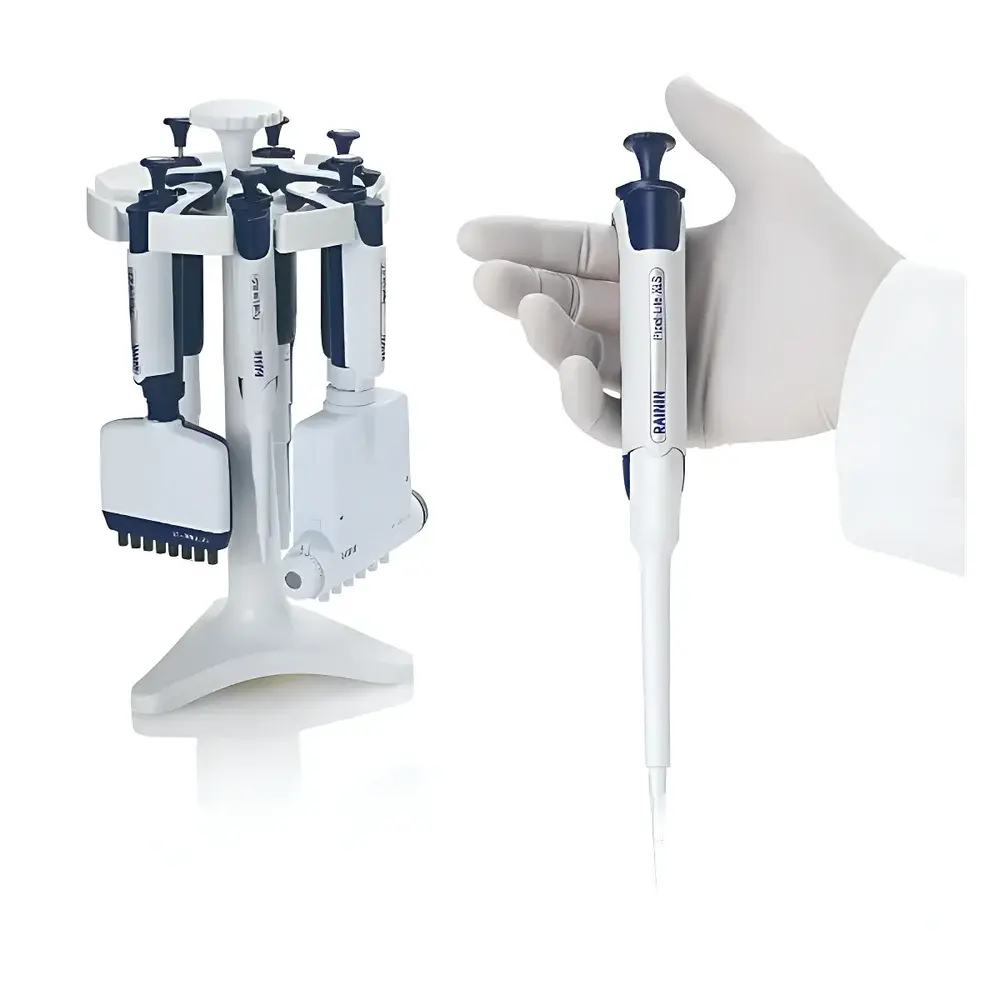
METTLER TOLEDO Rainin Pipet-Lite XLS+ Single-Channel, Multi-Channel, and Adjustable-Spacing Pipettes
| Brand | METTLER TOLEDO |
|---|---|
| Origin | Switzerland |
| Model | Pipet-Lite XLS+ |
| Volume Range | 0.1–20 mL (multiple fixed-volume variants) |
| Sterilization | Autoclavable (121°C, 20 min) |
| Tip Compatibility | LTS (Low-Torque Seal) and universal conical tips |
| Ergonomic Design | Integrated finger hooks, thumb cushion, internal dampening mechanism |
| Compliance | ISO 8655 compliant |
| RFID | Embedded for asset tracking |
| Channel Options | 1-, 6-, 8-, and 12-channel |
| Adjustable Spacing | 9–14 mm (8-channel), 9–19 mm (6-channel) |
Overview
The METTLER TOLEDO Rainin Pipet-Lite XLS+ is a high-precision, manually operated liquid handling system engineered for reproducible volumetric delivery across research, clinical diagnostics, and quality control laboratories. Built upon Rainin’s legacy of ISO 8655-compliant pipette design, the XLS+ platform integrates mechanical precision with ergonomic innovation to minimize operator-induced variability—particularly critical in low-volume applications (down to 0.1 µL) where human factors significantly influence measurement uncertainty. Unlike conventional air-displacement pipettes, the XLS+ employs a dual-stage plunger mechanism with integrated mechanical dampening to stabilize piston motion during aspiration and dispensing, reducing force fluctuations that contribute to volume deviation. Its modular architecture supports single-channel, fixed-spacing multi-channel (6-, 8-, and 12-channel), and adjustable-spacing configurations—enabling seamless transition between tube-based workflows and microplate formats without tooling or recalibration.
Key Features
- Ergonomic hand grip with molded finger hooks and contoured thumb rest reduces muscular fatigue during extended use—validated through independent biomechanical assessment per ISO 7730 thermal comfort and ISO 5349-1 hand-transmitted vibration standards.
- LTS (Low-Torque Seal) tip interface eliminates reliance on O-rings; instead, a precision-machined cylindrical seal ensures consistent tip engagement force and minimizes channel-to-channel variation (< ±0.5% CV at 10 µL).
- Integrated mechanical dampener absorbs thumb-force transients, maintaining piston velocity stability—critical for accurate low-volume transfers (e.g., 0.5–10 µL range).
- Autoclavable lower assembly (including tip cone, ejector arm, and shaft) withstands 121°C for 20 minutes without dimensional drift or seal degradation—fully compliant with ISO 17025 traceable calibration protocols.
- Volume lock mechanism prevents accidental setting changes during transport or benchtop handling—especially valuable in shared-core facilities subject to frequent reassignment.
- Embedded RFID tag enables automated inventory management, audit trail logging, and GLP/GMP-aligned maintenance scheduling via Rainin’s LiteTouch Connect software suite.
Sample Compatibility & Compliance
The Pipet-Lite XLS+ accommodates both LTS-certified and standard conical (universal) pipette tips across its full volume range (0.1 µL to 20 mL). All variants meet ISO 8655 Parts 1–6 for accuracy, precision, and environmental robustness—including temperature sensitivity testing (±0.02% / °C), humidity resilience (30–80% RH), and mechanical shock resistance (1 m drop test per IEC 60068-2-32). The adjustable-spacing models support ANSI/SLAS-standard microplates (96-well, 384-well) and PCR tubes (0.2–2.0 mL), with spacing calibrated using NIST-traceable gauge blocks. Regulatory alignment includes FDA 21 CFR Part 11 readiness (when paired with validated software), EU Annex 11 principles for electronic records, and compatibility with laboratory quality systems operating under ISO/IEC 17025 or CLIA requirements.
Software & Data Management
While the XLS+ operates as a standalone mechanical instrument, its embedded RFID tag interfaces with Rainin LiteTouch Connect—a secure, browser-based platform supporting asset lifecycle tracking, usage analytics, and preventive maintenance alerts. Each scan logs date/time, user ID (if integrated with LDAP/Active Directory), sterilization cycles, and calibration status—generating audit-ready reports aligned with ALCOA+ data integrity principles. Calibration certificates are digitally signed and timestamped; historical performance data (e.g., post-calibration verification results) can be exported in CSV or PDF for regulatory submission. The system supports integration with LIMS platforms via HL7 or RESTful API endpoints, enabling automatic synchronization of pipette assignment, maintenance history, and QC event logs.
Applications
The XLS+ serves as a foundational tool in molecular biology (cDNA synthesis, qPCR setup), pharmaceutical QC (dissolution testing, assay preparation), clinical microbiology (antibiotic susceptibility testing), and biomanufacturing (cell culture passaging, buffer dilution). Its low-force LTS ejection and consistent inter-channel delivery make it particularly suited for high-throughput ELISA workflows requiring sub-5 µL dispense accuracy. In regulated environments, the combination of mechanical reliability, autoclavability, and digital traceability supports compliance with USP , ASTM E2917, and ISO 15197 for diagnostic device manufacturing. The adjustable-spacing configuration streamlines serial dilutions across gradient plates and sample normalization across heterogeneous tube racks.
FAQ
Is the Pipet-Lite XLS+ compatible with non-Rainin pipette tips?
Yes—it accepts both LTS-certified tips and standard conical tips, though optimal accuracy and LTS-specific benefits (e.g., reduced ejection force, improved sealing consistency) require LTS-compatible consumables.
Can the adjustable-spacing model be used for both 96-well and 384-well plates?
The 8-channel version supports 96-well plates (spacing: 9–14 mm); the 6-channel version covers wider tube arrays and select 384-well formats via custom spacing presets—but direct 384-well compatibility requires verification against plate manufacturer tolerances.
Does the RFID functionality require additional hardware?
Yes—an optional Rainin RFID reader (sold separately) is required for scanning; however, the embedded tag remains passive and does not affect pipette operation or sterility.
How often should the XLS+ be calibrated?
Per ISO 8655 and internal SOPs, calibration frequency depends on usage intensity and risk assessment—typically every 3–6 months for routine QC labs, with interim verification performed before each high-value assay.
Is the entire pipette autoclavable?
Only the lower assembly (tip cone, ejector arm, and shaft) is autoclavable; the upper housing contains non-heat-resistant components and must remain unsterilized.



