
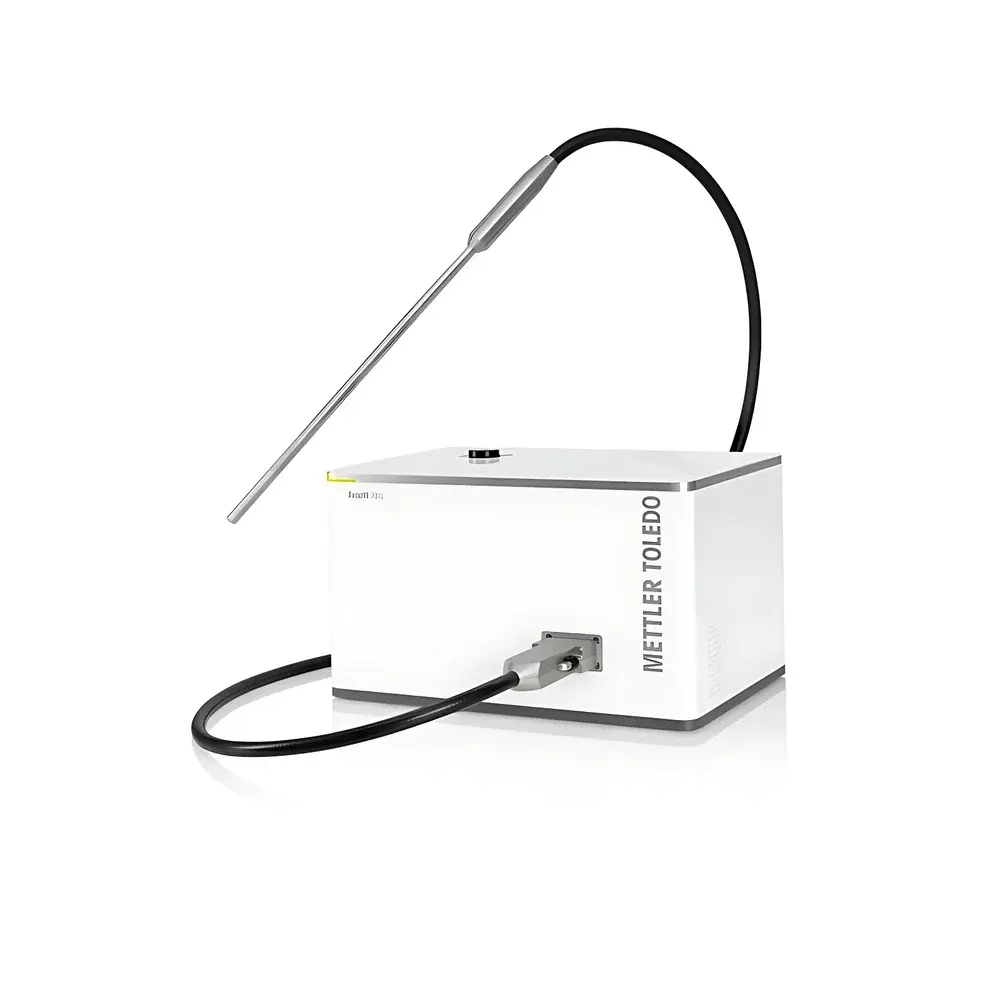
METTLER TOLEDO ReactIR 701L In Situ Fourier Transform Infrared (FTIR) Spectrometer for Real-Time Reaction Monitoring
| Brand | METTLER TOLEDO |
|---|---|
| Origin | USA |
| Model | ReactIR 701L |
| Instrument Type | In-line / Flow-through Process Spectrometer |
| FTIR Architecture | Michelson Interferometer-Based |
| Wavenumber Range | 4000–650 cm⁻¹ |
| Spectral Resolution | 4 cm⁻¹ |
| Scan Rate | 7 scans per second |
| Signal-to-Noise Ratio (SNR) | 2000:1 |
| Detector | High-Sensitivity, Liquid-Nitrogen-Cooled MCT (Mercury Cadmium Telluride) |
| Probe Compatibility | Fiber-Optic ATR, Transmission, and Reflectance Probes |
| Operating Environment | Lab-scale reactors (glass, stainless steel), flow cells, and microreactors |
Overview
The METTLER TOLEDO ReactIR 701L is a research-grade, in situ Fourier Transform Infrared (FTIR) spectrometer engineered for real-time, non-invasive monitoring of chemical reactions under process-relevant conditions. Leveraging a high-stability Michelson interferometer architecture and a liquid-nitrogen-cooled MCT detector, the ReactIR 701L delivers exceptional spectral fidelity and long-term signal stability—critical for quantitative kinetic modeling and mechanistic elucidation. Unlike offline sampling or attenuated post-processing methods, the ReactIR 701L enables continuous, time-resolved acquisition of mid-infrared spectra directly within the reaction medium via fiber-optic probes. This capability supports direct observation of transient intermediates, functional group evolution, and stoichiometric progression—providing empirical evidence for rate-determining steps, side-product formation, and endpoint determination without manual intervention or sample withdrawal.
Key Features
- Real-time, in situ spectral acquisition at up to 7 full-spectrum scans per second—enabling millisecond-level resolution for fast exothermic or catalytic reactions.
- Wavenumber range of 4000–650 cm⁻¹ with 4 cm⁻¹ nominal resolution, optimized for detection of C=O, O–H, N–H, C–N, C–O, and C–H vibrational modes central to organic synthesis, pharmaceutical process chemistry, and polymerization kinetics.
- Liquid-nitrogen-cooled MCT detector delivering a signal-to-noise ratio of 2000:1 (at 4 cm⁻¹, 16 scans), ensuring robust quantitation down to low-ppm concentration changes in reactive species.
- Modular probe interface supporting multiple sampling geometries: diamond ATR probes for heterogeneous slurries and viscous media; transmission flow cells for homogeneous solutions; and reflective probes for gas-phase or vapor-phase monitoring.
- Integrated thermal management and vibration-damping housing for stable operation in standard laboratory fume hoods, reactor skids, and pilot-plant environments—no external optical table required.
Sample Compatibility & Compliance
The ReactIR 701L is compatible with a broad spectrum of chemistries—including aqueous, organic, corrosive, and high-pressure systems—when paired with chemically resistant probe materials (e.g., Hastelloy, sapphire, or PEEK). It meets design requirements for GLP-compliant laboratories and supports audit-ready data integrity through hardware-enforced timestamping, electronic signatures, and immutable raw-data archiving. While not inherently 21 CFR Part 11 certified as a standalone instrument, its iC IR software platform (v6.0+) provides configurable user access controls, change-tracking logs, and electronic record generation aligned with FDA and EMA expectations for analytical instrumentation used in process development and tech transfer. The system conforms to ISO/IEC 17025:2017 principles for method validation and supports ASTM E1655–22 (standard practices for quantitative infrared analysis) when deployed with validated calibration protocols.
Software & Data Management
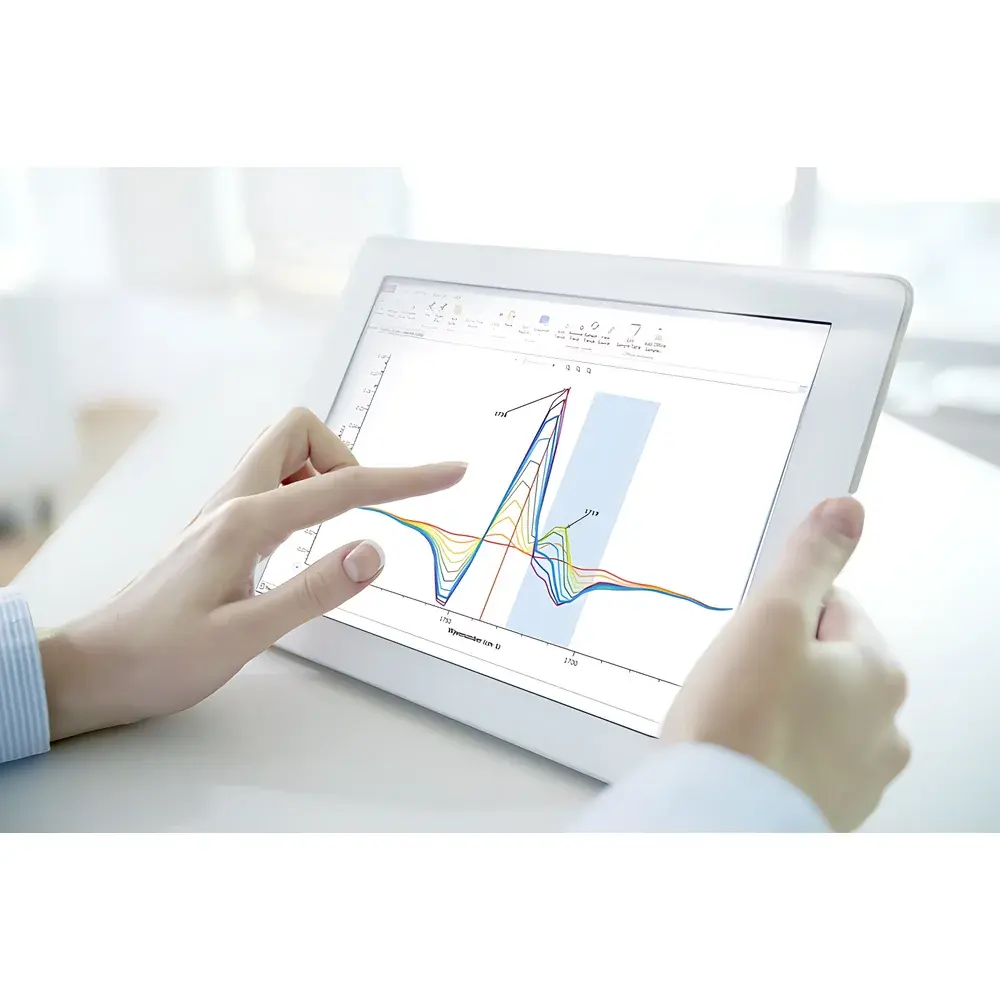
Controlled exclusively by METTLER TOLEDO’s iC IR software, the ReactIR 701L employs chemometrics-driven algorithms for automated peak identification, baseline correction, and multivariate curve resolution (MCR). Its “One-Click Analysis” workflow applies rule-based logic to assign spectral features to known functional groups—accelerating interpretation without compromising scientific rigor. All spectral data are stored in vendor-neutral HDF5 format with embedded metadata (time, temperature, agitation speed, probe ID), enabling traceable integration with LIMS, ELN, and PAT (Process Analytical Technology) frameworks. Batch comparison tools support statistical process control (SPC) charting of peak area trends, while kinetic modeling modules export rate constants and activation energies directly to MATLAB or Python-based simulation environments.
Applications
- Reaction mechanism studies in API synthesis, including nucleophilic substitution, hydrogenation, and cross-coupling pathways.
- Crystallization endpoint detection and polymorph tracking via lattice-mode fingerprinting.
- Catalyst deactivation profiling through real-time monitoring of metal–ligand bond vibrations.
- Biocatalytic reaction optimization—e.g., monitoring amide bond formation or ester hydrolysis in enzymatic batch reactors.
- Continuous flow chemistry development, where residence time distribution and mixing efficiency are correlated with spectral time-series data.
- Quality-by-Design (QbD) initiatives requiring Design Space definition and control strategy validation per ICH Q8(R3).
FAQ
Can the ReactIR 701L be integrated with third-party reactor control systems?
Yes—via OPC UA and Modbus TCP interfaces, enabling synchronized acquisition of spectral data alongside temperature, pressure, pH, and dosing signals.
Is calibration required before each experiment?
No routine recalibration is needed; the system uses internal reference lasers for interferometer alignment and includes automated background subtraction routines. Annual verification against NIST-traceable standards is recommended.
What probe options are available for highly viscous or particulate-laden reaction mixtures?
Diamond ATR probes with 1.5 mm or 3 mm crystal faces are standard; custom sapphire or silicon carbide variants are available for abrasive or HF-containing systems.
Does the ReactIR 701L support quantitative analysis for regulatory submissions?
Yes—when deployed with documented IQ/OQ/PQ protocols and validated calibration models, it supports data submission under ICH M4 and FDA guidance for process understanding.
How does the ReactIR 701L differ from benchtop FTIR spectrometers?
It is purpose-built for dynamic, in-process measurement—not static sample characterization—with hardened optics, real-time spectral streaming, and probe-based sampling architecture eliminating sample handling artifacts.




