
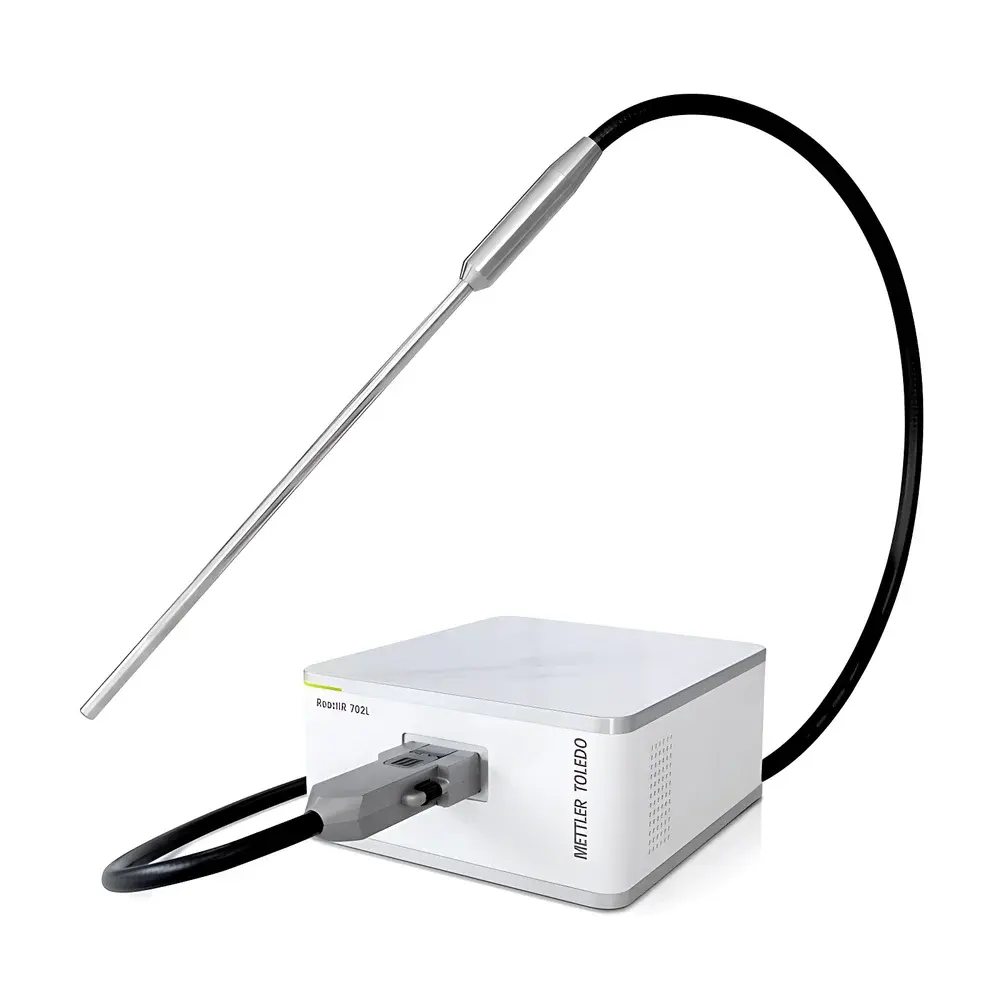
METTLER TOLEDO ReactIR 702L In Situ Fourier Transform Infrared (FTIR) Spectrometer for Real-Time Reaction Monitoring
| Brand | METTLER TOLEDO |
|---|---|
| Origin | USA |
| Model | ReactIR 702L |
| Instrument Type | In-line / Flow-through Process Analytical Technology (PAT) System |
| Spectral Range | 4000–800 cm⁻¹ |
| Detector | Solid-State Cooled MCT (Mercury Cadmium Telluride) |
| Optical Interface | Fiber-Optic Probe Coupling (No Purge Gas Required) |
| Configuration | Benchtop, Stackable, Vent-Hood Compatible |
Overview
The METTLER TOLEDO ReactIR 702L is a purpose-built, in situ Fourier Transform Infrared (FTIR) spectrometer engineered for real-time, quantitative monitoring of chemical reactions under process-relevant conditions. Unlike conventional benchtop IR systems requiring sample extraction and offline analysis, the ReactIR 702L employs fiber-optic probe technology to deliver non-invasive, continuous mid-infrared spectral acquisition directly within reactors, flow cells, or sampling loops. Its core measurement principle relies on absorption spectroscopy in the 4000–800 cm⁻¹ range, where fundamental vibrational modes of functional groups (e.g., C=O, O–H, N–H, C–N, C–O) yield chemically specific signatures. This enables direct tracking of reactant consumption, intermediate formation, product generation, and side-reaction evolution—without perturbing reaction thermodynamics or kinetics. Designed for Process Analytical Technology (PAT) frameworks, the system supports Quality by Design (QbD) initiatives and aligns with ICH Q5, Q7, and Q9 guidance for pharmaceutical development and manufacturing.
Key Features
- Solid-state cooled MCT detector eliminates dependency on liquid nitrogen, enabling unattended operation over extended durations without cryogen handling hazards or Dewar refills.
- Fiber-optic probe interface requires no optical alignment or purge gas (e.g., dry air or N₂), reducing operational complexity and maintenance overhead.
- “Always-on” detector architecture minimizes system warm-up time, allowing immediate spectral acquisition upon instrument power-up.
- Compact, stackable benchtop form factor optimizes space utilization in fume hoods and shared laboratory environments.
- Chemically resistant probe materials—including Hastelloy®, sapphire windows, and PFA/PEEK wetted components—support operation across aggressive media (e.g., strong acids, bases, halogenated solvents) at temperatures up to 150 °C and pressures up to 10 bar (dependent on probe configuration).
- Compatible with batch, semi-batch, and continuous flow reactors via dip-in probes, flow cells, or recirculation loops.
Sample Compatibility & Compliance
The ReactIR 702L accommodates diverse phase systems: homogeneous liquid-phase reactions, heterogeneous catalytic suspensions, gas-liquid interfaces, and emulsions. Its robust probe design permits direct immersion into corrosive, viscous, or particulate-laden streams without signal degradation. The system complies with key regulatory expectations for analytical instrumentation used in GxP environments: audit trail functionality, electronic signature support, and user-access controls are embedded within iC IR software to meet FDA 21 CFR Part 11 requirements. Data integrity adheres to ALCOA+ principles (Attributable, Legible, Contemporaneous, Original, Accurate, Complete, Consistent, Enduring, Available). Method validation workflows support compliance with ICH Q2(R2) for analytical procedure verification. Optional IQ/OQ documentation packages facilitate installation and operational qualification per ISO/IEC 17025 and ASTM E2500.
Software & Data Management
Controlled by METTLER TOLEDO’s iC IR software, the ReactIR 702L delivers an integrated platform for acquisition, processing, and interpretation. The software features automated peak detection and time-resolved concentration profiling using multivariate curve resolution (MCR) or classical least-squares (CLS) calibration models. Built-in reaction curve analysis tools compute rate constants, identify inflection points, and generate kinetic plots (e.g., d[conc]/dt vs. time). All raw interferograms, spectra, metadata, and processed results are stored in a secure, timestamped database with version-controlled method files. Export formats include CSV, ASCII, JCAMP-DX, and PDF reports compliant with internal SOPs and external regulatory submissions. Remote monitoring and data export are supported via secure network protocols (TLS 1.2+), with optional integration into LIMS or MES platforms through OPC UA or RESTful API interfaces.
Applications
- Reaction mechanism elucidation: Identification and quantification of transient intermediates in nucleophilic substitutions, reductions, oxidations, and cross-coupling reactions.
- Process optimization: Determination of optimal stoichiometry, addition rates, temperature profiles, and catalyst loading based on real-time concentration trajectories.
- Crystallization endpoint detection: Monitoring of supersaturation dynamics and polymorphic transitions via characteristic lattice vibration bands.
- Biocatalysis studies: Tracking enzymatic activity, cofactor regeneration, and substrate inhibition in aqueous and biphasic systems.
- Continuous manufacturing support: Enabling feed-forward control in flow chemistry by correlating spectral trends with residence time distribution and conversion efficiency.
- Impurity formation pathway analysis: Early detection of degradants or side products during stability-indicating reaction studies.
FAQ
Does the ReactIR 702L require routine optical alignment or purging?
No. Its fiber-optic coupling and sealed optical path eliminate manual alignment; ambient air operation is enabled by proprietary moisture-resistant optics—no purge gas is necessary.
Can the system be validated for use in regulated pharmaceutical development?
Yes. iC IR includes 21 CFR Part 11-compliant audit trails, role-based access control, and electronic signature capabilities—fully supporting GMP-compliant method validation per ICH Q2(R2).
What probe options are available for high-pressure or corrosive environments?
Standard offerings include Hastelloy C-276 dip probes (up to 10 bar, 150 °C), sapphire-windowed flow cells, and PFA-lined recirculation manifolds—all qualified for HCl, H₂SO₄, HF, and organic halides.
Is calibration required before each experiment?
Baseline correction is performed automatically prior to acquisition; quantitative analysis relies on pre-established calibration models validated per ICH Q2(R2) guidelines—not daily recalibration.
How does ReactIR differentiate between structurally similar compounds (e.g., regioisomers)?
By resolving subtle spectral shifts in fingerprint-region absorbances (e.g., 1500–900 cm⁻¹) combined with multivariate modeling—enabling discrimination where UV-Vis or Raman lack sufficient specificity.





