
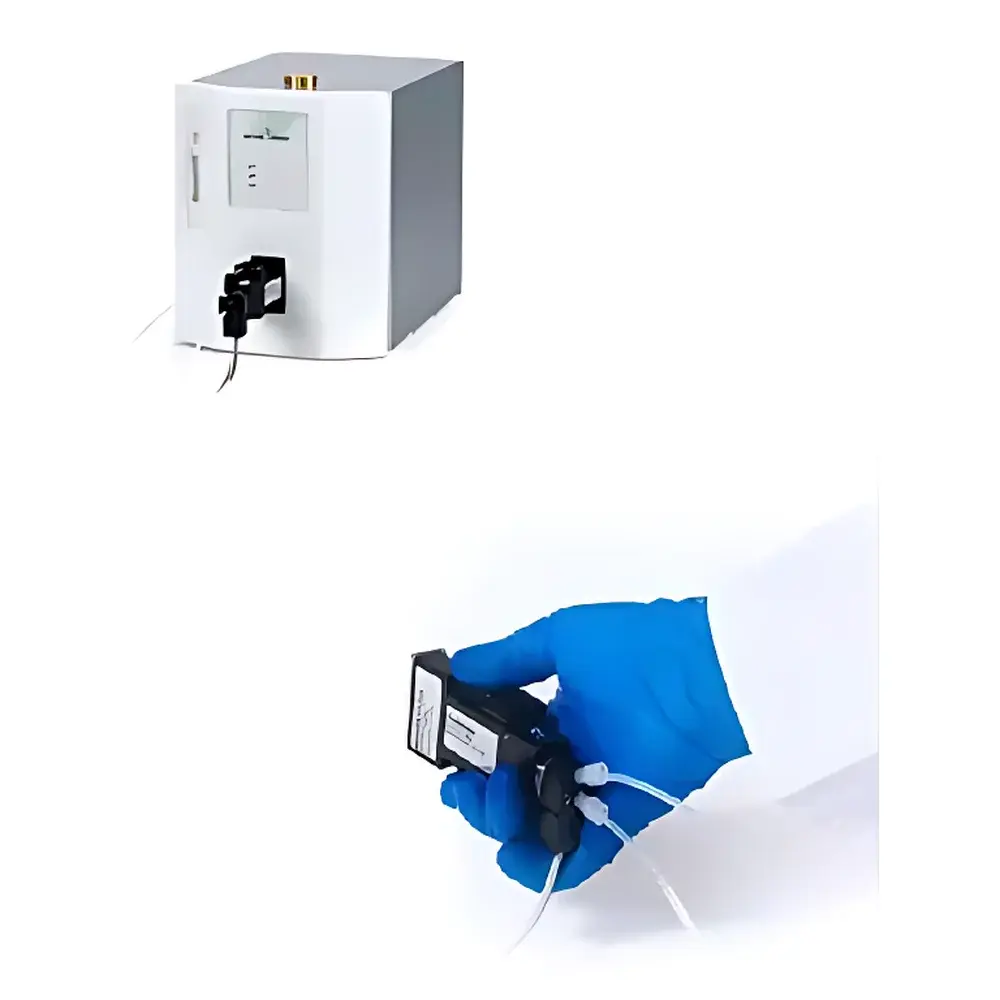
METTLER TOLEDO ReactIR™ DS Micro Flow Cell
| Brand | METTLER TOLEDO |
|---|---|
| Origin | USA |
| Manufacturer Type | Authorized Distributor |
| Origin Category | Imported |
| Model | DS Micro Flow Cell |
| Pricing | Upon Request |
Overview
The METTLER TOLEDO ReactIR™ DS Micro Flow Cell is an in-line, attenuated total reflectance (ATR) Fourier transform infrared (FTIR) flow cell engineered for real-time, non-invasive molecular monitoring of continuous flow chemical processes. Designed as a core component of the ReactIR™ platform, it enables quantitative, spectroscopically resolved tracking of reactants, intermediates, and products directly within the fluidic path—without sampling, quenching, or dilution. Its operation relies on ATR-FTIR principles: infrared light undergoes multiple internal reflections at the interface between an IR-transparent crystal (diamond or silicon) and the flowing sample, generating evanescent wave penetration (~0.5–2 µm depth) that yields chemically specific absorbance spectra proportional to analyte concentration. This physics-based measurement modality ensures high selectivity for functional group evolution, kinetic profiling, and mechanistic validation under industrially relevant flow conditions.
Key Features
- Sub-millimolar detection sensitivity enabled by high-refractive-index ATR crystals (diamond or silicon) with optimized optical path geometry
- Integrated platinum resistance temperature sensor (Pt100) for real-time, in-situ temperature monitoring within the flow channel
- Pressure-rated design supporting operation from ambient to 30 bar (435 psi), compatible with high-flow-rate and back-pressure-regulated systems
- Modular wetted-path construction using chemically inert materials: diamond/silicon ATR element, gold-plated stainless steel body, Hastelloy C-22 fittings, and Kalrez® perfluoroelastomer O-rings
- Two standard internal volumes: 10 µL and 50 µL—optimized for low reagent consumption and rapid response time (<2 s residence time at 1 mL/min)
- Universal 1/4″-28 flat-bottom port configuration (Omnifit-compatible) for seamless integration into diverse flow manifolds, microreactors, and modular synthesis platforms
- Support for dual-stream monitoring via MultiplexIR™ technology when paired with appropriate fiber-optic switching modules
Sample Compatibility & Compliance
The DS Micro Flow Cell exhibits broad compatibility across organic solvents (e.g., THF, DCM, MeOH, DMF), aqueous media, slurries, and heterogeneous catalytic mixtures. Its diamond ATR element provides exceptional resistance to abrasion, acid/base corrosion, and thermal shock—ensuring long-term stability in aggressive synthetic environments. The device complies with engineering requirements for GMP-aligned process analytical technology (PAT) deployment: pressure vessel design adheres to ASME B31.3 guidelines; temperature sensor calibration traceable to NIST standards; and mechanical construction suitable for installation in Class 1 Div 1 hazardous locations when used with appropriate enclosures. While the cell itself does not carry CE or UKCA marking, its integration into ReactIR™ systems supports compliance with FDA 21 CFR Part 11 (when deployed with audit-trail-enabled software), ICH Q5, Q7, and ISO 14644-1 cleanroom-compatible handling protocols.
Software & Data Management
When connected to a ReactIR™ spectrometer, the DS Micro Flow Cell operates under iC IR software—a validated, 21 CFR Part 11-compliant platform supporting electronic signatures, role-based access control, and full audit trail functionality. Spectral acquisition parameters (resolution: 4 cm⁻¹ typical; scan rate: up to 16 spectra/sec) are synchronized with flow controller timestamps, enabling precise kinetic alignment. Chemometric tools—including peak area integration, multivariate curve resolution (MCR-ALS), and reaction progress kinetic analysis (RPKA)—are embedded for automated quantification of transient species. Raw interferograms and processed spectra are stored in vendor-neutral .spa or .csv formats, facilitating third-party modeling (e.g., MATLAB, Python SciPy) and LIMS integration via OPC UA or RESTful API extensions.
Applications
The DS Micro Flow Cell serves as a foundational PAT tool in continuous manufacturing workflows across pharmaceutical, fine chemical, and agrochemical development. It is routinely applied to: determination of steady-state onset and duration in plug-flow reactors; identification and half-life estimation of reactive intermediates (e.g., diazonium salts, enolates, metal–ligand adducts); endpoint detection in telescoped multi-step sequences; catalyst deactivation profiling under sustained turnover; and real-time optimization of residence time distribution (RTD) in segmented flow regimes. Its sub-µL volume and fast thermal equilibration also make it suitable for high-throughput reaction screening on automated flow platforms, where >100 conditions/day can be evaluated with <5 mg of each substrate.
FAQ
Can the DS Micro Flow Cell be used with non-ReactIR™ FTIR spectrometers?
No—it requires optical coupling via ReactIR™-specific fiber-optic cables and firmware-level synchronization with iC IR software for spectral calibration and timing integrity.
Is cleaning validation supported for GMP production use?
Yes—its fully drainable, zero-dead-volume geometry and inert wetted materials allow for verified solvent flush protocols; cleaning efficiency can be confirmed spectroscopically via residual peak absence.
What is the maximum recommended flow rate for the 10 µL cell?
For optimal signal-to-noise and laminar flow profile, METTLER TOLEDO recommends ≤2 mL/min; higher rates may induce turbulence and reduce spectral reproducibility.
Does the integrated temperature sensor compensate for spectral drift due to thermal expansion?
No—the Pt100 provides process temperature logging only; spectral baseline stability is maintained via internal reference laser and dynamic alignment algorithms, independent of fluid temperature.
Are custom port configurations or extended temperature ranges available?
Standard configurations are fixed; extended-range variants (e.g., –20 °C to 120 °C) require factory-engineered versions (e.g., TC series) with Peltier or jacketed thermal management—contact METTLER TOLEDO Process Analytics for OEM integration support.





