
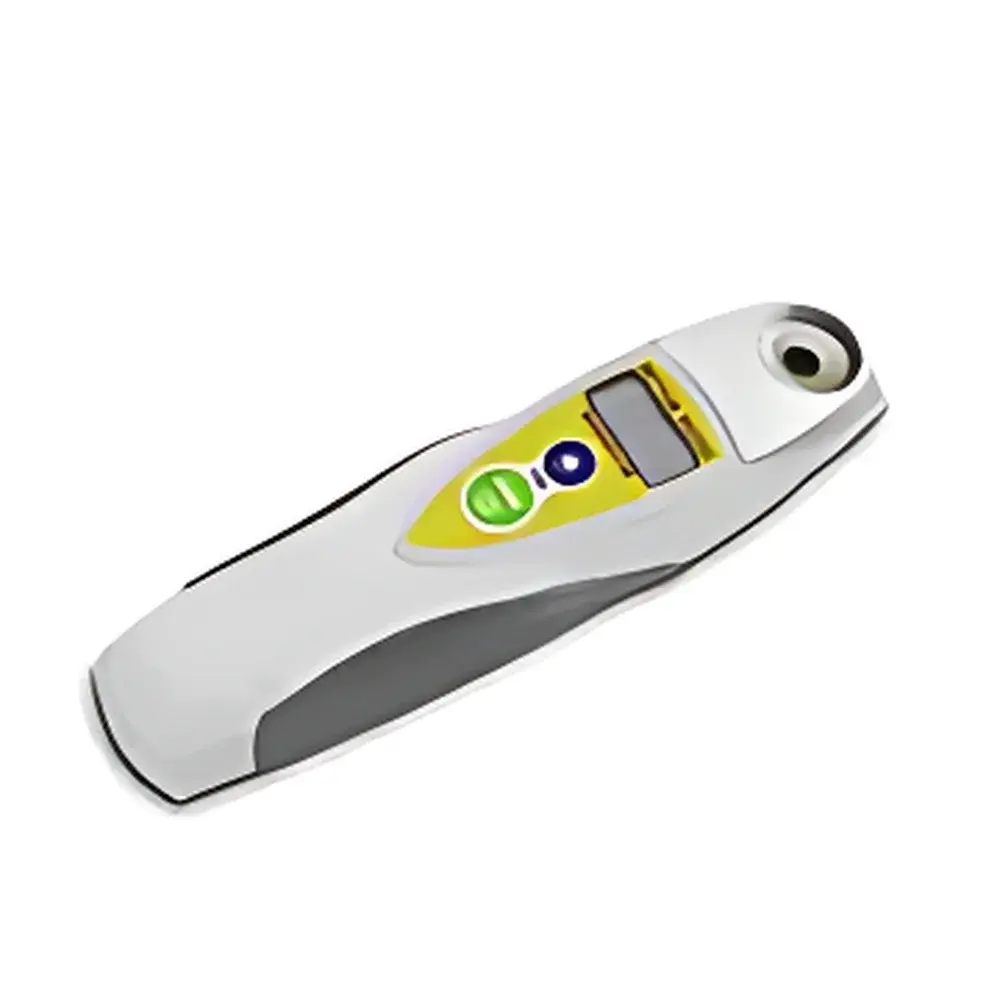
METTLER TOLEDO Refracto 30PX / 30GX Portable Digital Refractometer
| Brand | METTLER TOLEDO |
|---|---|
| Origin | Switzerland |
| Model | 30PX / 30GX |
| Measurement Principle | Sodium D-line (589.3 nm) critical angle method |
| Refractive Index Range | 1.32–1.50 (30PX), 1.32–1.65 (30GX) |
| Resolution | 0.0001 RIU |
| Accuracy | ±0.0005 RIU |
| Temperature Range | 10–40 °C |
| Temperature Compensation | Integrated Peltier-controlled sensor with automatic compensation (ATC) |
| Display | High-resolution LCD |
| Data Output | USB and optional Bluetooth connectivity |
| Compliance | Designed for GLP/GMP environments |
Overview
The METTLER TOLEDO Refracto 30PX and 30GX are precision-engineered portable digital refractometers designed for rapid, field-deployable, and laboratory-grade refractive index (RI) measurements. Based on the fundamental optical principle of critical angle measurement at the sodium D-line wavelength (589.3 nm), these instruments deliver traceable, temperature-compensated RI values with high reproducibility across diverse sample matrices. Unlike traditional Abbe refractometers requiring manual alignment and visual interpolation, the Refracto series employs a solid-state prism assembly coupled with a high-sensitivity photodiode array to digitally determine the critical angle boundary—enabling robust, operator-independent results. Its dual-mode operation—either as a benchtop unit with sample droplet application or as an immersion probe directly inserted into tanks, reactors, or process streams—makes it uniquely suited for quality control in dynamic manufacturing environments where time-to-result and measurement flexibility are critical.
Key Features
- Dual operational modes: Benchtop droplet measurement (using integrated sample well) and direct immersion sensing (via detachable probe head compatible with both 30PX and 30GX models)
- Integrated Peltier-controlled temperature sensor ensures real-time, automatic temperature compensation (ATC) across the full 10–40 °C operating range, eliminating manual correction tables
- High-resolution 0.0001 RIU resolution and ±0.0005 RIU accuracy—certified per ISO 17025-accredited calibration protocols
- Optimized optical path design enables reliable measurement of highly colored, turbid, or low-transmittance samples (e.g., caramelized syrups, crude oil fractions, herbal extracts) without signal saturation or scattering artifacts
- Intuitive icon-driven interface with multilingual support (English, German, French, Spanish, Chinese, Japanese); no training required for routine operation
- Onboard memory stores up to 1,000 measurement records with timestamp, temperature, and user ID; export via USB or Bluetooth to CSV or PDF formats
Sample Compatibility & Compliance
The Refracto 30PX and 30GX accommodate aqueous solutions, organic solvents, emulsions, suspensions, and viscous liquids—including those with particulate content up to 50 µm nominal size—without clogging or prism fouling. The sapphire-coated measuring prism provides chemical resistance to acids, alkalis, and halogenated solvents, ensuring long-term stability under repeated cleaning with ethanol, isopropanol, or mild detergent solutions. Both models comply with IEC 61000-4 electromagnetic compatibility standards and meet IP65 ingress protection rating for dust and water resistance. For regulated industries, the instruments support GLP/GMP workflows when paired with METTLER TOLEDO LabX software: full electronic signatures, audit trails, user access levels, and 21 CFR Part 11-compliant data archiving are available through validated configuration.
Software & Data Management
While fully functional as standalone devices, the Refracto series integrates natively with METTLER TOLEDO LabX laboratory software. LabX enables centralized instrument management, automated report generation (including customizable templates for Brix, % w/w, or custom concentration curves), statistical process control (SPC) charting, and seamless integration into LIMS or MES platforms via ODBC or REST API. All raw measurement data—including analog photodiode output traces, temperature logs, and environmental metadata—are retained for retrospective analysis. Firmware updates are delivered via secure HTTPS channels with SHA-256 signature verification, maintaining system integrity throughout the instrument lifecycle.
Applications
These refractometers serve critical QC/QA functions across multiple regulated sectors. In food and beverage production, they verify sugar content (Brix) in fruit juices, soft drinks, and confectionery syrups—supporting compliance with AOAC 932.12 and ISO 21527. In pharmaceutical manufacturing, they monitor solvent composition during API crystallization, excipient blending, and cleaning validation (e.g., ethanol/water rinse verification per USP ). Petrochemical applications include hydrocarbon fraction purity assessment (e.g., benzene/toluene/xylene blends) and lubricant base oil classification per ASTM D1218. Additionally, they support R&D in cosmetics (surfactant concentration in shampoos), biotechnology (cell culture media osmolality estimation), and academic research requiring portable, NIST-traceable RI reference measurements.
FAQ
What is the difference between the Refracto 30PX and 30GX models?
The 30PX is optimized for general-purpose aqueous and low-viscosity applications (RI range: 1.32–1.50), while the 30GX extends the upper limit to 1.65 to accommodate high-refractive-index solvents such as ethylene glycol, glycerol, and aromatic hydrocarbons.
Does the instrument require recalibration before each use?
No—factory calibration is stable for 12 months under normal use. A two-point verification using certified NIST-traceable standards (e.g., distilled water and sucrose solution) is recommended daily in GMP environments.
Can the immersion probe be used in pressurized or agitated vessels?
Yes—the probe housing is rated for static pressures up to 6 bar and continuous operation in stirred tanks; however, flow velocity should remain below 1 m/s to avoid mechanical stress on the prism mount.
Is temperature compensation algorithm configurable?
The ATC follows the standard Lorentz-Lorenz equation with built-in coefficients for water, ethanol, and common industrial solvents; custom polynomial coefficients can be loaded via LabX for proprietary formulations.
How is measurement uncertainty determined for a specific sample type?
Uncertainty budgets must be established per ISO/IEC 17025:2017 Annex A, incorporating contributions from temperature sensor drift (±0.1 °C), prism surface contamination, sample homogeneity, and repeatability (typically ≤0.0002 RIU at 95% confidence).



