
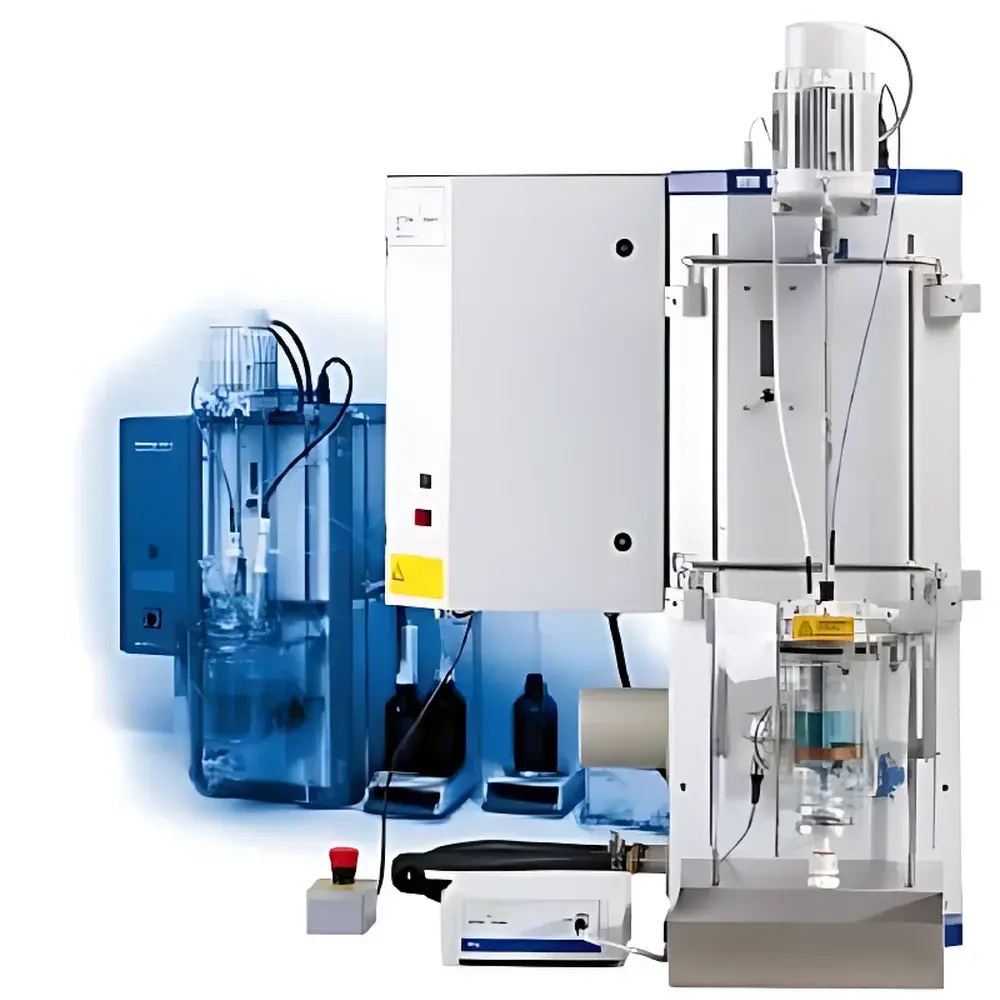
METTLER TOLEDO RTCal™ Real-Time Reaction Calorimeter
| Brand | METTLER TOLEDO |
|---|---|
| Origin | Switzerland |
| Model | RTCal™ |
| Temperature Ramp Rate | 8 °C/min |
| Emergency Cooling Rate | 30 °C/min |
| Temperature Control Modes | Tr (isothermal/gradient), Tj (isothermal/gradient), reflux/condensation, crystallization, adiabatic |
| Agitation Speed Range | 30–2500 rpm (repeatability ±1%) |
| Maximum Torque | 1 N·m |
| Overall Heat Transfer Coefficient (U-value) | online measurement, accuracy ±1%, repeatability 1–3% (standard experiments) |
Overview
The METTLER TOLEDO RTCal™ Real-Time Reaction Calorimeter is an advanced, fully automated laboratory-scale reaction calorimetry system engineered for precise, model-free quantification of thermal effects during chemical transformations. Unlike conventional heat-flow calorimeters relying on calibration with electrical heaters or reference reactions, the RTCal™ employs a patented wall-sensor methodology—measuring local heat flux directly through the reactor wall at a defined point. This principle, rooted in Fourier’s law of conduction and validated against ISO 11357-4 and ASTM E698 standards, enables real-time, calibration-free determination of reaction enthalpy (ΔHr), cumulative reaction heat (Qr), and conversion (Xr) without dependence on reactant physical properties, phase behavior, or mixing regime. Designed as a scalable, liter-volume replica of semi-batch production reactors, the RTCal™ bridges the gap between lab-scale kinetic studies and plant-scale process safety evaluation—supporting thermally critical operations including exothermic synthesis, crystallization, hydrogenation, nitration, and distillation under industrially representative conditions (pressure up to 10 bar, temperature range −20 to 200 °C). Its architecture integrates seamlessly with METTLER TOLEDO’s RC1e™ platform, extending its applicability to complex multi-step sequences requiring dynamic control of pH, dosing profiles, vapor-phase composition, and jacket temperature trajectories.
Key Features
- Wall-integrated heat-flux sensors enabling true real-time calorimetry without calibration drift or dependency on reaction medium properties
- Dual-redundant architecture: over 3,000 independently monitored valves and sensors with cross-validated signal paths ensure data integrity and experimental reproducibility (RSD ≤1% for standard calorimetric runs)
- Multi-mode temperature control: Tr (reactor temperature), Tj (jacket temperature), reflux/condensation, crystallization, and adiabatic modes—all programmable with ramp/hold/soak profiles
- High-fidelity agitation system: 30–2500 rpm range with torque monitoring up to 1 N·m, supporting semi-quantitative assessment of mass transfer limitations and suspension homogeneity
- Integrated safety subsystem: automatic emergency cooling (30 °C/min), pressure relief interlocks, runaway detection algorithms, and hardware-based thermal cutoffs compliant with IEC 61511 functional safety requirements
- Modular design compatible with optional accessories: pH electrodes, FTIR flow cells, Raman probes, and automated liquid handling for unattended multi-day experiments
Sample Compatibility & Compliance
The RTCal™ accommodates heterogeneous and multiphase systems—including slurries, emulsions, gas-liquid reactions (e.g., hydrogenations, oxidations), and viscous polymerizations—without compromising thermal resolution. Its stainless-steel 1–2 L reactor vessel meets ASME BPVC Section VIII Div. 1 requirements and is rated for operation under inert, oxidative, or corrosive atmospheres (with optional Hastelloy C-276 lining). All software workflows adhere to FDA 21 CFR Part 11 for electronic records and signatures, incorporating full audit trails, user role management, and immutable data archiving. Instrument qualification follows IQ/OQ/PQ protocols aligned with ICH Q5A, Q7, and USP guidelines—ensuring suitability for GLP- and GMP-regulated environments in pharmaceutical development and fine chemical manufacturing.
Software & Data Management
Control and analysis are performed via METTLER TOLEDO’s iCirc™ software—a validated, Windows-based platform supporting synchronized acquisition of >100 process variables (temperature, pressure, dosing mass, pH, torque, heat flow, jacket power). Raw calorimetric data undergoes real-time deconvolution using proprietary algorithms that compensate for jacket dynamics and wall thermal capacitance, delivering second-by-second reaction heat rates with ≤0.5 W resolution. Export formats include CSV, Excel, and ASTM E2554-compliant .dxp files for third-party modeling tools (e.g., gPROMS, Aspen Custom Modeler). Data integrity safeguards include automatic backup to network drives, SHA-256 hashing of raw datasets, and time-stamped electronic signatures traceable to individual operators.
Applications
The RTCal™ serves as a cornerstone instrument for process safety and development laboratories across regulated industries. It supports thermal hazard assessment per CCPS Guidelines and NFPA 491 methodologies—quantifying adiabatic temperature rise (ΔTad), time-to-maximum-rate (TMRad), and criticality classes for RC1 screening. In API route scouting, it enables comparative evaluation of alternative reagents, solvents, and stoichiometries based on heat release profiles and byproduct formation kinetics. For crystallization process design, it correlates supersaturation evolution with nucleation onset and polymorphic selection. Additional use cases include optimization of distillation energy balances, validation of kinetic models for scale-up, and generation of input data for DSC-based thermal stability predictions.
FAQ
How does RTCal™ differ from traditional heat-flow calorimeters?
It eliminates calibration dependencies by measuring wall heat flux directly—avoiding assumptions about heat capacity, mixing efficiency, or thermal lag that affect conventional methods.
Can RTCal™ operate under vacuum or elevated pressure?
Yes—the reactor system is rated for operation from full vacuum to 10 bar(g) with appropriate sealing and pressure-sensing configurations.
Is the system compliant with regulatory data integrity requirements?
Yes: iCirc™ software is 21 CFR Part 11 compliant, featuring electronic signatures, audit trails, and secure data export protocols required for FDA and EMA submissions.
What level of training is required to operate RTCal™?
Operators require foundational knowledge in reaction engineering and calorimetry principles; METTLER TOLEDO provides certified operator training covering method development, safety protocol execution, and PQ documentation.
Does RTCal™ support integration with external analytical devices?
Yes—via analog/digital I/O and OPC UA interfaces, enabling synchronization with inline FTIR, Raman, or UV-Vis spectrometers for correlative reaction monitoring.




