
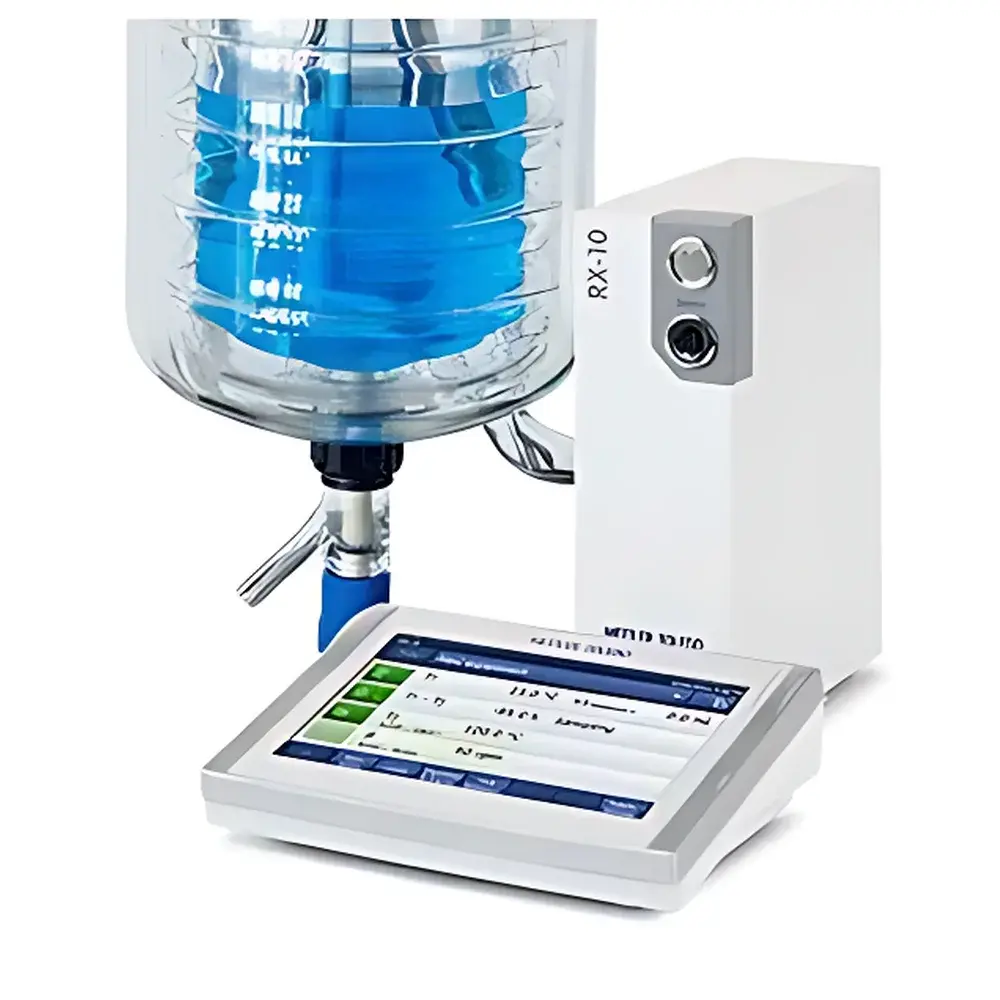
METTLER TOLEDO RX-10 Automated Jacketed Reactor Control System
| Brand | METTLER TOLEDO |
|---|---|
| Origin | Switzerland |
| Model | RX-10 |
| Application Scope | Jacketed laboratory reactors (mL to L scale) |
| Integrated PAT Compatibility | In-situ pH, FTIR, FBRM, PVM, particle size analysis |
| Control Interface | Touchscreen + iC/iControl software suite |
| Regulatory Support | 21 CFR Part 11 compliant audit trail, electronic signature, data integrity features |
| Thermal Control Integration | Compatible with external chillers, heaters, and circulators |
| Data Acquisition | Synchronized timestamped logging of temperature, stirring speed, dosing volume, pH, and PAT sensor streams |
Overview
The METTLER TOLEDO RX-10 Automated Jacketed Reactor Control System is an engineering-grade process automation platform designed for precise, reproducible, and fully traceable control of jacketed laboratory reactors across chemical synthesis, crystallization development, and pharmaceutical process research. Built on a deterministic real-time architecture, the RX-10 implements closed-loop feedback control using PID and advanced cascade algorithms to regulate jacket temperature, agitation torque, reagent dosing, and in-situ analytical inputs—including pH, FTIR absorbance, focused beam reflectance measurement (FBRM), and particle video microscopy (PVM). Unlike standalone controllers, the RX-10 functions as a unified orchestration layer that integrates heterogeneous hardware—regardless of reactor volume (from 10 mL to 20 L), manufacturer, or thermal management configuration—into a single validated operational environment. Its core purpose is to eliminate manual intervention points, standardize experimental execution, and ensure ALCOA+ (Attributable, Legible, Contemporaneous, Original, Accurate, Complete, Consistent, Enduring, Available) data governance from bench-scale discovery through to tech transfer.
Key Features
- Unified touchscreen HMI with intuitive workflow navigation—supports rapid setup of heating/cooling ramps, multi-step dosing sequences, pH-triggered additions, and crystallization-specific profiles (e.g., anti-solvent addition, seeding, controlled supersaturation)
- Bi-directional communication with METTLER TOLEDO iC Software Suite (iC Data, iC Reaction, iC Crystallization) enabling remote monitoring, script-based experiment sequencing, and synchronized multi-parameter trending
- Hardware-agnostic integration: interfaces with third-party circulators, peristaltic/diaphragm pumps, load cells, conductivity/pH transmitters, and PAT probes via standardized analog (4–20 mA, 0–10 V), digital (RS485, Modbus TCP), and proprietary optical fiber protocols
- Embedded data integrity framework compliant with FDA 21 CFR Part 11 and EU Annex 11 requirements—includes role-based access control, electronic signatures, immutable audit trails, and encrypted raw data storage
- Real-time reaction calorimetry readiness: supports optional integration with RC1mx or EasyMax Advanced reaction calorimeters for heat flow quantification without hardware retrofitting
- Scalable architecture: same control logic and validation documentation applicable to R&D, pilot plant, and early-phase manufacturing environments—facilitating seamless process scale-up and regulatory filing support
Sample Compatibility & Compliance
The RX-10 is compatible with all standard jacketed glass and stainless-steel reactors—whether single- or double-jacketed—from major suppliers including Chemglass, Ace Glass, and METTLER TOLEDO’s own EasyMax/OptiMax platforms. It accommodates volumetric ranges from 10 mL microreactors to 20 L pilot-scale vessels, supporting both batch and semi-batch operation modes. All firmware and software components are developed and validated under ISO 9001 and IEC 62304 medical device software lifecycle standards. The system meets GLP/GMP data handling requirements per OECD GLP Principles, USP , and ASTM E2500-13 for analytical instrument qualification. PAT sensor integration follows ASTM E2772-21 guidelines for multivariate data acquisition in process analytical technology applications.
Software & Data Management
Data acquisition occurs at user-configurable sampling intervals (100 ms to 5 min), with all signals time-stamped to UTC and stored in vendor-neutral HDF5 format. The iC Data module provides automated report generation—including deviation alerts, critical parameter excursions, and PAT correlation matrices—with export options to PDF, CSV, and XML for LIMS or ELN ingestion. Version-controlled experiment templates, change history tracking, and electronic lab notebook (ELN) synchronization ensure full traceability from protocol design to final analysis. Raw data files include embedded metadata (operator ID, SOP version, calibration certificates, environmental conditions), satisfying regulatory expectations for data provenance and long-term archival.
Applications
- Chemical synthesis optimization: precise stoichiometric control, exotherm management, and endpoint detection via in-situ FTIR or Raman
- Crystallization process development: dynamic control of supersaturation, nucleation induction timing, polymorph screening, and crystal size distribution (CSD) modulation using integrated FBRM/PVM
- Reaction calorimetry studies: coupling with RC1mx for heat balance modeling and kinetic parameter estimation
- Process safety assessment: automated runaway reaction detection through real-time enthalpy rate monitoring and thermal accumulation profiling
- Technology transfer support: identical control logic deployment across lab, pilot, and manufacturing scales reduces process variability and accelerates regulatory submission timelines
- Quality-by-Design (QbD) implementation: enables Design Space exploration via DoE-driven automated experimentation with built-in statistical analysis tools
FAQ
Can the RX-10 be retrofitted to existing non-METTLER TOLEDO jacketed reactors?
Yes—the RX-10 uses open communication protocols and modular I/O modules to integrate with legacy reactors equipped with standard analog sensors and actuators.
Does the system support 21 CFR Part 11-compliant electronic signatures?
Yes—role-based authentication, biometric or token-based sign-off, and tamper-evident audit logs are embedded in firmware and enforced across all software modules.
Is PAT probe calibration managed within the RX-10 software?
Calibration procedures for connected PAT devices (e.g., ReactIR, ParticleTrack) are documented and executed externally; however, calibration metadata and validity timestamps are automatically ingested and linked to acquired datasets.
What level of temperature control accuracy is achievable with external chillers/heaters?
Accuracy depends on the connected thermal unit’s specifications; typical jacket temperature stability is ±0.2 °C over 24 h when paired with high-performance circulators meeting DIN 12876-1 Class II standards.
Can multiple RX-10 units be centrally monitored from one iC server?
Yes—iC Server supports concurrent connection to up to 32 RX-10 systems, enabling cross-reactor comparison, fleet-wide alarm aggregation, and centralized backup policy enforcement.



