
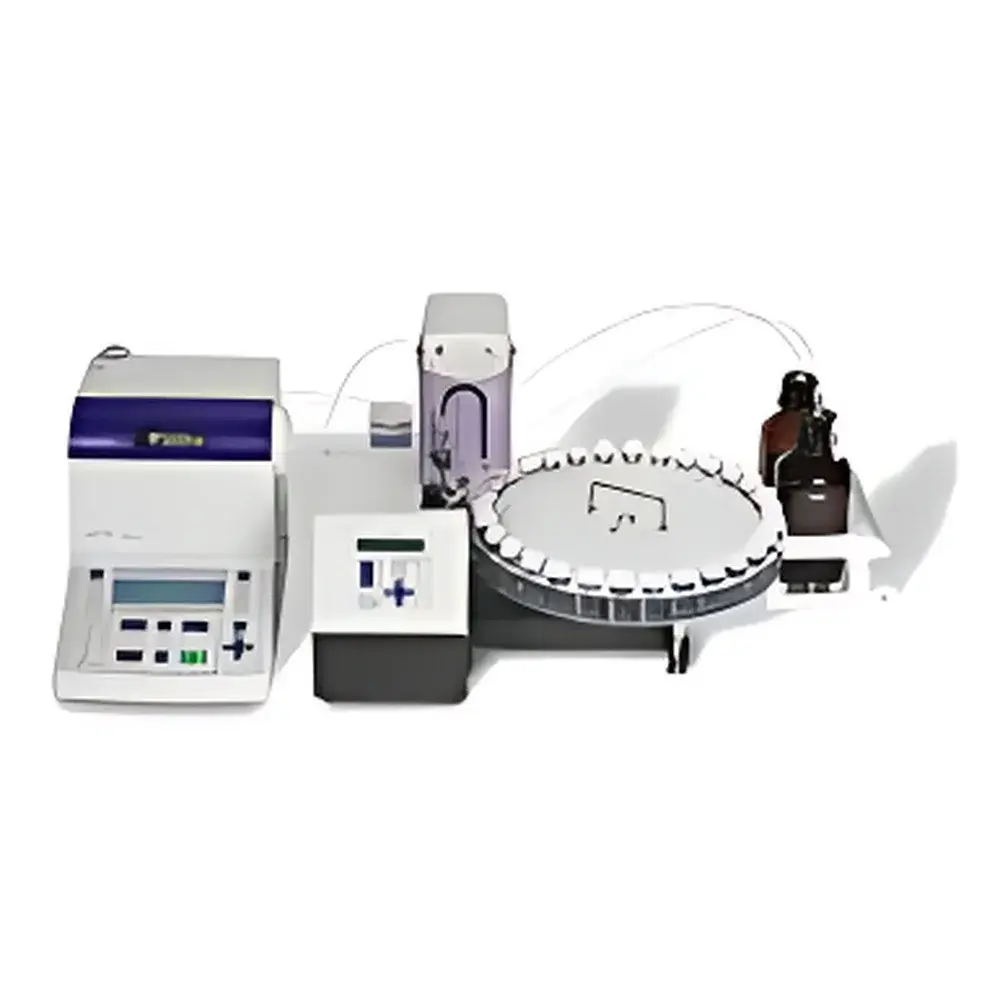
METTLER TOLEDO SC1/SC30 Automated Sample Handler and Cleaning System for Density and Refractive Index Analyzers
| Brand | METTLER TOLEDO |
|---|---|
| Origin | Switzerland |
| Model | SC1 / SC30 |
| Sample Capacity | 1 vial (20 mL, 9 mL, or 6 mL) |
| Maximum Sample Viscosity | ≤ 30,000 mPa·s |
| Sample Introduction Method | Positive-pressure pumping |
| Cleaning Protocol | Dual-solvent automated rinse and dry |
| Drying Method | Pneumatic-assisted air-drying |
| Temperature Control | Optional electric heating module (for sample pre-conditioning) |
| Sample Recovery | Optional automatic return to source vial |
| Compliance | Designed for integration with METTLER TOLEDO DE (density), RE (refractometry), and DR (combined density/refractometry) instruments |
Overview
The METTLER TOLEDO SC1/SC30 Automated Sample Handler and Cleaning System is an engineered interface designed exclusively for high-precision density and refractive index analyzers—including the DE, RE, and DR series. It operates on a positive-pressure fluidic principle, eliminating reliance on gravity-driven or siphon-based aspiration that can introduce bubble formation, sample degradation, or inconsistent fill volumes. This architecture ensures robust handling of thermally sensitive, volatile, or highly viscous samples—up to 30,000 mPa·s—without compromising measurement integrity. By automating both sample introduction and post-measurement cleaning in a sealed, inert environment, the SC1/SC30 minimizes operator intervention, reduces carryover risk, and supports unattended operation across multi-sample workflows. Its design aligns with core metrological requirements for traceability, repeatability, and environmental control in regulated laboratory environments.
Key Features
- Positive-pressure sample delivery: Eliminates vacuum-induced degassing artifacts; enables reliable analysis of low-surface-tension, volatile, or gas-prone liquids (e.g., ethanol-water mixtures, light hydrocarbons).
- Dual-solvent cleaning cycle: First solvent removes residual sample matrix; second high-volatility solvent (e.g., acetone or isopropanol) provides rapid, residue-free drying via pulsed pneumatic flow—no manual wiping or waiting.
- Integrated error detection: Synchronizes with host instrument firmware to identify and flag common measurement anomalies—including air bubbles in the measuring cell, incomplete sample homogeneity, or solvent contamination—via real-time diagnostic feedback.
- Sealed-vial sampling protocol: Sample vials remain hermetically closed until immediate pre-measurement puncture, preventing evaporation, oxidation, or ambient particulate ingress—critical for high-value or unstable formulations.
- Modular thermal management: Optional electric heating module maintains precise sample temperature prior to injection, essential for viscosity-sensitive measurements or ASTM D1250-compliant petroleum density corrections.
- Automated sample recovery (optional): Enables quantitative return of measured sample to its original container—valuable for limited-quantity pharmaceutical intermediates or hazardous materials requiring containment.
Sample Compatibility & Compliance
The SC1/SC30 accommodates standard vial formats (6 mL, 9 mL, and 20 mL) and interfaces seamlessly with METTLER TOLEDO’s certified density cells (oscillating U-tube) and Abbe-type refractometer cells. It complies with ISO 12084 (petroleum products), ASTM D4052 (density of liquids by digital density meter), and USP (refractive index). When integrated into validated workflows, the system supports 21 CFR Part 11–compliant electronic records through METTLER TOLEDO LabX software, including audit trails for sample sequence, cleaning logs, error events, and parameter changes. Its closed-loop architecture meets GLP/GMP requirements for sample integrity and procedural consistency in QC laboratories.
Software & Data Management
The SC1/SC30 operates under METTLER TOLEDO LabX software, which orchestrates method-driven sequences—including sample order, cleaning solvent selection, dwell times, temperature setpoints, and recovery activation. All hardware actions are timestamped and logged alongside analytical results, enabling full traceability from raw data to final report. LabX supports IQ/OQ documentation packages, user access levels with role-based permissions, and export to LIMS via CSV, XML, or direct SQL database integration. No standalone drivers or third-party utilities are required—the system is recognized natively upon USB or Ethernet connection.
Applications
- Quality control of pharmaceutical excipients and active ingredients where solvent residue or thermal history must be controlled.
- High-throughput density profiling of biodiesel blends per EN 14214 or ASTM D7467.
- Refractive index validation of optical resins and polymer solutions during R&D scale-up.
- Regulatory submission support for food-grade syrups, alcoholic beverages, and essential oils under FDA or EFSA guidelines.
- Research applications involving thermosensitive biologics, ionic liquids, or nanofluids where manual handling introduces variability.
FAQ
Can the SC1/SC30 be used with non-METTLER TOLEDO density or refractometry instruments?
No—it is mechanically and electronically optimized for DE, RE, and DR series instruments only; no third-party interoperability is supported.
Does the system require calibration independent of the host analyzer?
No—its function is purely mechanical and procedural; all metrological calibration resides within the connected density or refractometer unit.
Is the dual-solvent cleaning process validated for residue limits?
Yes—validation protocols are available in METTLER TOLEDO’s Application Note AN-DE-013, covering carryover testing per ICH Q5C guidelines using HPLC-UV detection.
What safety features prevent over-pressurization or solvent leakage?
The system incorporates pressure-relief valves, leak-detection sensors in the fluid path, and automatic shutdown if flow resistance exceeds predefined thresholds.
Can the SC1 and SC30 models be interchanged on the same instrument?
No—SC1 is intended for single-vial batch processing; SC30 supports carousel-based 30-position automation and requires dedicated mounting hardware and LabX license extension.
Related Products



