
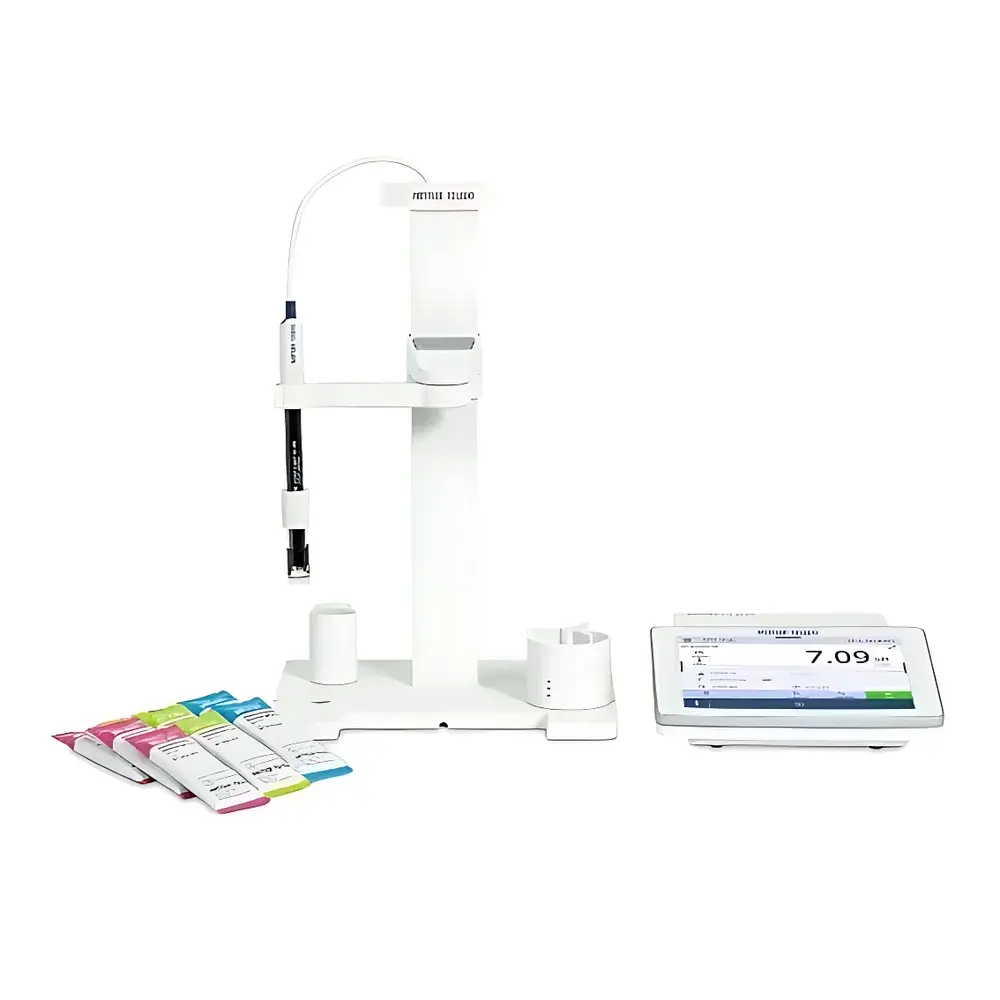
METTLER TOLEDO SevenDirect SD50 Benchtop pH/ION Meter
| Brand | METTLER TOLEDO |
|---|---|
| Origin | Switzerland |
| Instrument Type | Benchtop |
| Model | SD50 |
| Measurement Parameters | pH, mV (ORP), ref mV, Ion Concentration (pX, mol/L, mmol/L, mg/L, ppm, %), Temperature |
| pH Range | –2.000 to 20.000 |
| mV Range | –2000.0 to 2000.0 |
| Temperature Range | –30.0 to 130.0 °C |
| Ion Concentration Range | 0 to 999,999 (unit-dependent) |
| pH Resolution | 0.001/0.01/0.1 (selectable) |
| mV Resolution | 0.1 / 1 |
| Temperature Resolution | 0.1 °C |
| pH Accuracy | ±0.002 |
| mV Accuracy | ±0.1 (–500.0 to 500.0 mV) or ±0.2 (–2000.0 to 2000.0 mV) |
| Ion Accuracy | ±0.5% of reading |
| pX Accuracy | ±0.002 |
| Temperature Accuracy | ±0.1 °C (0–100 °C) |
| Calibration | Up to 5-point, auto-buffer recognition, 11 built-in buffer sets + 10 customizable sets |
| Endpoint Modes | Auto, Manual, Time Interval |
| Language Support | 10 languages (English, Chinese, German, French, Italian, Russian, Korean, Spanish, Portuguese, Japanese) |
| Data Storage | 2000 GLP-compliant records with timestamp, sample ID, electrode ID, user ID |
| Connectivity | USB (U-disk export), PC software integration |
| Enclosure Rating | IP54 |
| User Management | Dual-level access control |
| Touchscreen | 7-inch full-color capacitive display with glove-mode support |
| Accessories Included | InLab Expert Pro-ISM electrode, EasyMix™ electrode stand, buffer pouches, protective cover, corrosion-resistant interface housing |
Overview
The METTLER TOLEDO SevenDirect SD50 is a high-precision benchtop pH and ion concentration meter engineered for laboratories requiring rigorous electrochemical measurement integrity across diverse sample matrices. Built upon a robust potentiometric platform, the SD50 measures hydrogen ion activity (pH), redox potential (mV/ORP), reference electrode potential (ref mV), and monovalent/multivalent ion activities (pX) via selective ion electrodes (ISEs). Its core architecture integrates advanced temperature-compensated Nernst equation calculation, real-time electrode diagnostics, and intelligent endpoint detection—enabling traceable, repeatable results in compliance with ISO 17025, ASTM E70, USP , and CLSI EP15-A3 guidelines. Designed and manufactured in Switzerland, the instrument delivers metrological stability under variable ambient conditions while supporting full traceability from measurement initiation through data export.
Key Features
- 7-inch full-color capacitive touchscreen with glove-mode operation—functional with latex, nitrile, or cotton gloves—ensuring usability in controlled environments without compromising hygiene or safety.
- Intelligent EasyMix™ electrode stand providing vertical adjustment, multi-axis positioning, and integrated cable management to minimize mechanical stress on ISEs and reference junctions during immersion and stirring.
- Dual-level user management with configurable permissions: administrator-level access for method creation, calibration editing, and system configuration; operator-level access restricted to routine measurements and data review—preventing unauthorized parameter changes per GLP/GMP requirements.
- Auto-recognition of 11 preloaded buffer sets (including DIN, NIST, USP, and custom-defined standards) with up to 10 additional user-defined buffers; supports 2–5 point calibrations with automatic slope and offset validation.
- IP54-rated enclosure featuring a replaceable front protective shield and hermetically sealed interface housing resistant to corrosive vapors and accidental splashes—ideal for QC labs handling aggressive acids, bases, or saline solutions.
- Three endpoint modes: auto-stabilization detection (±0.1 mV/15 s), manual trigger, or time-interval sampling—enabling flexibility for kinetic studies, titration endpoints, or batch monitoring protocols.
- Real-time GLP data logging: each entry captures timestamp, sample ID, electrode serial number, user ID, temperature, calibration status, and measurement uncertainty—stored locally with tamper-evident audit trail.
Sample Compatibility & Compliance
The SD50 accommodates aqueous, semi-aqueous, and low-ionic-strength samples—including pharmaceutical formulations, food extracts, environmental water, fermentation broths, and electroplating baths—when paired with appropriate METTLER TOLEDO InLab® electrodes (e.g., InLab Expert Pro-ISM, InLab Science, or InLab Flex). Its wide pH range (–2.000 to 20.000) and extended mV span (–2000.0 to +2000.0 mV) support highly alkaline caustic solutions, strong reducing agents, and non-aqueous solvents when used with compatible reference systems. All measurements adhere to ISO 9001 quality management principles and are fully compliant with FDA 21 CFR Part 11 when deployed with METTLER TOLEDO LabX® software for electronic signatures, audit trail retention, and role-based access enforcement.
Software & Data Management
Data generated by the SD50 is structured for seamless integration into regulated workflows. Internal storage retains up to 2000 measurement records with full metadata. Export options include direct USB flash drive transfer (CSV or PDF formats) or automated synchronization via LabX® PC software—enabling centralized data archiving, statistical process control (SPC) charting, and deviation reporting. LabX validates instrument performance against user-defined acceptance criteria, generates calibration certificates with uncertainty budgets, and maintains immutable audit trails meeting ALCOA+ (Attributable, Legible, Contemporaneous, Original, Accurate, Complete, Consistent, Enduring, Available) principles. The instrument also supports time-synchronization with domain controllers via NTP-compatible network interfaces (when connected through optional Ethernet module).
Applications
- Pharmaceutical quality control: dissolution testing, buffer preparation verification, and raw material assay per USP and EP 2.2.3.
- Food & beverage: acidity titration, salt content analysis (Na⁺, Cl⁻, NO₃⁻), and shelf-life stability monitoring.
- Environmental testing: wastewater pH profiling, heavy metal ion screening (Pb²⁺, Cd²⁺, F⁻), and drinking water compliance per EPA Method 300.0.
- Chemical R&D: catalyst slurry characterization, polymerization reaction endpoint detection, and electrolyte formulation optimization.
- Academic research: enzyme kinetics involving proton-coupled electron transfer, membrane transport studies, and sensor development validation.
FAQ
Does the SD50 support ISO/IEC 17025-compliant calibration records?
Yes—the instrument automatically logs calibration parameters, electrode diagnostics, environmental conditions, and operator identity, enabling generation of auditable calibration reports aligned with ISO/IEC 17025 clause 6.4.3.
Can I validate the entire measurement system—including electrode, cable, and instrument—in one workflow?
Yes—guided system verification provides pass/fail indicators based on slope, asymmetry potential, and response time thresholds defined in METTLER TOLEDO’s certified verification protocol (SOP-SD50-VER-01).
Is the touchscreen responsive when wearing sterile gloves in a cleanroom environment?
Yes—glove mode enhances capacitive sensitivity to accommodate standard medical-grade gloves without requiring stylus input.
How is data integrity maintained during USB export?
Exported files include digital signatures and embedded checksums; LabX software further enforces file version control and prevents post-export modification.
What electrode compatibility does the SD50 offer beyond pH sensors?
It supports all METTLER TOLEDO SmartElectrodes® with ISM (Intelligent Sensor Management), including ISEs for ammonium, fluoride, nitrate, calcium, sodium, potassium, and chloride—each delivering automatic sensor identification, lifetime tracking, and calibration history recall.





