
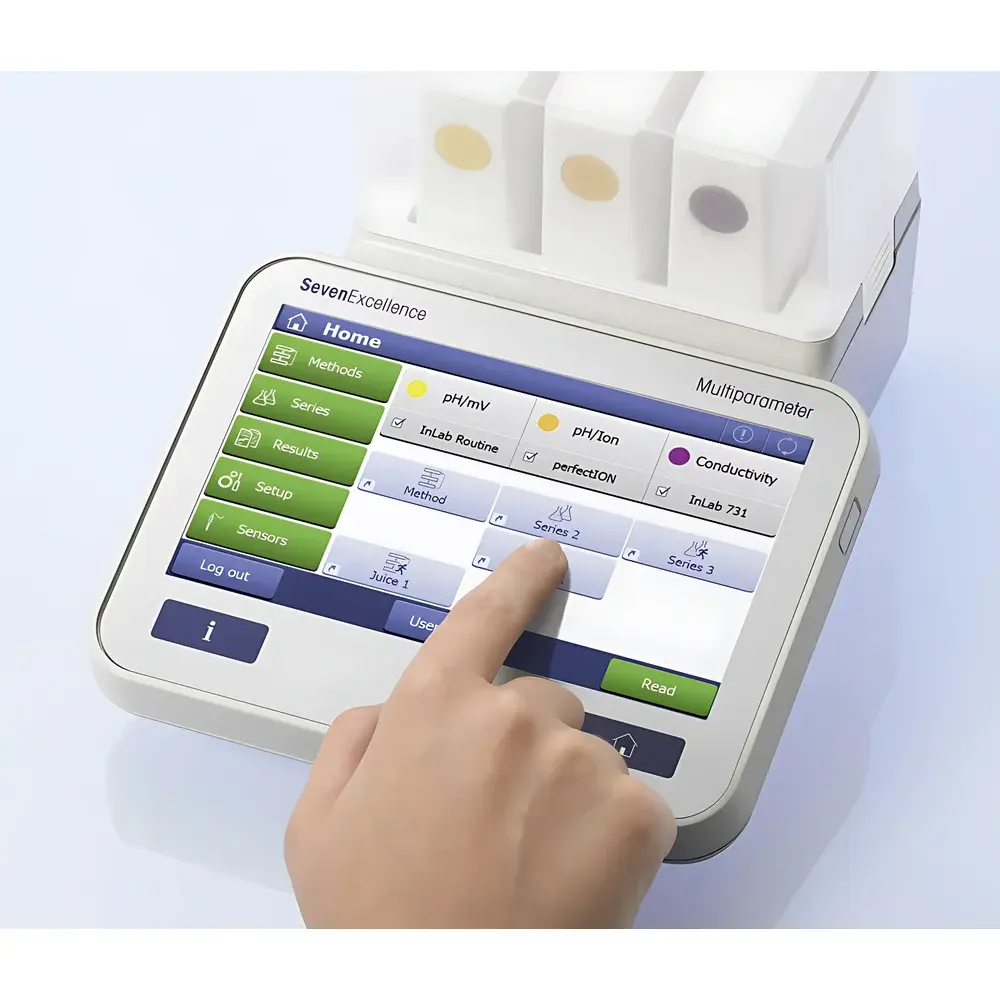
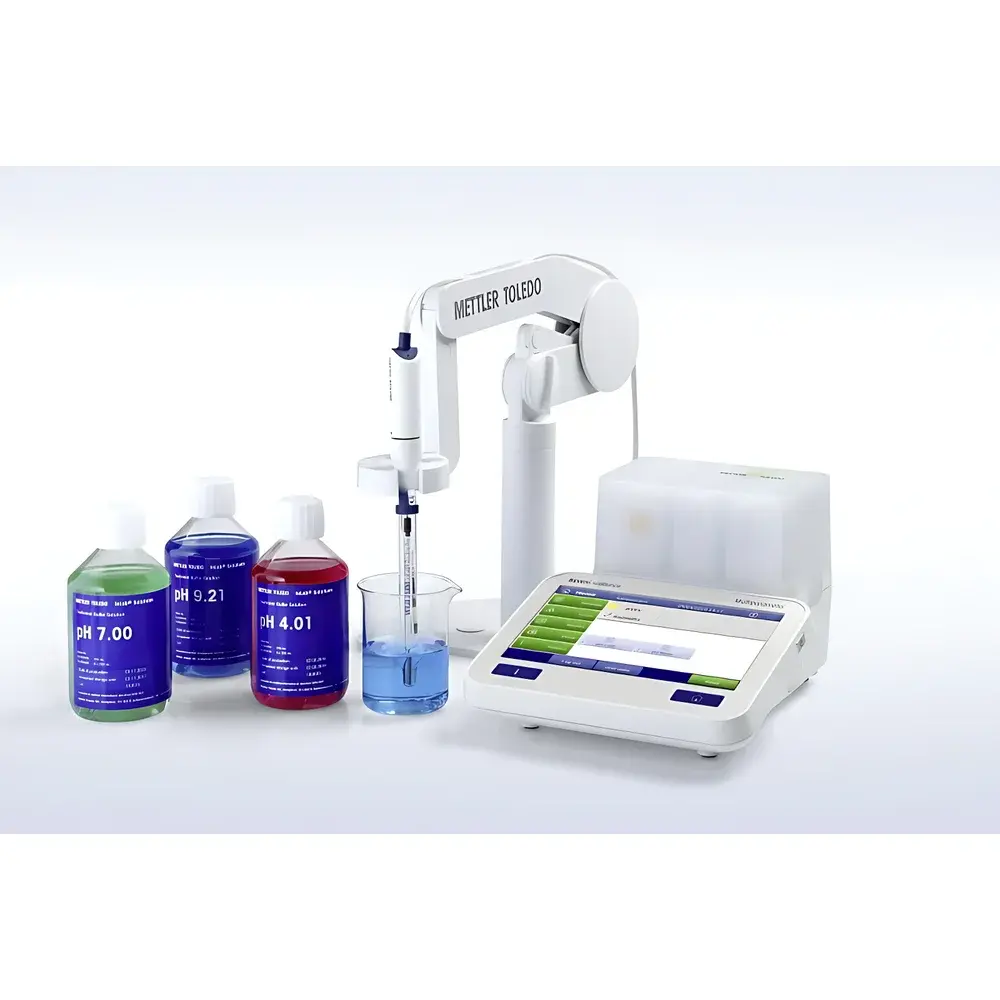
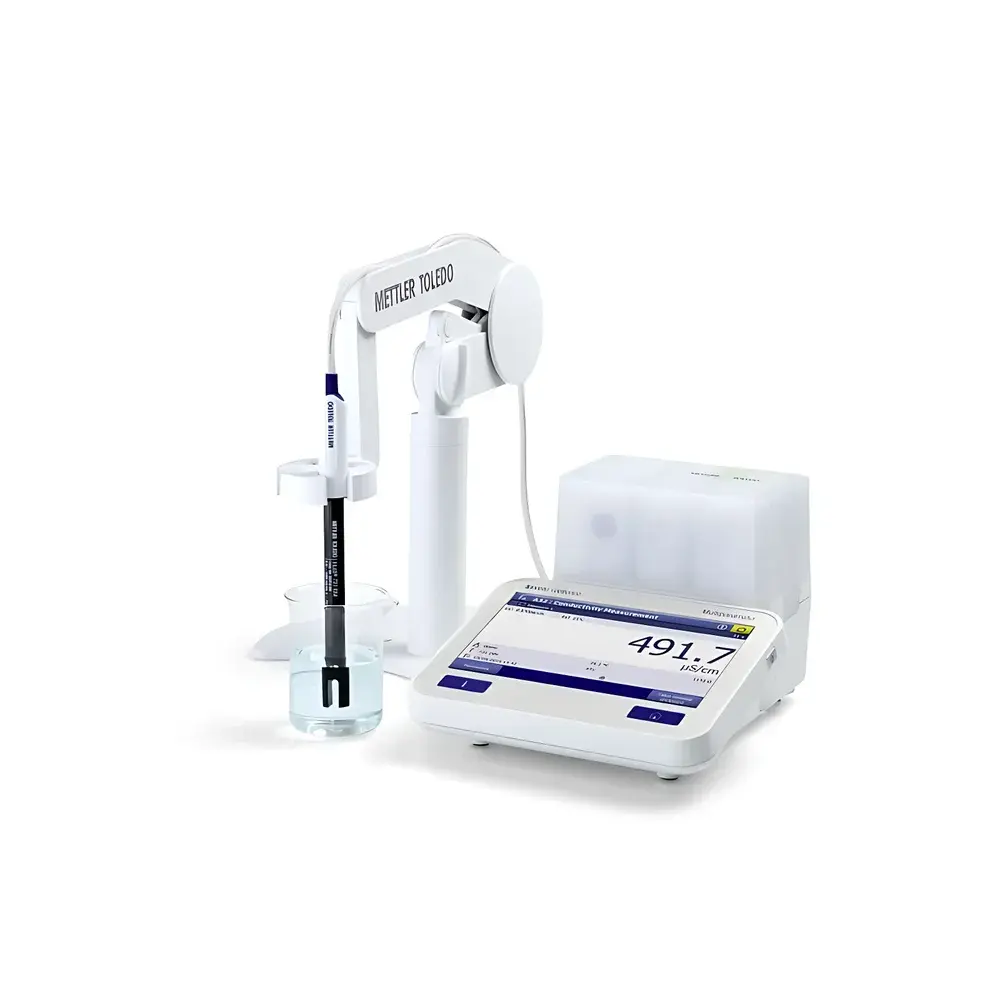
METTLER TOLEDO SevenExcellence S400/S470/S500/S700 Modular pH/Conductivity/Ion Meter
| Brand | METTLER TOLEDO |
|---|---|
| Origin | Shanghai, China |
| Model Range | S400 (pH/mV/ISFET), S470 (pH/mV/ISFET + Conductivity/TDS/Salinity/Resistivity/Conductivity Ash), S500 (pH/mV/Ion Concentration), S700 (Conductivity/TDS/Salinity/Resistivity/Conductivity Ash) |
| Measurement Range | –2.000 to 20.000 pH |
| Resolution | 0.001 / 0.01 / 0.1 pH |
| Accuracy | ±0.002 pH |
| mV Range | –2000.0 to +2000.0 mV |
| mV Resolution | 0.1 / 1 mV |
| mV Accuracy | ±0.1 mV |
| Conductivity Range | 0.001 µS/cm to 2000 mS/cm |
| Conductivity Accuracy | ±0.5% |
| Temperature Range (ATC/MTC) | –30.0 to 130.0 °C |
| Temperature Accuracy | ±0.1 °C |
| Data Storage | 20,000 data points, 250 analytical result sets |
| Compliance | GLP-compliant data handling, ISO/IEC 17025-ready workflows, supports 21 CFR Part 11 audit trails via LabX software |
Overview
The METTLER TOLEDO SevenExcellence modular platform represents a paradigm shift in laboratory electrochemical instrumentation—engineered for precision, traceability, and adaptability across regulated and research-intensive environments. Unlike fixed-function benchtop meters, the SevenExcellence system is built on a scalable, three-channel hardware architecture that accepts interchangeable measurement modules: S400 (pH/mV/ISFET), S470 (dual-channel pH + conductivity), S500 (pH/mV/ion concentration), and S700 (dedicated conductivity suite). Each module implements potentiometric, conductimetric, or ion-selective electrode (ISE) principles under strict adherence to IUPAC-recommended measurement protocols. The system’s core measurement engine complies with ASTM D1293 (pH of water), ASTM D5391 (conductivity of pure water), and ISO 7888 (electrical conductivity of water), ensuring metrological consistency across pharmaceutical QC, food safety testing, chemical process validation, and academic electrochemistry labs.
Key Features
- Modular Three-Channel Architecture: Expand functionality without replacing hardware—add pH, conductivity, or ion modules independently; all share unified firmware, calibration history, and user permissions.
- ISM® (Intelligent Sensor Management): Automatic electrode recognition via digital chip interface; stores sensor type, serial number, calibration history, and expiry dates; prevents mismatched calibrations and enforces sensor lifecycle control.
- OneClick™ Method Execution: Predefined SOPs—including multi-point pH calibration (2–5 buffers), conductivity cell constant verification, or ion standard addition sequences—are launched with single-touch activation and enforce parameter locking per method.
- uFocus™ Display Mode: Context-aware UI that suppresses non-essential fields during active measurement—showing only real-time value, stability indicator, temperature, and electrode status—to reduce cognitive load and minimize operator error.
- uPlace™ Electrode Holder: Ergonomic, vertically adjustable stand with integrated cable management and quick-release mechanism; enables one-handed electrode immersion while maintaining consistent depth and preventing vessel contact or probe damage.
- GLP-Compliant Data Integrity: Four-tier user roles (Operator, Supervisor, QA, Administrator); password-protected method editing; automatic timestamping; full audit trail for all calibrations, measurements, and configuration changes; meets ALCOA+ principles for raw data preservation.
Sample Compatibility & Compliance
The SevenExcellence platform accommodates aqueous, viscous, low-ionic-strength, and high-salinity samples through configurable electrode selection (e.g., InLab® Science for general use, InLab® Routine Pro for turbid media, or InLab® Pure for ultrapure water). All modules support automatic temperature compensation (ATC) using Pt1000 or NTC sensors, and endpoint detection modes include manual hold, auto-stable (±0.1 mV/0.002 pH over 10 s), and timed acquisition. Regulatory alignment includes full support for FDA 21 CFR Part 11 when paired with LabX software—enabling electronic signatures, role-based access, and immutable audit logs. Instrument qualification documentation (DQ/IQ/OQ) templates are provided per GMP Annex 15 and EU GMP Chapter 4 requirements.
Software & Data Management
Data capture and reporting are fully integrated via LabX direct pH software (included) or enterprise-grade LabX software (optional). LabX direct pH enables real-time graphing, statistical summaries (mean, SD, RSD, confidence intervals), and export to CSV, PDF, or Excel—retaining metadata (operator ID, timestamp, electrode ID, calibration certificate reference). For networked labs, LabX centralizes instrument fleets, enforces global method libraries, and generates automated compliance reports for internal audits or regulatory inspections. U disk export preserves full context—including calibration curves, raw mV readings, and temperature logs—without requiring software installation on client machines.
Applications
- Pharmaceutical & Biotechnology: USP pH verification of injectables, buffer preparation, and dissolution media; conductivity testing per EP 2.2.38 for Water for Injection (WFI).
- Food & Beverage: pH monitoring in dairy fermentation, meat processing, and beverage acidification; TDS/salinity profiling in brine solutions and sauces.
- Chemical & Petrochemical: Corrosion inhibitor efficacy testing via pH drift analysis; conductivity-based purity assessment of solvents and catalyst slurries.
- Academic Research: Multi-ion titrations (e.g., Ca²⁺, F⁻, NH₄⁺) with dynamic slope correction; long-term stability studies of reference electrodes under variable temperature gradients.
- Environmental Testing: Field-deployable calibration verification using portable standards; resistivity mapping of deionized rinse water in semiconductor cleaning lines.
FAQ
Does the SevenExcellence system support ISO/IEC 17025-compliant uncertainty estimation?
Yes—calibration uncertainty contributions (buffer tolerance, temperature effect, electrode repeatability) are programmable per method; combined uncertainty is calculated and reported alongside each measurement.
Can the S470 module perform simultaneous pH and conductivity measurements on the same sample?
Yes—the dual-channel design allows concurrent, time-synchronized acquisition from separate pH and conductivity electrodes, with shared temperature compensation and unified data logging.
Is ISFET electrode support limited to specific models?
ISFET compatibility is native to the S400 and S470 modules; no additional hardware or license is required—full sensor diagnostics and drift monitoring are enabled out-of-the-box.
How does the system handle electrode calibration outside certified buffer ranges?
The meter enforces buffer validity checks using embedded NIST-traceable pH values; deviations >±0.05 pH trigger warning flags and prevent method execution until resolution.
What peripheral devices are validated for GxP use with this platform?
Rondolino automated samplers, uMix magnetic stirrers, and certified thermal printers (e.g., Zebra ZD420) are qualified for 21 CFR Part 11 environments when deployed with LabX software and documented IQ/OQ protocols.






