
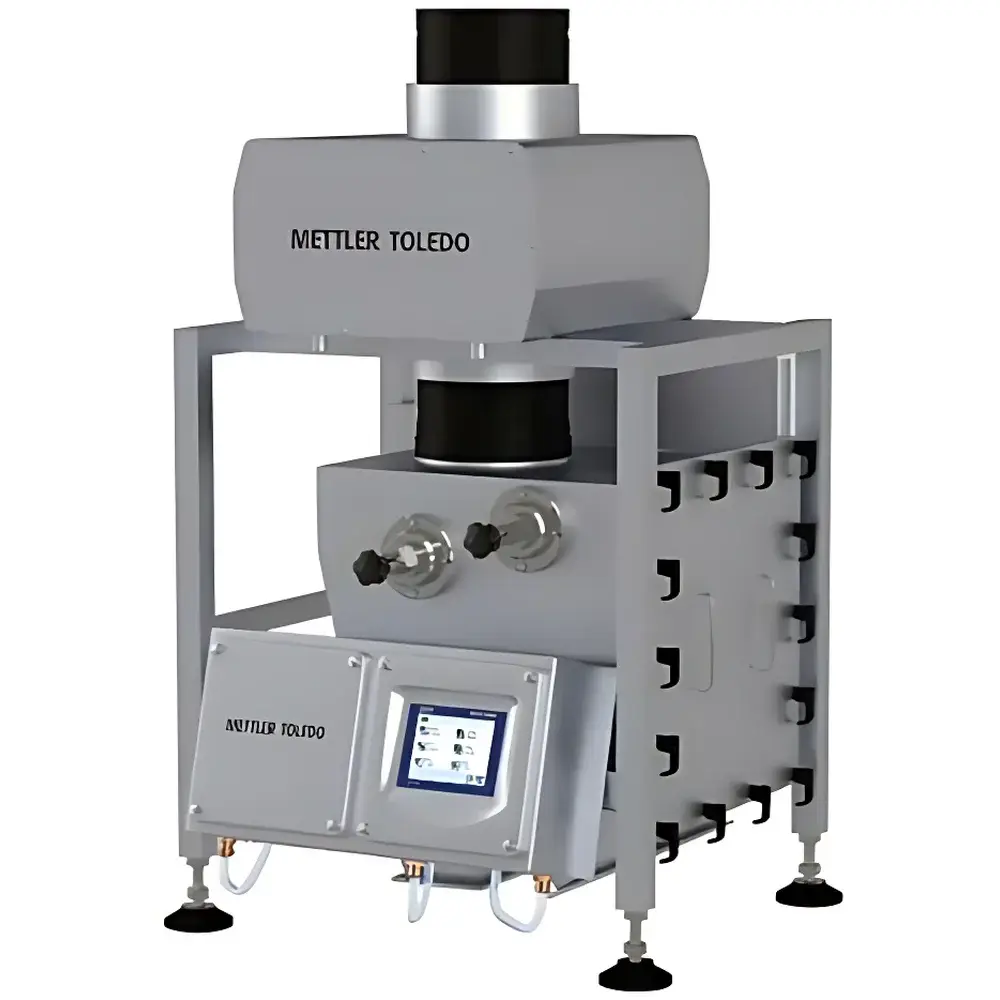
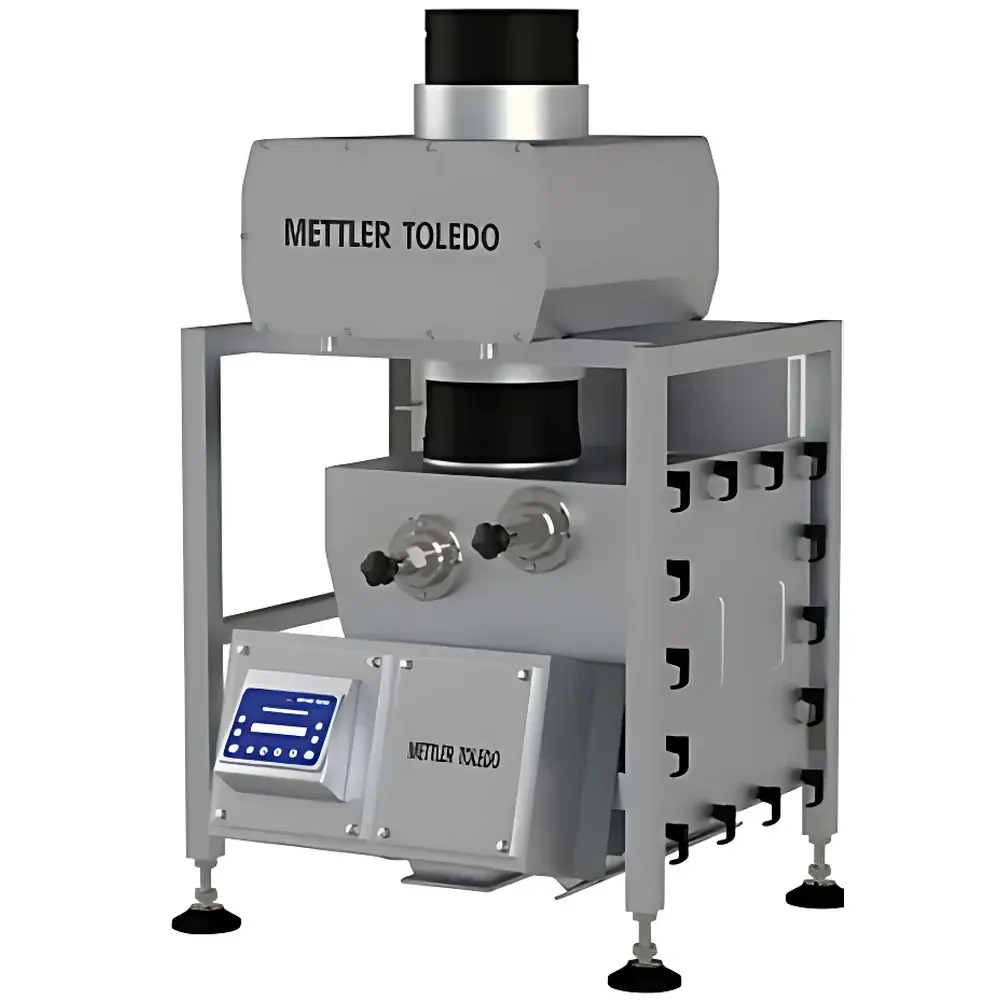
METTLER TOLEDO Signature/Profile Gravity-Fed Vertical Metal Detection System
| Brand | METTLER TOLEDO |
|---|---|
| Origin | United Kingdom |
| Manufacturer Type | Authorized Distributor |
| Origin Category | Imported |
| Model | Signature/Profile |
| Pricing | Upon Request |
Overview
The METTLER TOLEDO Signature and Profile Gravity-Fed Vertical Metal Detection Systems are engineered for high-sensitivity, in-line detection of ferrous, non-ferrous, and stainless steel contaminants in free-falling dry bulk materials. Operating on the principle of balanced coil electromagnetic induction, these systems generate a stable, uniform magnetic field across the product stream; metallic foreign bodies disrupt this field, triggering precise signal analysis via digital signal processing (DSP) algorithms. Designed specifically for vertical gravity-fed applications—where product flows unassisted through the detector aperture—the systems eliminate conveyor belt interference and minimize false rejects caused by product effect or moisture variability. Their compact vertical architecture enables integration into existing processing lines with minimal headroom requirements, making them ideal for retrofit installations in space-constrained food, pharmaceutical, chemical, and agricultural facilities.
Key Features
- High-sensitivity detection of all metal types—including austenitic stainless steel (e.g., 304, 316), which exhibits low magnetic permeability and high electrical resistivity—achieving detection limits down to Ø0.3 mm spherical equivalents under typical operating conditions.
- Dual-platform control interface: Signature model features a sealed membrane keypad with tactile feedback and IP65-rated front panel; Profile model integrates a full-color, capacitive-touch HMI with intuitive icon-driven navigation and real-time status visualization.
- Integrated rejection mechanisms including Sealtite® pneumatic divert valves (optimized for fine powders and dust-laden streams to prevent cross-contamination), Open-Style divert valves (for granular or friable products), and Y-branch divert configurations for multi-stream routing.
- ATEX-certified variants available (II 2G Ex db IIB T4 Gb / II 2D Ex tb IIIC T100°C Db) for use in Zone 1/21 hazardous areas involving combustible dusts or vapors.
- Modular electronics architecture with dual-redundant microprocessors, self-diagnostics, and automatic gain stabilization to maintain consistent sensitivity across ambient temperature fluctuations (10–40 °C) and product density variations.
Sample Compatibility & Compliance
These systems accommodate a broad range of dry, free-flowing materials—including flour, sugar, spices, dairy powders, tea leaves, plastic pellets, and fertilizer granules—with particle sizes ranging from sub-100 µm fines to irregular objects up to 50 mm in maximum dimension. Product throughput rates are scalable from 0.5 to 12 t/h depending on aperture size (standard options: 150 × 150 mm to 300 × 300 mm) and material density. The systems comply with IEC 60601-1 (medical electrical equipment safety), IEC 61000-6-2/-4 (EMC immunity and emissions), and are designed to support regulatory alignment with FDA 21 CFR Part 11 (electronic records/signatures), EU Annex 11 (computerized systems), and GMP/GLP documentation requirements. Optional audit trail logging and user access level management (Operator, Supervisor, Administrator) facilitate compliance validation.
Software & Data Management
Both Signature and Profile platforms run on METTLER TOLEDO’s proprietary detection firmware, featuring embedded event logging with time-stamped reject records, sensitivity calibration history, and system fault diagnostics. The Profile HMI supports USB export of CSV-formatted logs and optional Ethernet/IP or Modbus TCP connectivity for integration into SCADA or MES platforms (e.g., Siemens SIMATIC, Rockwell FactoryTalk). All configuration changes—including sensitivity thresholds, rejection delay timing, and product-specific memory profiles—are password-protected and recorded in an immutable audit trail. Firmware updates are performed via secure USB drive with SHA-256 signature verification to ensure integrity and traceability.
Applications
- Food manufacturing: detection of metal fragments in flour milling, instant beverage powder blending, confectionery ingredient dosing, and pet food extrusion feed streams.
- Pharmaceutical excipient handling: verification of stainless steel sieve mesh debris or tooling wear particles in lactose, microcrystalline cellulose, or starch-based blends prior to tableting or capsule filling.
- Chemical and agrochemical production: safeguarding catalyst carriers, pesticide granules, and fertilizer compounds during bagging or silo loading operations.
- Recycled polymer processing: identification of metallic contaminants in post-consumer PET or PP flake streams prior to extrusion.
FAQ
What is the minimum detectable stainless steel sphere size under standard calibration conditions?
Detection capability depends on product effect, aperture size, and throughput; typical validated limits range from Ø0.3 mm to Ø0.8 mm for 304 stainless steel in low-conductivity powders at nominal flow rates.
Can the system be validated per ISO 22000 or BRCGS requirements?
Yes—METTLER TOLEDO provides IQ/OQ documentation templates, sensitivity test kits (including certified test pieces per ISO 22000 Annex C), and on-site qualification support aligned with BRCGS Issue 9 Section 4.9.3.
Is remote monitoring or cloud-based data aggregation supported?
While native cloud connectivity is not embedded, the Profile model’s Modbus TCP or Ethernet/IP interface enables third-party middleware integration for centralized dashboarding and predictive maintenance analytics.
How often does the system require recalibration?
Calibration stability is verified during daily pre-operational checks; full electronic calibration is recommended every 6 months or after mechanical impact, firmware update, or environmental relocation.
Does the Sealtite valve prevent product leakage during rejection?
Yes—Sealtite technology employs synchronized dual-piston actuation and positive-seal geometry to isolate the reject stream, eliminating carryover into the main product line, even for cohesive or electrostatically charged powders.



