
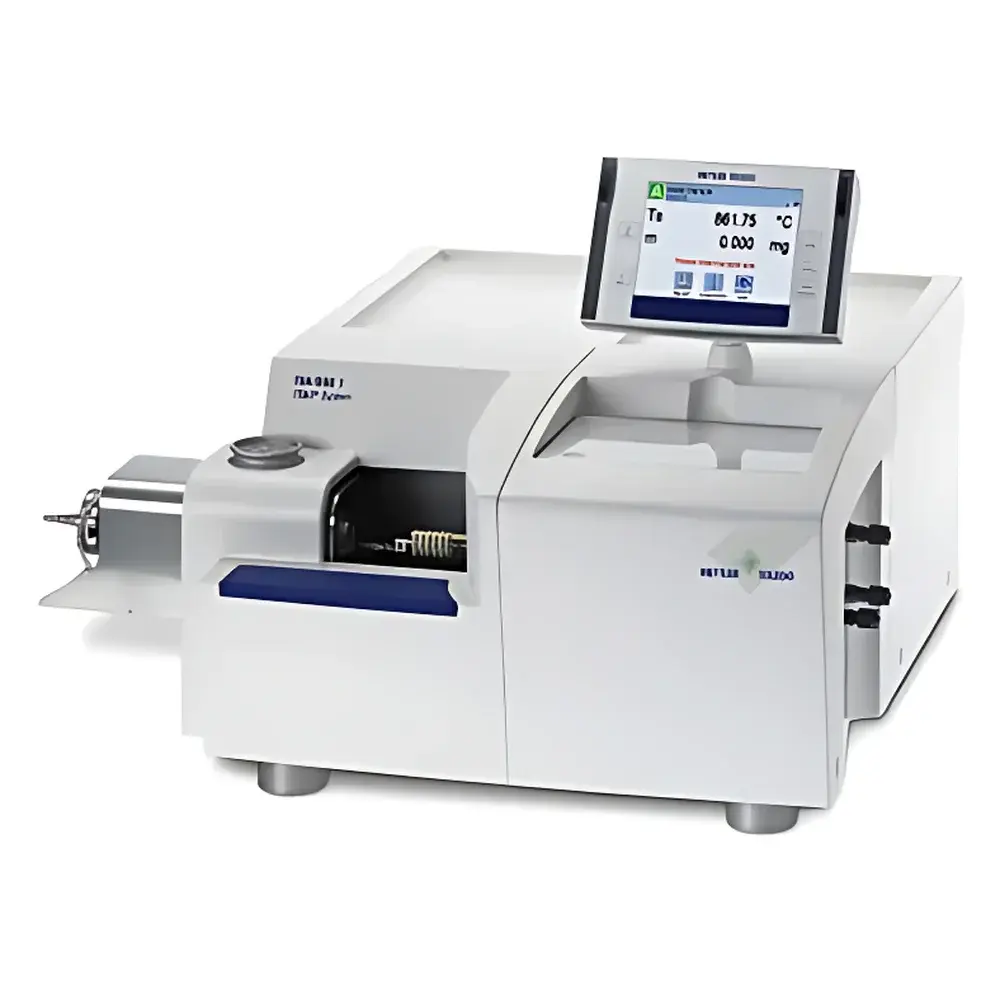
METTLER TOLEDO TGA/DSC 1 Excellence Simultaneous Thermal Analyzer
| Brand | METTLER TOLEDO |
|---|---|
| Origin | Switzerland |
| Model | TGA/DSC 1 Excellence |
| Temperature Range | RT to 1100 °C or RT to 1600 °C |
| Balance Sensitivity | 0.1 µg or 0.01 µg |
| DSC Sensor | 6-pair Pt/Pt–Rh thermocouples |
| Heat Flow Resolution | 0.00003 °C |
| Enthalpy Accuracy (metal standards) | ±1% |
| Compliance | ASTM E1131, ISO 11358, USP <1234>, FDA 21 CFR Part 11 (with optional audit trail) |
Overview
The METTLER TOLEDO TGA/DSC 1 Excellence Simultaneous Thermal Analyzer is an advanced benchtop instrument engineered for precise, real-time concurrent measurement of mass change (thermogravimetry, TGA) and heat flow (differential scanning calorimetry, DSC) under controlled thermal conditions. Based on the fundamental principles of thermoanalytical coupling—where sample mass loss/gain and endo-/exothermic transitions are recorded in a single, synchronized experiment—the system delivers high-fidelity data essential for material characterization across R&D, quality control, and regulatory compliance workflows. Its design traces lineage to METTLER’s pioneering 1964 commercial TGA/DTA instrument, with continuous refinement culminating in the Excellence platform’s robust architecture, thermal stability, and metrological traceability. The instrument operates across two standard temperature ranges—RT to 1100 °C for general-purpose applications, or RT to 1600 °C for high-temperature ceramics, refractories, and metallurgical studies—enabling broad applicability without hardware compromise.
Key Features
- Ultra-microbalance core: Incorporates METTLER TOLEDO’s proprietary monolithic quartz suspension balance with active drift compensation, delivering verified sensitivity down to 0.01 µg and long-term baseline stability under dynamic heating conditions.
- 6-pair Pt/Pt–Rh thermocouple DSC sensor: A proprietary star-configured sensor array derived from METTLER’s multi-thermocouple DSC technology, providing enhanced signal-to-noise ratio, improved peak resolution (ΔT < 0.1 °C for overlapping transitions), and superior reproducibility across thermal scan rates from 0.01 to 200 °C/min.
- Hermetically sealed furnace chamber: Equipped with integrated gas purging (N₂, Ar, O₂, synthetic air), vacuum capability (<10⁻² mbar), and pressure regulation (up to 10 bar optional), ensuring fully defined and repeatable atmospheres for oxidative stability, decomposition kinetics, or moisture-sensitive analyses.
- Modular expandability: Designed for seamless integration with hyphenated techniques—including quadrupole mass spectrometry (MS), Fourier-transform infrared spectroscopy (FTIR), and humidity-controlled sorption modules—enabling evolved gas analysis (EGA), desorption profiling, and dynamic vapor sorption (DVS) studies.
- Automated sample handling: Optional 48-position robotic autosampler supports unattended operation with programmable crucible selection (alumina, platinum, gold-plated), lid management, and thermal history tracking—critical for high-throughput QC labs operating under GLP or GMP frameworks.
Sample Compatibility & Compliance
The TGA/DSC 1 Excellence accommodates solid powders, granules, films, fibers, tablets, and small metallic specimens (max. 500 mg) in standard crucibles (30–70 µL volume). It complies with internationally recognized thermal analysis standards including ASTM E1131 (TGA), ASTM E1269 (DSC heat capacity), ISO 11358 (polymer TGA), and USP (thermal analysis of pharmaceuticals). When configured with electronic signature, audit trail, and user access control modules, the system meets FDA 21 CFR Part 11 requirements for regulated environments. All calibration procedures follow ISO/IEC 17025 traceable protocols using certified reference materials (e.g., Ni, In, Zn, Al₂O₃).
Software & Data Management
Powered by STARe Evaluation Software (v18.x), the system provides full workflow control—from method definition and real-time monitoring to kinetic modeling (e.g., Kissinger, Ozawa–Flynn–Wall), derivative thermogravimetric (DTG) analysis, and multi-step deconvolution of overlapping DSC peaks. Raw data are stored in vendor-neutral .tdms format; export options include CSV, ASCII, and XML for LIMS integration. The software supports automated report generation compliant with SOP templates, version-controlled method libraries, and secure electronic records with time-stamped operator logs.
Applications
This analyzer serves critical functions in polymer science (degradation onset, filler content, crosslink density), pharmaceutical development (polymorph screening, excipient compatibility, residual solvent quantification), food science (moisture loss, starch gelatinization, lipid oxidation), and advanced materials (catalyst decomposition, battery electrode stability, ceramic sintering behavior). Its dual-signal fidelity enables direct correlation between mass loss events (e.g., dehydration, pyrolysis) and corresponding enthalpic signatures—essential for mechanistic interpretation in patent support, regulatory filings, and failure analysis.
FAQ
What is the maximum sample weight capacity for quantitative TGA analysis?
Standard operation recommends ≤100 mg for optimal resolution and signal linearity; up to 500 mg is supported for screening or high-mass industrial samples, with appropriate baseline correction.
Can the instrument perform isothermal TGA or modulated DSC (MDSC)?
Yes—full programmable temperature profiles include isothermal holds, step scans, and MDSC modes (with optional Q5000 IR module) for separating reversing and non-reversing heat flow components.
Is remote monitoring and control supported?
The system integrates with METTLER TOLEDO’s LabX PC-based platform, enabling secure remote access, centralized instrument management, and cloud-synced data backup via validated network configurations.
How often does the balance require recalibration?
Automatic internal calibration occurs at startup and after major temperature excursions; external verification with certified weights is recommended per ISO/IEC 17025 intervals (typically every 3–6 months depending on usage frequency and audit requirements).
Are application-specific methods preloaded in the software?
STARe includes >120 validated method templates aligned with ASTM, ISO, and USP monographs—including polymer ash content (ASTM D5630), drug purity (USP ), and metal oxide reduction (ISO 11358-2)—all editable and SOP-compliant.



