
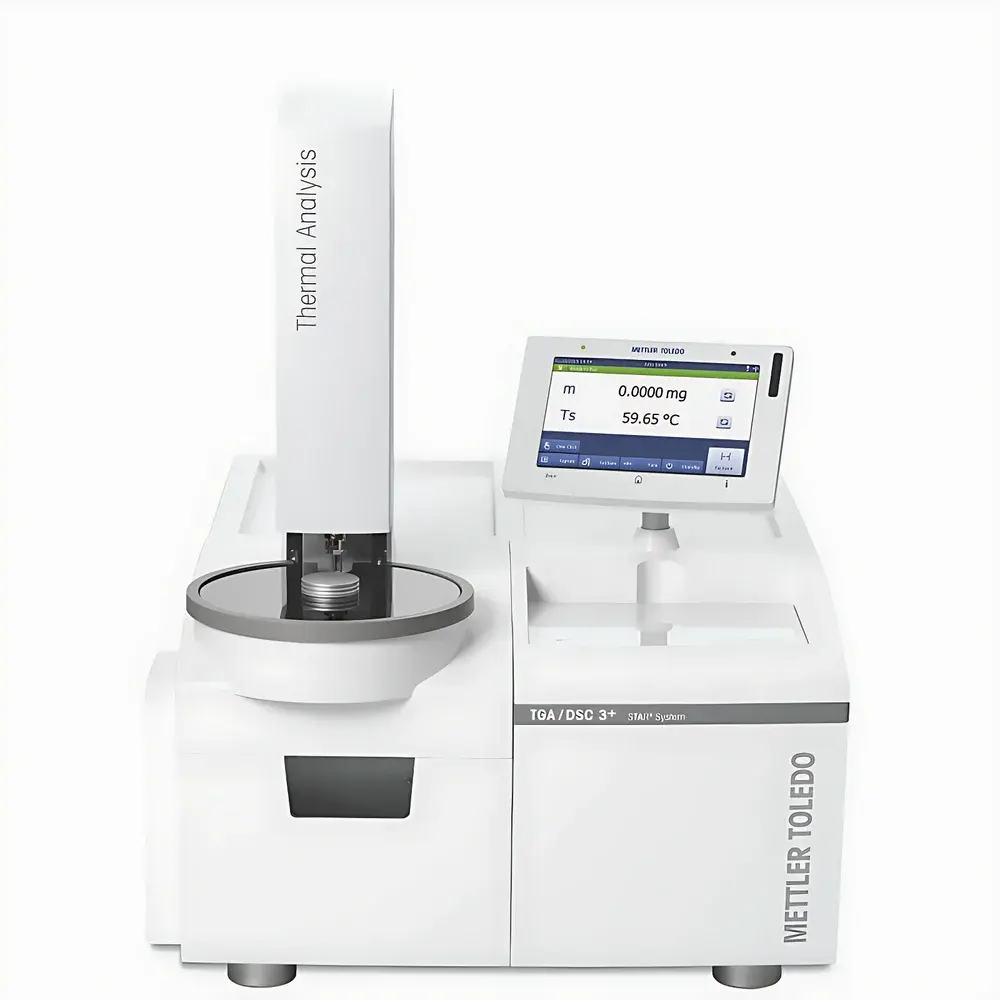
METTLER TOLEDO TGA/DSC 3+ Advanced Simultaneous Thermal Analyzer
| Brand | METTLER TOLEDO |
|---|---|
| Origin | Switzerland |
| Model | TGA/DSC 3+ Advanced |
| Temperature Range | RT to 1100 °C / 1600 °C |
| Temperature Accuracy | ±0.05 K |
| Balance Sensitivity | 0.1 µg |
| Heating/Cooling Rate | 0.02–150 K/min / 0.02–250 K/min |
| DSC Sensor | 6-pair Pt/Pt-Rh thermocouples |
| Simultaneous Measurement Capability | Yes |
| Modular Configuration | Standard |
| Compliance Ready | ASTM E1131, ISO 11358, USP <1163>, FDA 21 CFR Part 11 (with optional software module) |
Overview
The METTLER TOLEDO TGA/DSC 3+ Advanced Simultaneous Thermal Analyzer is an engineered platform for precise, synchronized measurement of mass change (thermogravimetry, TGA) and heat flow (differential scanning calorimetry, DSC) under controlled thermal conditions. Based on the fundamental principles of thermogravimetric analysis—where sample mass is continuously monitored as a function of temperature or time—and differential scanning calorimetry—where heat flux differences between sample and reference are quantified—the instrument delivers high-fidelity data for compositional, kinetic, and thermal stability analysis. Its dual-sensor architecture enables true simultaneous acquisition without temporal offset, ensuring strict correlation between mass loss events (e.g., decomposition, volatilization, oxidation) and associated enthalpic transitions (e.g., glass transitions, melting, crystallization, curing). Designed and manufactured in Switzerland, the system reflects over five decades of thermal analysis innovation since METTLER TOLEDO’s first commercial TGA/DTA instrument in 1964.
Key Features
- Ultra-microbalance with 0.1 µg sensitivity and active drift compensation, optimized for long-term stability across wide dynamic ranges
- High-resolution 6-pair platinum/platinum-rhodium thermocouple DSC sensor, delivering superior signal-to-noise ratio and baseline reproducibility
- Extended temperature capability: standard operation from room temperature to 1100 °C; high-temperature furnace option extends range to 1600 °C with inert or reactive gas environments
- Programmable heating and cooling rates from 0.02 to 150 K/min (standard) or up to 250 K/min (high-speed mode), enabling both slow-scan kinetic studies and rapid thermal profiling
- Hermetically sealed, gas-tight measurement chamber with integrated mass flow controllers and pressure regulation—compatible with inert (N₂, Ar), oxidative (air, O₂), or reducing (H₂, forming gas) atmospheres
- Fully modular architecture supporting field-upgradable components including automatic sample changers (up to 48 positions), vacuum systems, and interface modules for hyphenated techniques
Sample Compatibility & Compliance
The TGA/DSC 3+ accommodates solid, powder, fiber, and thin-film samples in standard ceramic, alumina, or platinum crucibles (including hermetic and high-pressure variants). It supports quantitative moisture analysis via integrated humidity control modules and complies with international standards governing thermal characterization—including ASTM E1131 (TGA), ISO 11358 (polymer TGA), ISO 17514 (DSC calibration), and USP (thermal analysis in pharmaceutical development). When configured with METTLER TOLEDO’s STARe software and audit trail module, the system meets FDA 21 CFR Part 11 requirements for electronic records and signatures in regulated GMP/GLP environments.
Software & Data Management
STARe Evaluation Software provides comprehensive instrument control, real-time data visualization, and advanced post-processing—including peak deconvolution, kinetic modeling (e.g., Kissinger, Ozawa-Flynn-Wall), multi-step decomposition fitting, and derivative thermogravimetry (DTG). All raw and processed data are stored in secure, timestamped project files with full metadata traceability. Optional database integration supports LIMS connectivity and automated report generation compliant with ISO/IEC 17025 documentation protocols.
Applications
This analyzer serves critical roles across R&D, quality assurance, and production support laboratories. In polymer science, it characterizes filler content, degradation onset, residual solvent, crosslink density, and thermal oxidative stability. In pharmaceuticals, it validates polymorphic form transitions, excipient compatibility, desolvation behavior, and stability-indicating assay performance. In food science, it quantifies moisture, fat, ash, and carbohydrate decomposition profiles. Additional applications span battery materials (cathode/anode decomposition, SEI formation), catalysts (thermal stability, coke burn-off), ceramics (sintering kinetics), and nanocomposites (filler dispersion and interfacial interactions).
FAQ
What gases can be used with the TGA/DSC 3+?
Standard configurations support N₂, air, O₂, Ar, He, CO₂, and forming gas (N₂/H₂); custom gas manifolds enable switching between up to four gases during a single run.
Is vacuum operation possible?
Yes—optional vacuum pump integration achieves pressures down to 10⁻² mbar, essential for low-volatility compound analysis and pyrolysis studies.
Can the system be coupled to mass spectrometry or FTIR?
Yes—dedicated evolved gas analysis (EGA) interfaces provide heated transfer lines (up to 300 °C) and flow-splitting capabilities for seamless coupling to QMS, TOF-MS, or FTIR spectrometers.
How is calibration performed?
Temperature calibration uses certified metal standards (In, Sn, Zn, Ag, Au) per ISO 17514; enthalpy calibration employs high-purity indium and zinc; mass calibration utilizes certified weights traceable to national metrology institutes.
What level of automation is supported?
The optional RoboReady™ auto-sampler handles up to 48 samples unattended, with programmable crucible weighing, lid placement, and purge gas conditioning—fully integrated into STARe workflow scheduling.



