
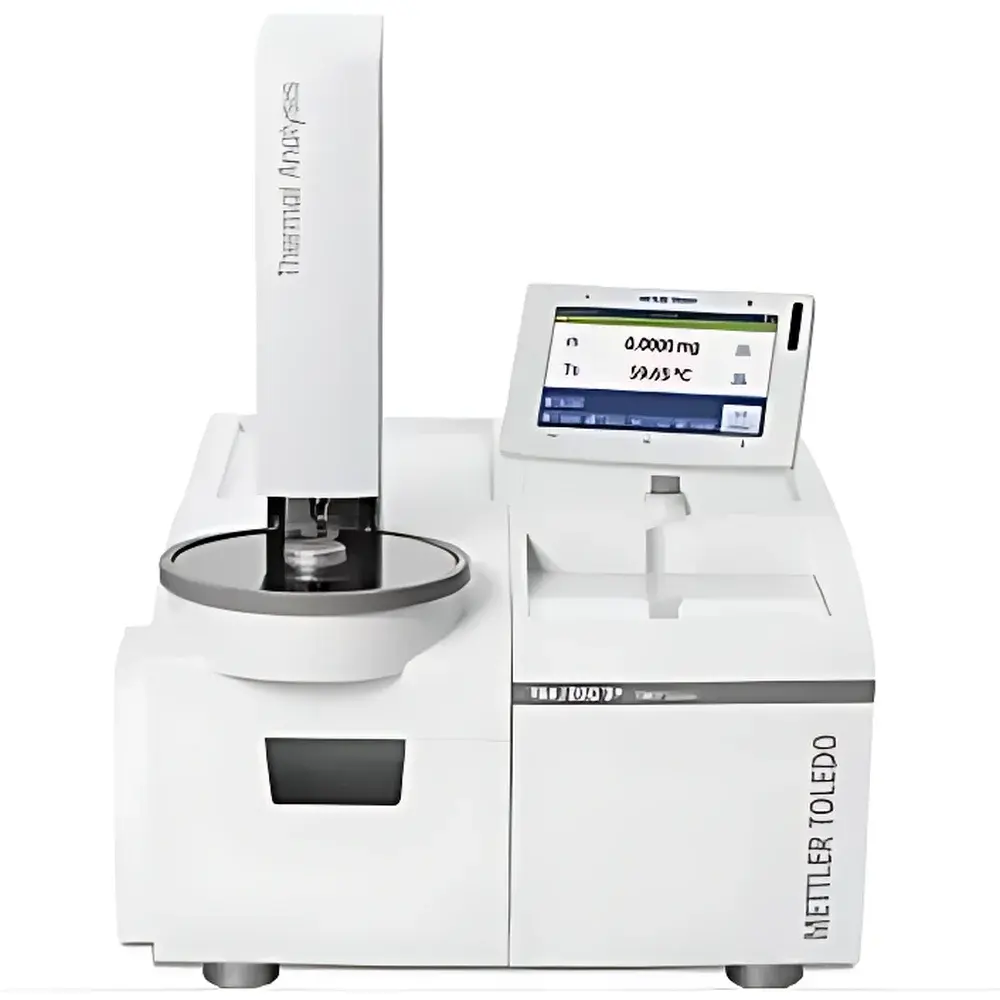
METTLER TOLEDO TGA/DSC 3+ Simultaneous Thermal Analyzer – Premium Configuration
| Brand | METTLER TOLEDO |
|---|---|
| Origin | Switzerland |
| Model | TGA/DSC 3+ |
| Temperature Range | RT to 1100 °C / 1600 °C |
| Temperature Accuracy | ±0.05 K |
| Balance Sensitivity | 0.1 µg |
| Heating/Cooling Rate | 0.02–150 K/min / 0.02–250 K/min |
| DSC Sensor | 6-pair Pt/Pt–Rh thermocouples |
| Sample Capacity | Multi-sample (with optional autosampler) |
| Instrument Type | Modular, general-purpose simultaneous TGA/DSC |
Overview
The METTLER TOLEDO TGA/DSC 3+ Simultaneous Thermal Analyzer is an advanced, modular benchtop instrument engineered for precise, synchronized measurement of mass change (thermogravimetry, TGA) and heat flow (differential scanning calorimetry, DSC) under controlled thermal conditions. Based on the fundamental principles of thermogravimetric analysis—where sample mass is continuously monitored as a function of temperature or time—and differential scanning calorimetry—where heat flux differences between sample and reference are quantified—the TGA/DSC 3+ delivers high-fidelity dual-signal acquisition in a single run. Its design traces back to METTLER TOLEDO’s pioneering commercial TGA/DTA systems introduced in 1964, with continuous evolution culminating in the 2015 launch of the TGA/DSC 3+ platform. The instrument employs a proprietary ultra-microbalance with 0.1 µg resolution, coupled with a symmetrical, star-arranged 6-pair platinum/platinum–rhodium thermocouple DSC sensor. This architecture enables true simultaneous detection of thermal events—including decomposition, oxidation, phase transitions, crystallization, and glass transitions—with exceptional signal-to-noise ratio and baseline stability across its full operating range.
Key Features
- Ultra-microbalance technology: High-stability, electromagnetic force-compensation balance with 0.1 µg sensitivity and long-term drift < 0.5 µg/h, ensuring reproducible mass tracking over extended experiments.
- Extended temperature capability: Dual furnace configuration supports operation from ambient to 1100 °C (standard) or up to 1600 °C (high-temperature option), with programmable heating/cooling rates spanning 0.02–150 K/min (standard) or 0.02–250 K/min (high-speed option).
- High-resolution DSC sensor: Six symmetrically arranged Pt/Pt–Rh thermocouple pairs provide enhanced thermal symmetry, improved signal linearity, and superior sensitivity for detecting weak endothermic or exothermic transitions.
- Hermetically sealed measurement chamber: Maintains precisely defined atmospheres (inert, oxidative, reducing) and enables vacuum operation down to <10⁻² mbar, critical for volatile decomposition studies and moisture-sensitive samples.
- Modular expandability: Supports seamless integration of optional accessories including the 56-position robotic autosampler, turbomolecular vacuum pump, quadrupole mass spectrometer (MS), Fourier-transform infrared spectrometer (FTIR), or combined MS/FTIR gas analysis systems.
- Thermal accuracy and calibration traceability: Certified temperature accuracy of ±0.05 K against ITS-90 standards; DSC enthalpy accuracy validated per ISO 11357-1 using certified metal standards (e.g., indium, zinc, tin).
Sample Compatibility & Compliance
The TGA/DSC 3+ accommodates solid powders, granules, films, fibers, and small-volume liquids in standard alumina, platinum, or gold crucibles (including hermetic and high-pressure variants). It complies with key international testing standards including ASTM E1131, ASTM E1858, ISO 11357 series (plastics), ISO 11358 (polymers), USP , and ICH Q5C for biopharmaceutical stability assessment. Its hardware and software architecture support GLP/GMP environments: audit trails, electronic signatures, and user access control align with FDA 21 CFR Part 11 requirements when configured with METTLER TOLEDO’s STARe Evaluation Software and LabX® PC-based data management suite.
Software & Data Management
Controlled via STARe Software (version 18.x or later), the system provides intuitive method setup, real-time dual-curve visualization, and automated peak identification with baseline correction algorithms. Data export conforms to ASTM E1447 and ASTM E1457 formats for interoperability with third-party analytics platforms. LabX software enables centralized instrument management, raw data archiving with SHA-256 checksums, and full traceability of operator actions, parameter changes, and calibration events—essential for regulated laboratories requiring full 21 CFR Part 11 compliance. All measurement files include embedded metadata (instrument ID, firmware version, calibration dates, environmental logs) to support ISO/IEC 17025 accreditation.
Applications
The TGA/DSC 3+ serves as a core analytical tool in R&D, quality assurance, and production support across multiple sectors. In polymer science, it characterizes thermal degradation onset, filler content, copolymer composition, and curing kinetics. For pharmaceuticals, it assesses polymorphic transitions, desolvation behavior, excipient compatibility, and thermal stability of active pharmaceutical ingredients (APIs). In food science, it quantifies moisture loss, starch gelatinization, lipid oxidation, and protein denaturation. Additional applications include catalyst deactivation profiling, battery electrode material decomposition, ceramic sintering behavior, and nanocomposite thermal stability evaluation—particularly when coupled with evolved gas analysis (EGA) modules.
FAQ
What is the maximum sample weight capacity for standard crucibles?
Standard alumina crucibles support up to 200 mg; platinum crucibles accommodate up to 100 mg depending on thermal load constraints.
Can the TGA/DSC 3+ perform isothermal TGA or stepwise DSC scans?
Yes—STARe software supports custom temperature programs including multi-step isothermal holds, dynamic ramp-and-hold sequences, and modulated DSC (TOPEM) protocols.
Is calibration required before each analysis?
No—routine calibration uses factory-certified reference materials (e.g., Ni Curie point, Al melting point); full system calibration is recommended annually or after major maintenance.
Does the instrument support purge gas switching during a single run?
Yes—integrated gas control module allows automatic switching between up to three gases (e.g., N₂ → O₂ → Ar) at predefined temperatures or times.
How is data integrity ensured in regulated environments?
LabX enforces role-based permissions, immutable audit trails, electronic signatures, and encrypted database storage—all validated per 21 CFR Part 11 Annex 11 guidelines.



