
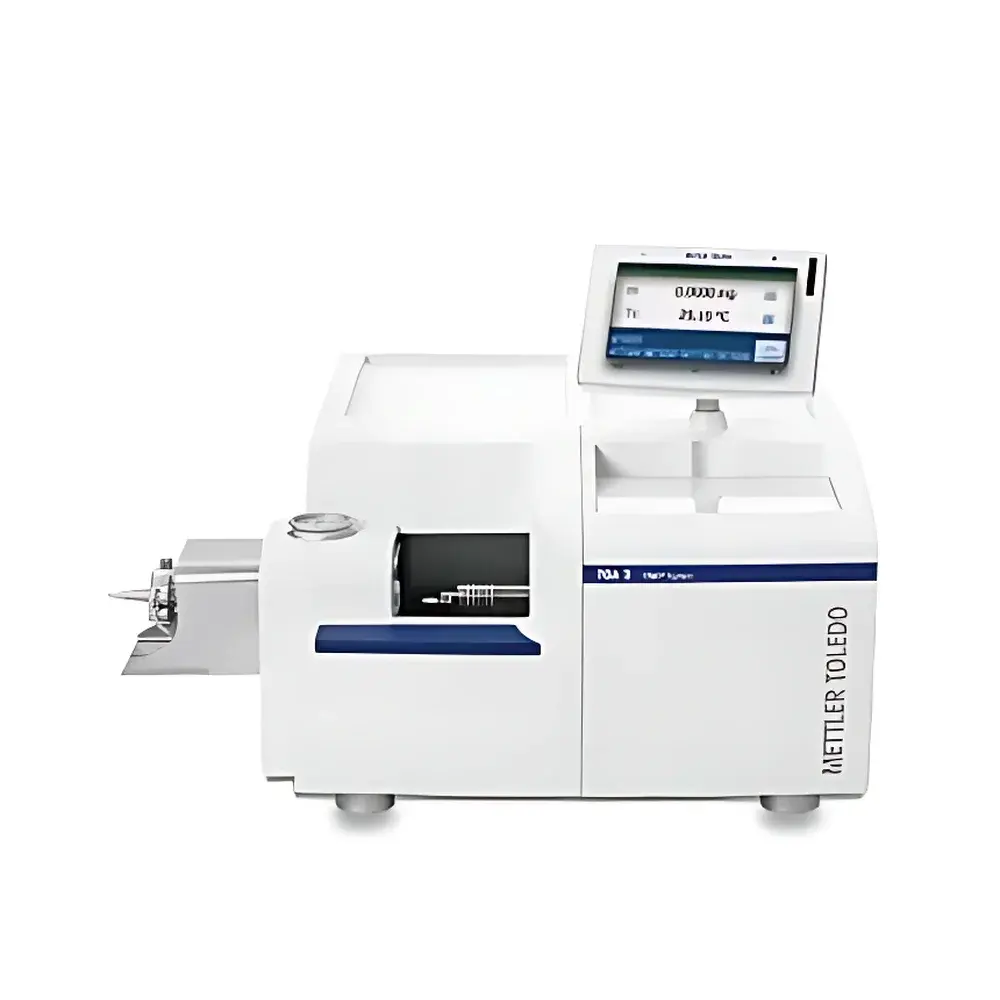
METTLER TOLEDO TGA2 Thermogravimetric Analyzer
| Brand | METTLER TOLEDO |
|---|---|
| Origin | Switzerland |
| Model | TGA2 |
| Temperature Range | RT to 1100 °C |
| Balance Sensitivity | 0.1 µg / 1 µg (depending on balance module) |
| Heating/Cooling Rate | 0.02 to 150 K/min |
| Temperature Accuracy | ±1 K |
| Blank Curve Repeatability | < ±10 µg across full temperature range |
| Sensor Type | Single-pan SDTA (Simultaneous Differential Thermal Analysis) |
Overview
The METTLER TOLEDO TGA2 Thermogravimetric Analyzer is a high-precision, modular thermal analysis platform engineered for rigorous quantitative mass-change measurement under controlled temperature and atmosphere conditions. Based on the fundamental principle of thermogravimetry—continuous monitoring of sample mass as a function of temperature or time under defined gas environments—the TGA2 delivers exceptional stability, sensitivity, and reproducibility for both routine quality control and advanced materials research. Its core architecture centers on METTLER TOLEDO’s proprietary ultra-microbalance technology, integrated with a single-pan SDTA sensor that enables simultaneous acquisition of mass loss and differential thermal signal (derived via mathematical modeling from heat flow dynamics). This dual-signal capability supports internal calibration using certified metal standards (e.g., indium, tin, zinc), ensuring traceable accuracy without reliance on external reference instruments. Designed and manufactured in Switzerland, the TGA2 adheres to stringent ISO 9001-certified production protocols and meets key regulatory expectations for analytical instrumentation used in GLP, GMP, and FDA-regulated environments.
Key Features
- Ultra-microbalance system with selectable sensitivity: 0.1 µg or 1 µg resolution, optimized for both high-mass stability and sub-microgram detection limits
- Single-pan SDTA sensor architecture enabling concurrent mass and thermal signal acquisition—eliminating mechanical coupling artifacts common in dual-pan designs
- Automated buoyancy correction algorithm: dynamically compensates for convective and density-related mass artifacts across the full temperature range (RT–1100 °C), removing the need for separate blank runs while maintaining full data traceability
- Modular hardware interface supporting seamless integration with auxiliary systems—including vacuum pumps, quadrupole mass spectrometers (MS), Fourier-transform infrared (FTIR) spectrometers, and humidity generators—for evolved gas analysis (EGA)
- Precise gas flow control with integrated mass flow controllers (MFCs) for programmable switching between inert (N₂, Ar), oxidative (air, O₂), or reducing (H₂, CO) atmospheres
- One Click™ operation workflow: pre-configured method templates, automated calibration routines, and context-aware prompts reduce operator dependency and minimize procedural errors
- Robust, temperature-stabilized auto-sampler capable of unattended 24/7 operation with up to 48 sample positions and integrated crucible handling
Sample Compatibility & Compliance
The TGA2 accommodates standard platinum, alumina, and quartz crucibles (including hermetic and vented variants), supporting solids, powders, fibers, thin films, and viscous pastes. Sample mass range spans 0.1 mg to 1000 mg depending on crucible type and required resolution. The instrument complies with ASTM E1131 (Standard Test Method for Compositional Analysis by Thermogravimetry), ISO 11358 (Plastics — Thermogravimetry of polymers), and USP <467> residual solvent testing guidelines. Its software architecture supports 21 CFR Part 11-compliant electronic signatures, audit trails, and user access controls—enabling deployment in regulated pharmaceutical, food safety, and medical device manufacturing laboratories subject to FDA or EMA inspection.
Software & Data Management
Thermal Analysis Software STARe (v17.x or later) provides unified control, real-time visualization, and advanced post-processing capabilities including derivative thermogravimetry (DTG), multi-step kinetic modeling (e.g., Friedman, Ozawa-Flynn-Wall), and comparative overlay of multiple curves with statistical deviation mapping. All raw data—including balance output, furnace temperature, gas flow rates, and sensor voltage—is stored in vendor-neutral HDF5 format with embedded metadata (instrument ID, calibration timestamp, operator ID, method version). Data export options include CSV, ASCII, and XML for LIMS integration. Secure network deployment allows remote monitoring and centralized fleet management across multi-site R&D or QC operations.
Applications
The TGA2 serves as a foundational tool across industrial and academic domains requiring compositional, thermal stability, and decomposition pathway characterization. In polymer science, it quantifies filler content, plasticizer volatility, and thermal degradation onset. In pharmaceutical development, it verifies active pharmaceutical ingredient (API) crystallinity, detects hydrate/solvate loss, and validates excipient compatibility. For construction materials, it determines cement hydration kinetics, limestone calcination profiles, and fire-retardant efficiency. In battery research, it evaluates cathode/anode material decomposition thresholds and electrolyte thermal runaway behavior. Additionally, its EGA-ready configuration supports environmental analysis (e.g., VOC emissions from composites) and catalysis studies (e.g., coke formation kinetics on supported metals).
FAQ
Does the TGA2 require regular manual blank runs for buoyancy correction?
No. The built-in buoyancy compensation algorithm operates in real time using furnace geometry, gas density models, and convection parameters—eliminating mandatory blank measurements while preserving metrological integrity.
Can the TGA2 be validated for use in GMP environments?
Yes. It supports IQ/OQ/PQ documentation packages, 21 CFR Part 11-compliant software, and traceable calibration against NIST-traceable reference materials (e.g., Ni, Cu, Al melting points).
What is the maximum heating rate achievable with full mass stability?
The instrument maintains ≤±5 µg baseline drift at 150 K/min in nitrogen, verified per ASTM E1131 Annex A3 for dynamic performance validation.
Is FTIR or MS coupling limited to specific firmware versions?
No. All TGA2 units ship with standardized analog/digital I/O ports and synchronization triggers compatible with third-party spectrometers meeting IEEE 488.2 or Ethernet/IP communication protocols.
How is temperature accuracy verified across the operating range?
Via multi-point calibration using certified pure metal standards (In, Sn, Pb, Zn, Ag) with uncertainty ≤±0.1 K, traceable to national metrology institutes (e.g., PTB, NIST).



