
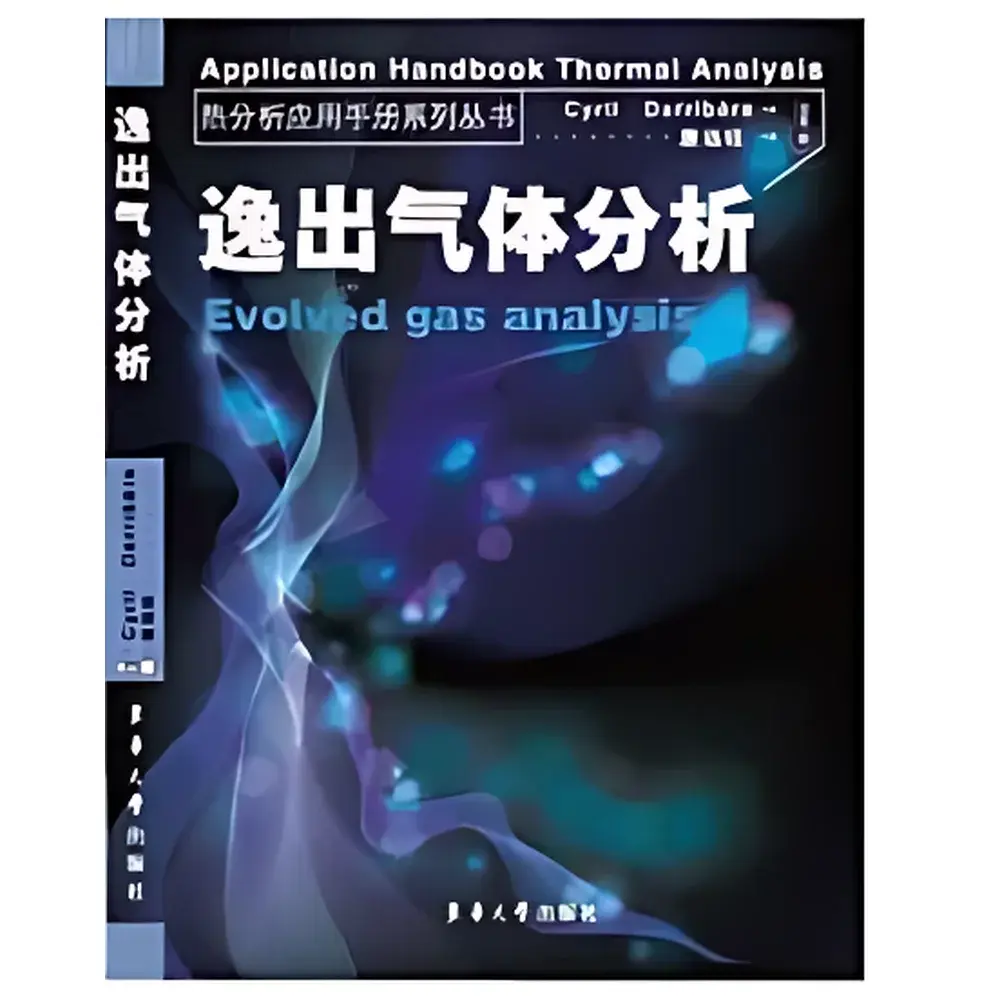
METTLER TOLEDO Thermal Analysis Application Handbook Series: Evolved Gas Analysis (EGA)
| Brand | METTLER TOLEDO |
|---|---|
| Origin | Shanghai, China |
| Product Type | Technical Reference Handbook |
| Model | Thermal Analysis Application Handbook – Evolved Gas Analysis |
| Compliance | Compatible with TGA-FTIR and TGA-MS coupling configurations per ISO 11358, ASTM E1131, and USP <1031> guidelines |
| Format | Printed and digital PDF (English edition) |
| Intended Use | Method development & interpretation support for thermal decomposition gas-phase characterization |
Overview
The Evolved Gas Analysis (EGA) handbook is a peer-reviewed technical reference publication developed by METTLER TOLEDO to support rigorous interpretation and method design for hyphenated thermal analysis techniques—specifically thermogravimetric analysis coupled with Fourier-transform infrared spectroscopy (TGA-FTIR) and mass spectrometry (TGA-MS). Unlike instrument operation manuals, this volume focuses on the physicochemical rationale underpinning gas evolution profiling during controlled thermal decomposition. It systematically addresses how volatile species—ranging from H2O, CO2, and NH3 to complex organics and halogenated fragments—are liberated, transported through transfer lines, and spectroscopically or mass-resolved in real time. The handbook emphasizes quantitative correlation between mass loss events (Δm, %) and spectral/ionic signatures (e.g., m/z 18 for H2O, 44 for CO2, 17 for NH3), enabling unambiguous assignment of decomposition steps in polymers, pharmaceuticals, catalysts, and inorganic hydrates. Its structure bridges fundamental theory and applied practice, making it indispensable for analysts validating thermal stability, residual solvent content, or degradation pathways under GLP-compliant workflows.
Key Features
- Comprehensive theoretical foundation covering gas-phase transport kinetics, interface design considerations (e.g., heated transfer line temperature gradients, residence time optimization), and spectral deconvolution strategies for overlapping FTIR bands
- 15 rigorously documented case studies—including pharmaceutical excipients, engineering polymers, zeolites, and elastomers—each annotated with raw TGA curves, synchronized FTIR/MS chromatograms, and stepwise interpretation logic
- Dedicated tutorial sections for pedagogical validation: calcium oxalate monohydrate (CaC2O4·H2O) and copper(II) sulfate pentahydrate (CuSO4·5H2O), illustrating stoichiometric water release and intermediate oxide formation
- Critical experimental variables addressed: heating rate impact on MS signal intensity and peak resolution, sample mass effects on detection limit and gas dilution, and carrier gas composition (N2 vs. He) on ion fragmentation patterns
- Standardized nomenclature and cross-referenced abbreviations aligned with IUPAC and ASTM E1131–22 terminology for inter-laboratory reproducibility
Sample Compatibility & Compliance
This handbook supports method development for solid and semi-crystalline samples compatible with standard TGA furnaces (e.g., METTLER TOLEDO TGA/DSC 3+, STARe System). It explicitly covers organic small molecules (e.g., acetylsalicylic acid), polymeric systems (PVC, silicone rubber, amino resins), hydrated inorganics, and composite materials such as printed circuit boards and fluorinated cable insulation. All applications adhere to internationally recognized thermal analysis standards: ISO 11358-1 (polymer degradation), ASTM E1131 (mass loss determination), and USP <1031> (residual solvents in drug substances). The EGA data interpretation protocols are structured to satisfy FDA 21 CFR Part 11 requirements for audit-trail documentation when integrated into validated LIMS or instrument control software environments.
Software & Data Management
While the handbook itself is a static technical document, its analytical frameworks integrate seamlessly with METTLER TOLEDO’s STARe software suite and third-party platforms including OPUS (Bruker FTIR) and MassHunter (Agilent MS). It provides explicit guidance on time-synchronized data alignment—critical for correlating derivative thermogravimetric (DTG) peaks with evolving FTIR absorbance or MS ion current profiles. Recommended workflows include baseline correction for atmospheric interference (CO2, H2O vapor), library matching against NIST/EPA/NIH spectral databases, and multivariate analysis (PCA) for differentiating BR/NR rubber blends via characteristic hydrocarbon fragment ratios (e.g., m/z 69 vs. m/z 71). The handbook also outlines metadata requirements for compliant archiving: instrument parameters (heating rate, purge flow), calibration records (mass axis drift, wavenumber accuracy), and analyst verification signatures.
Applications
The handbook serves as both a teaching resource and a troubleshooting guide across regulated and research-intensive domains. In pharmaceutical QA/QC, it enables identification and quantification of residual solvents (e.g., methanol, acetone) per ICH Q3C guidelines using TGA-MS peak area integration calibrated against certified reference materials. In polymer science, it supports failure analysis—such as PVC dehydrochlorination onset (HCl evolution at m/z 36/38) or silicone backbone scission (Si–O–Si cleavage yielding SiO2 condensates)—with mechanistic insight. For materials engineering, applications like zeolite desorption profiling or PCB delamination mapping provide direct input for thermal reliability modeling. Its inclusion of less common couplings—such as thermomechanical analysis (TMA) interfaced with MS—extends utility to dimensional stability studies where gas evolution coincides with coefficient-of-thermal-expansion transitions.
FAQ
Is this handbook compatible with non-METTLER TOLEDO TGA instruments?
Yes—the principles, interpretation frameworks, and application examples are platform-agnostic and applicable to any TGA system capable of coupling to FTIR or MS detectors.
Does the handbook include instrument setup instructions or hardware specifications?
No—it assumes operational familiarity with TGA-FTIR/MS interfaces; hardware configuration details are covered separately in instrument-specific user manuals.
Are raw data files or spectral libraries included with the publication?
No—this is a printed/digital reference text. Spectral libraries must be obtained from vendor-provided resources (e.g., Bruker OPUS libraries, NIST MS Search).
Can this handbook be cited in regulatory submissions?
Yes—it is referenced in multiple peer-reviewed publications and aligns with ASTM/ISO methodology standards; however, primary data generation must follow site-specific validation protocols.
Is training or application support provided by METTLER TOLEDO upon purchase?
Access to application specialists and regional thermal analysis workshops is available through authorized METTLER TOLEDO service channels, independent of handbook acquisition.



