
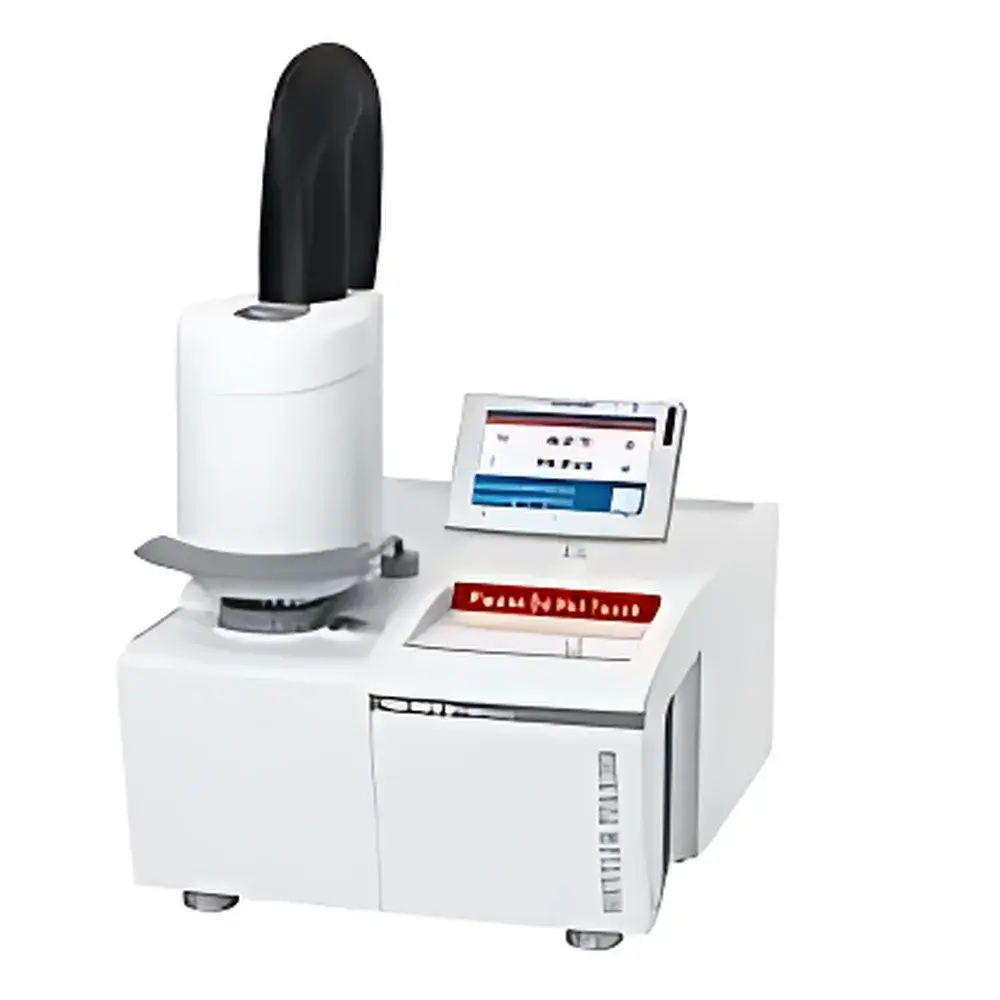
METTLER TOLEDO TMA/SDTA 2+ Thermomechanical Analyzer
| Brand | METTLER TOLEDO |
|---|---|
| Origin | Switzerland |
| Model | TMA/SDTA 2+ IC/600 / LF/1100 / LN/600 |
| Temperature Range | –80 to 600 °C |
| Temperature Accuracy | ±0.005 °C |
| Force Range | –0.1 to 1 N |
| Displacement Resolution | 0.5 nm |
| Frequency Range | 0.01–1 Hz |
Overview
The METTLER TOLEDO TMA/SDTA 2+ is a high-precision thermomechanical analyzer engineered for quantitative measurement of dimensional changes in solid and semi-solid materials as a function of temperature, time, and applied force. It operates on the fundamental principle of controlled-force or controlled-displacement mechanical probing under precisely regulated thermal conditions—utilizing either static (isothermal or dynamic ramp) or dynamic (oscillatory or creep/recovery) loading protocols. Unlike differential scanning calorimetry (DSC), which detects enthalpic transitions, the TMA/SDTA 2+ directly measures linear expansion, contraction, softening, creep deformation, and viscoelastic relaxation—making it indispensable for characterizing subtle transitions such as glass transitions in highly filled composites, thin-film stress development, polymer crystallinity onset, and thermal shrinkage in packaging films. Its integrated SDTA (Simultaneous Dynamic Thermal Analysis) capability enables real-time, sample-proximal temperature measurement with traceable accuracy—eliminating furnace-based temperature lag and ensuring metrological fidelity across the full –80 °C to 600 °C operating range.
Key Features
- True sample-contact temperature sensing via SDTA: direct thermocouple integration at the probe tip ensures ±0.005 °C temperature accuracy—calibratable using certified reference materials (e.g., pure metal melting points or certified expansion standards).
- Multi-mode mechanical actuation: supports compression, tension, penetration (needle mode), and three-point bending configurations—enabling analysis of diverse geometries including thin coatings (<1 µm), monofilaments, cylindrical rods, bulk polymers, elastomers, ceramics, and single crystals.
- Ultra-high displacement resolution of 0.5 nm achieved through low-noise capacitive transduction and active vibration damping—critical for detecting sub-nanometer dimensional shifts during early-stage glass transition or solvent-induced swelling.
- Programmable force control from –0.1 N (tensile preload) to +1 N (compressive load), with closed-loop feedback ensuring stable stress application during long-term isothermal holds or frequency sweeps (0.01–1 Hz).
- One Click™ touchscreen interface: intuitive 7-inch color display with GLP-compliant audit trail logging; pre-configured method templates support rapid deployment of ASTM E831, ISO 11359-2, and USP compliant assays with one-touch initiation and automatic data annotation.
Sample Compatibility & Compliance
The TMA/SDTA 2+ accommodates samples ranging from fragile 50-nm-thick ALD-deposited oxide layers on silicon wafers to 100-mm-long carbon fiber-reinforced polymer rods. Its modular probe system—including flat-ended, spherical, needle, and fiber-gripping tips—ensures mechanical compatibility without sample damage. All hardware and firmware comply with IEC 61000-4 electromagnetic immunity standards and meet CE marking requirements for laboratory instrumentation. Data acquisition and method execution are fully compatible with 21 CFR Part 11-compliant LIMS environments when paired with METTLER TOLEDO’s STARe software suite—supporting electronic signatures, user role-based access control, and immutable audit trails required for GMP/GLP-regulated R&D and QC laboratories.
Software & Data Management
STARe software provides full instrument control, real-time visualization, and advanced post-processing—including derivative thermomechanical analysis (DTMA), modulus calculation (E′ = σ/ε), coefficient of linear expansion (CTE) segmentation, and multi-cycle creep recovery modeling. Raw data files (.TMA) are stored in HDF5 format with embedded metadata (operator ID, calibration history, environmental logs). Batch processing workflows enable automated CTE reporting across >50 samples per run, with export options for CSV, PDF reports, and direct integration into MATLAB or Python-based analytics pipelines via documented REST API endpoints.
Applications
- Determination of coefficient of thermal expansion (CTE) in microelectronic encapsulants and underfill materials.
- Identification of glass transition temperature (Tg) in high-filler-content composites where DSC signal is suppressed.
- Quantification of residual stress relaxation in spin-coated photoresist films during post-apply bake cycles.
- Creep compliance measurement in biomedical hydrogels under physiological loading conditions.
- Thermal shrinkage profiling of biaxially oriented polypropylene (BOPP) films used in food packaging.
- Phase transition mapping in shape-memory alloys via constrained-heating penetration mode.
FAQ
What distinguishes SDTA from conventional furnace-based temperature measurement?
SDTA uses a miniature thermocouple mounted directly at the probe-sample interface—bypassing thermal lag inherent in furnace-sensor configurations—and delivers true sample surface temperature with metrological traceability.
Can the TMA/SDTA 2+ perform simultaneous TMA-DSC measurements?
No—it is a dedicated thermomechanical platform; however, its data is fully complementary to DSC results and can be co-plotted within STARe software for correlative thermal analysis.
Is needle-mode operation suitable for thin-film adhesion assessment?
Yes—penetration mode with sub-micron depth control enables quantification of interfacial delamination onset under thermal cycling, per ASTM D7905 guidelines.
How is displacement calibration verified?
Using certified step-height standards (e.g., NIST-traceable step gauges) and interferometric validation protocols documented in the instrument’s IQ/OQ/PQ qualification package.
Does the system support automated sample changers?
The TMA/SDTA 2+ is compatible with the optional RTC (Robotic Transfer Chamber) module for unattended 24/7 operation across up to 16 samples per batch.



