
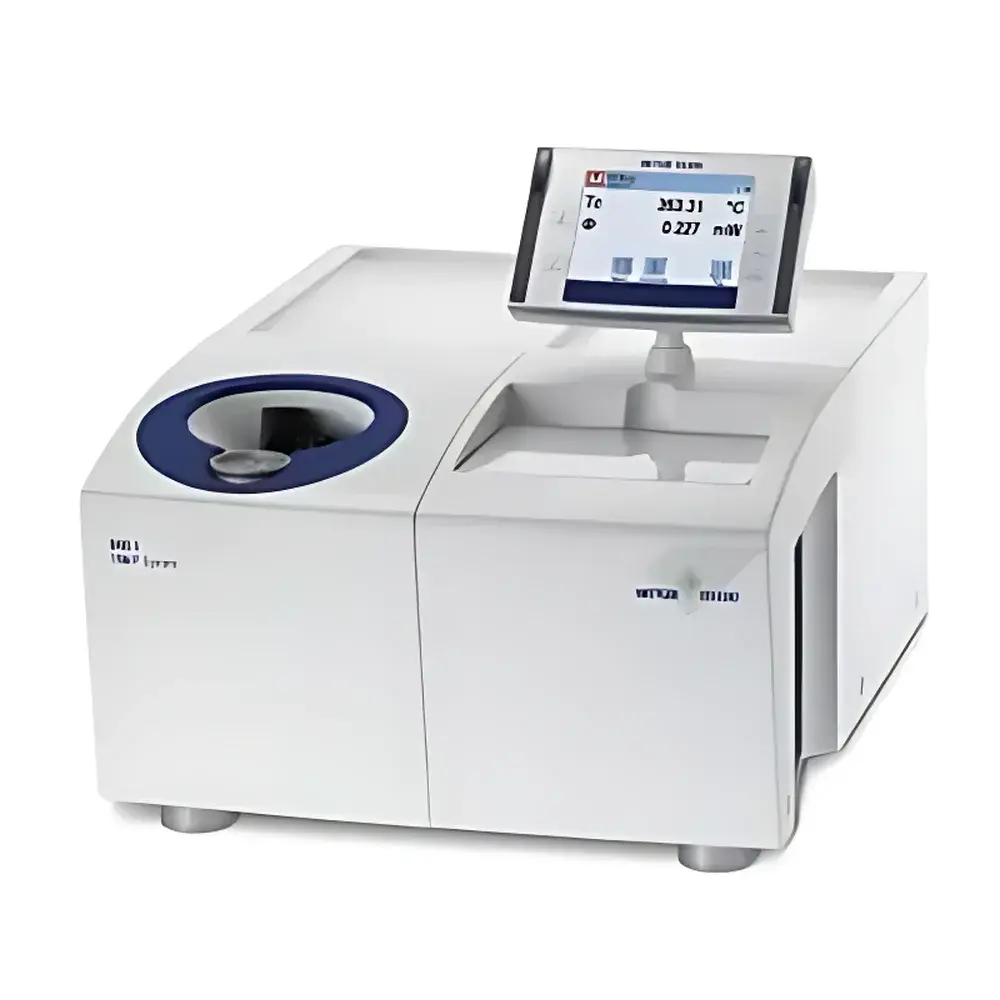
METTLER TOLEDO TOPEM™ TMDSC – Advanced Multi-Frequency Temperature-Modulated Differential Scanning Calorimeter
| Brand | METTLER TOLEDO |
|---|---|
| Origin | Switzerland |
| Model | TOPEM™ TMDSC |
| Category | Imported Instrument |
| Distributor Type | Authorized General Distributor |
| Pricing | Available Upon Request |
Overview
The METTLER TOLEDO TOPEM™ TMDSC is an advanced multi-frequency temperature-modulated differential scanning calorimeter engineered for high-resolution thermal characterization of materials across a broad dynamic range. Unlike conventional DSC, which applies a linear heating ramp, TOPEM™ superimposes a periodic temperature oscillation—comprising multiple simultaneous frequencies—onto a non-linear underlying temperature program. This unique modulation scheme enables the instrument to resolve heat flow into its reversing (frequency-independent, quasi-static) and non-reversing (frequency-dependent, kinetic) components in real time, based on the sample’s transient thermal response. The technique is grounded in linear system theory and calibrated via precise pulse-response analysis, allowing quantitative determination of heat capacity (Cp) with minimal baseline drift and exceptional signal-to-noise ratio. Designed for research laboratories and industrial R&D centers requiring rigorous thermal property quantification, the TOPEM™ platform supports fundamental studies of glass transitions, crystallization kinetics, curing behavior, phase separation, and low-energy relaxations in polymers, pharmaceuticals, composites, and amorphous solids.
Key Features
- Multi-frequency temperature modulation: Simultaneous application of up to 16 discrete harmonic frequencies within a single scan, enabling parallel acquisition of dynamic thermal responses without sequential frequency sweeps.
- Quasi-static heat capacity calibration: Direct Cp determination from pulse-response-derived baseline, eliminating reliance on reference material calibrations for absolute heat capacity values.
- High sensitivity & resolution: Capable of resolving thermal events with energy magnitudes below 0.1 µJ and onset separations as small as 0.3 °C, even under overlapping transitions.
- Reversing/non-reversing separation: Algorithmic deconvolution of total heat flow into thermodynamically reversible (e.g., glass transition, melting) and irreversible (e.g., cold crystallization, decomposition, crosslinking) contributions—without curve-fitting assumptions.
- Frequency-dependent analysis: Built-in evaluation tools for quantifying relaxation times, activation energies, and dynamic fragility via temperature- and frequency-resolved Cp and enthalpy recovery data.
- Robust thermal architecture: Patented sensor design with ultra-low thermal mass, symmetric furnace geometry, and active temperature control ensuring <±0.01 °C stability and <0.001 °C/min drift over extended runs.
Sample Compatibility & Compliance
The TOPEM™ TMDSC accommodates standard hermetic and non-hermetic aluminum, gold-plated, or high-pressure crucibles (20–50 µL volume), supporting solid, semi-crystalline, gel, and powder samples ranging from 1–20 mg. It complies with ISO 11357 (Plastics — Differential Scanning Calorimetry), ASTM E1269 (Standard Test Method for Determining Heat Capacity by DSC), and USP (Thermal Analysis). Data integrity adheres to FDA 21 CFR Part 11 requirements through optional electronic signature modules, audit trail logging, and user-access-controlled method templates—fully aligned with GLP and GMP validation frameworks. All calibration procedures follow METTLER TOLEDO’s traceable standards certified to NIST and PTB references.
Software & Data Management
Controlled via STARe (Scientific Thermal Analysis Research) software v16.x or later, the TOPEM™ platform provides integrated experiment design, real-time visualization, and post-processing workflows. The software includes dedicated TOPEM™ modules for automatic frequency response mapping, Cp baseline correction, relaxation spectrum modeling (via Fourier transform of heat flow residuals), and comparative kinetics analysis (e.g., Friedman, Ozawa–Flynn–Wall). Raw data are stored in vendor-neutral .TAR format; export options include ASCII, CSV, and XML for integration with MATLAB®, Python-based analysis pipelines, or LIMS systems. All processing steps—including baseline subtraction, peak integration, and component separation—are fully documented in the audit trail with timestamped operator IDs and parameter versioning.
Applications
- Pharmaceutical solid-state characterization: Quantifying amorphous content, detecting sub-Tg relaxations, assessing physical stability of lyophilized formulations.
- Polymer structure–property relationships: Mapping segmental mobility, identifying secondary relaxations (β, γ), evaluating crosslink density via enthalpy recovery kinetics.
- Food science: Measuring moisture-induced glass transitions, monitoring starch retrogradation, analyzing fat crystallization polymorphism.
- Advanced materials: Characterizing shape-memory alloy hysteresis, probing ion-conduction mechanisms in solid electrolytes, evaluating thermal aging in battery separators.
- Quality control & regulatory submission: Generating ICH Q5C-compliant thermal stability profiles and supporting ANDA/MAA dossiers with validated, auditable datasets.
FAQ
How does TOPEM™ differ from conventional TMDSC techniques such as “square-wave” or “single-frequency” modulation?
TOPEM™ employs multi-harmonic temperature modulation rather than discrete stepwise or sinusoidal single-frequency inputs—enabling simultaneous acquisition of frequency-domain information across a continuous bandwidth without sacrificing time resolution or thermal equilibrium fidelity.
Can TOPEM™ data be used for kinetic modeling of solid-state reactions?
Yes—the non-reversing heat flow component provides direct access to reaction enthalpies and rates; when combined with isoconversional methods implemented in STARe software, it supports robust model-free and model-fitting kinetic analysis per ASTM E698 and E1641.
Is calibration required before each measurement?
No—quasi-static Cp is derived intrinsically from the pulse response of the sensor-sample system; only initial temperature and enthalpy calibration using certified indium and zinc standards is needed per ISO 11357-1, typically performed quarterly or after maintenance.
Does the system support high-pressure or controlled-atmosphere measurements?
Yes—compatible with METTLER TOLEDO’s HP-DSC and gas-tight crucible accessories, enabling experiments under inert (N₂, Ar), oxidative (O₂), or reactive (H₂, CO₂) atmospheres up to 100 bar pressure.
What level of technical support and service coverage is available globally?
METTLER TOLEDO offers factory-certified field service engineers, remote diagnostics via SecureLink, on-site preventive maintenance contracts, and application-specific training programs accredited by the International Centre for Thermal Analysis (ICTA).



