
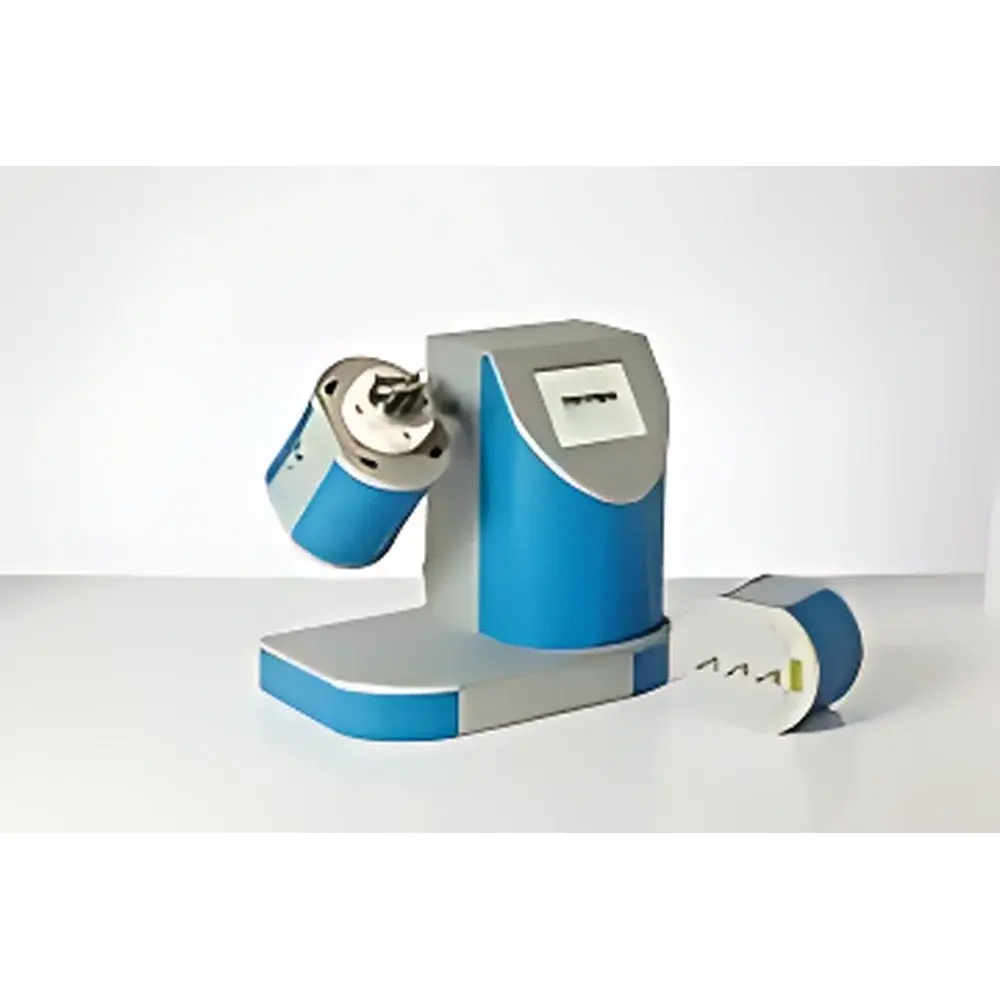
METTLER TOLEDO TT DMA Dynamic Mechanical Analyzer
| Brand | METTLER TOLEDO |
|---|---|
| Origin | Switzerland |
| Model | TT DMA |
| Temperature Range | −190 °C to 600 °C |
| Frequency Range | 0.001 Hz to 1000 Hz |
| Fixture Configurations | Dual-cantilever, single-cantilever, 3-point bending, shear, tension, compression |
| Operating Modes | Creep, constant-force (TMA), stress–strain, stress relaxation, isothermal, step-isothermal, multi-ramp thermal profiles |
| Environmental Options | Humidity chamber (up to 85 °C / 85 % RH), liquid immersion cell, gas purge (N₂, air, Ar) |
Overview
The METTLER TOLEDO TT DMA Dynamic Mechanical Analyzer is a high-precision, modular instrument engineered for the quantitative characterization of viscoelastic behavior in polymeric, composite, ceramic, and metallic materials under controlled thermal and mechanical stimuli. Based on the fundamental principles of dynamic mechanical thermal analysis (DMTA), the TT DMA applies a sinusoidal oscillatory force to a sample while simultaneously varying temperature, enabling measurement of storage modulus (E′), loss modulus (E″), and tan δ as functions of temperature, frequency, time, or strain amplitude. Its robust dual-beam force-rebalance transducer architecture ensures high sensitivity and long-term signal stability, critical for detecting subtle transitions—including glass transitions (Tg), secondary relaxations (β, γ), crystallization events, and crosslink density changes—in both research and regulated quality control environments.
Key Features
- Wide operational temperature range from −190 °C to 600 °C, supported by liquid nitrogen cooling and high-temperature furnace options with precise ±0.1 °C thermal accuracy.
- Frequency sweep capability spanning six decades: 0.001 Hz to 1000 Hz, allowing full spectrum analysis from quasi-static creep to high-frequency dynamic response.
- Multi-orientation fixture mounting—vertical up/down, horizontal, or custom angular alignment—enabling optimal sample geometry matching for anisotropic or constrained materials.
- Comprehensive mode library: linear and non-linear viscoelastic testing including creep recovery, stress relaxation, constant-force thermomechanical analysis (TMA), and controlled-strain/stress protocols.
- Modular environmental integration: optional humidity-controlled chamber (operable up to 85 °C and 85 % RH), inert gas purge (N₂, Ar, air), and liquid immersion cell for solvent-swelling or in-situ reaction studies.
- Real-time force and displacement feedback with active drift compensation, ensuring measurement integrity across extended isothermal holds or multi-step thermal ramps.
Sample Compatibility & Compliance
The TT DMA accommodates diverse sample geometries—including films, fibers, bulk solids, foams, adhesives, and molded parts—across standard fixtures: dual/single cantilever, 3-point bending, shear, tension, and compression. Fixture interchangeability is tool-free and calibrated via embedded reference standards traceable to NIST. The system complies with ISO 6721 (Plastics — Determination of dynamic mechanical properties), ASTM D4065 (Standard Practice for Plastics: Dynamic Mechanical Properties), and ASTM D7028 (Glass Transition Temperatures of Polymer Matrix Composites). When configured with audit-trail-enabled software and electronic signature modules, it supports GLP, GMP, and FDA 21 CFR Part 11 compliance for pharmaceutical excipient qualification and medical device polymer validation.
Software & Data Management
Controlled via METTLER TOLEDO’s STARe (Scientific Thermal Analysis Research) software platform, the TT DMA delivers intuitive method setup, real-time data visualization, and automated reporting. STARe includes advanced modeling tools—time–temperature superposition (TTS), Arrhenius and WLF fitting, master curve generation, and viscoelastic parameter extraction (e.g., activation energy, relaxation spectra). All raw and processed data are stored in vendor-neutral HDF5 format with embedded metadata (instrument ID, operator, calibration history, environmental conditions). Audit trails record user actions, parameter modifications, and data exports, supporting traceability requirements in regulated laboratories.
Applications
- Quantification of Tg breadth and sub-Tg relaxations in thermoplastics and elastomers for formulation optimization.
- Evaluation of crosslink density and network homogeneity in thermosets and rubber compounds via Payne effect analysis.
- Thermo-mechanical stability assessment of aerospace composites under cyclic loading and thermal cycling.
- Hydration-dependent modulus mapping of hydrogels and biopolymers using integrated humidity control.
- In-situ curing kinetics monitoring of epoxy resins via time-resolved modulus evolution during isothermal polymerization.
- Creep compliance and stress relaxation profiling for long-term reliability prediction in packaging films and sealants.
FAQ
What temperature calibration standards are used for the TT DMA?
The system employs certified reference materials including indium, zinc, and tin for DSC-based thermal calibration; DMA-specific verification uses standardized polymer standards (e.g., polystyrene, polyethylene) with documented transition temperatures per ISO 11357.
Can the TT DMA perform simultaneous DMA–TGA coupling?
No—the TT DMA is a standalone dynamic mechanical platform. For hyphenated analysis, METTLER TOLEDO offers separate TGA/DSC instruments; synchronized multi-technique workflows require external data synchronization protocols.
Is the humidity chamber compatible with all fixture types?
Yes—humidity control is fully integrated with all standard fixtures, though shear and compression configurations may require minor gasket adaptation for vapor containment at elevated RH levels.
How is force calibration performed on the TT DMA?
Force transducers are factory-calibrated using dead-weight standards traceable to national metrology institutes; field verification is supported via optional calibration kits containing precision reference springs and displacement gauges.
Does the TT DMA support ASTM D4065-compliant test sequences out of the box?
Yes—STARe software includes preconfigured method templates aligned with ASTM D4065 Annexes A1–A4, covering frequency sweeps, temperature ramps, and isothermal holds with automatic pass/fail evaluation against defined modulus and tan δ thresholds.



