

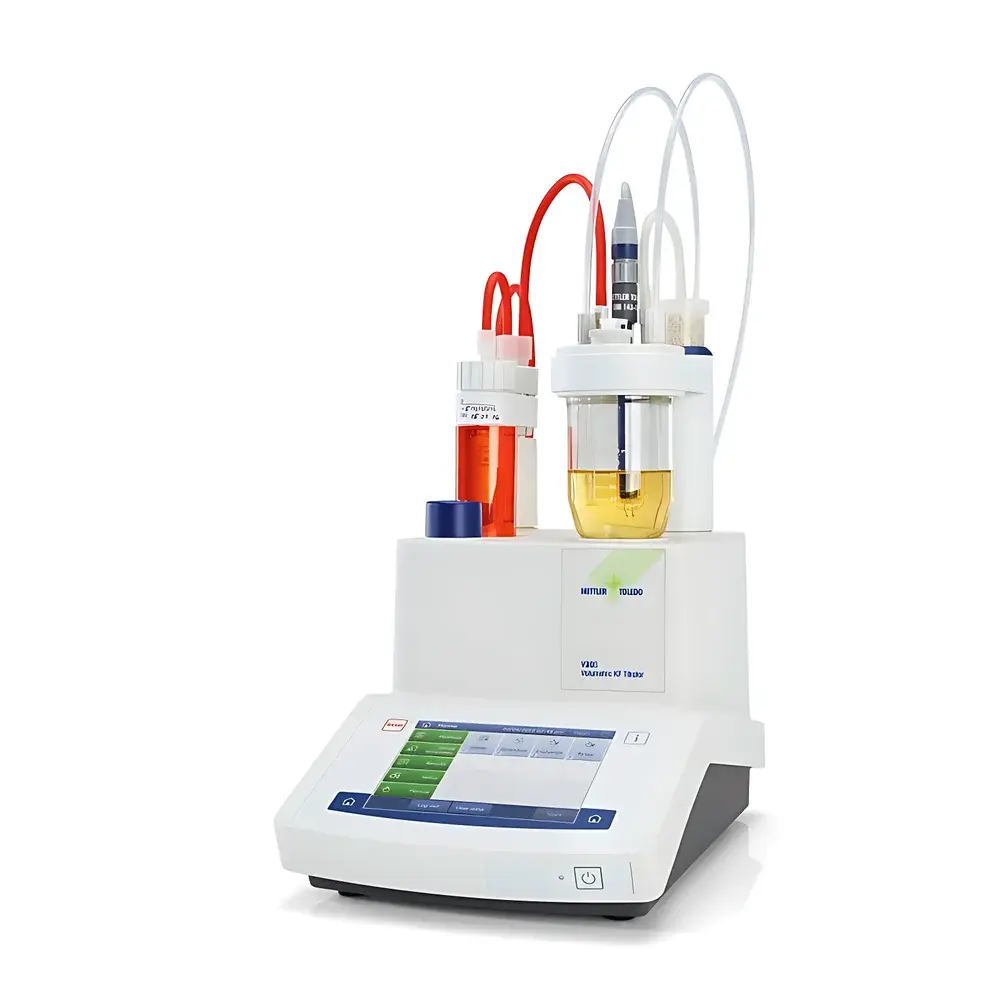
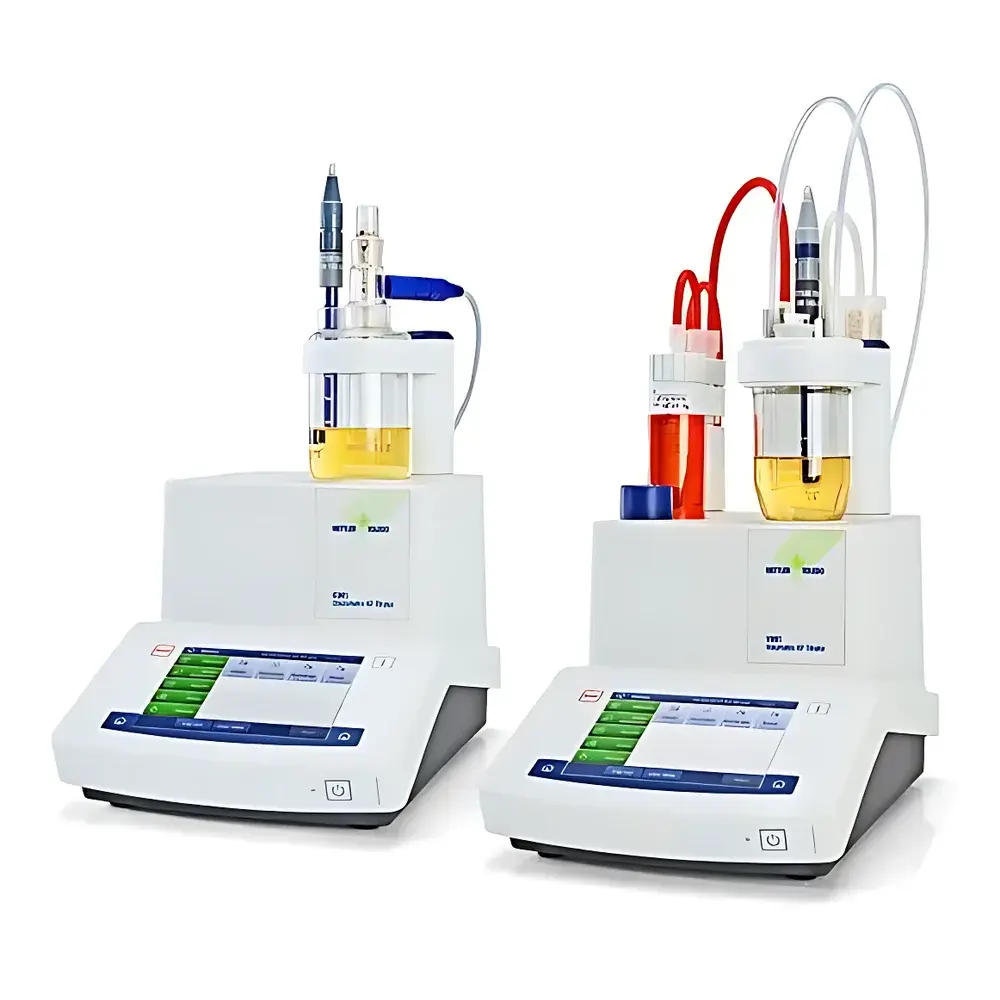
METTLER TOLEDO V20S/V30S Volumetric Karl Fischer Moisture Titrator
| Brand | METTLER TOLEDO |
|---|---|
| Origin | Switzerland |
| Instrument Type | Volumetric Karl Fischer Titrator |
| Titration Mode | Fully Automated |
| Measurement Resolution | 0.1 mV |
| Water Content Range | 10 ppm to 100% (w/w) |
| Accuracy | ±0.3% (for samples containing >10 mg H₂O) |
| Minimum Dispensing Volume | 0.05 µL |
| Titration Drive Precision | 20,000 steps per revolution |
| Compliance | Designed for GLP/GMP environments |
Overview
The METTLER TOLEDO V20S and V30S are fully automated volumetric Karl Fischer titrators engineered for precision, reproducibility, and regulatory compliance in pharmaceutical, chemical, polymer, and food quality control laboratories. Based on the stoichiometric reaction between iodine and water in a controlled anhydrous environment, these instruments quantify water content via coulometric or volumetric titration—selectable depending on sample type and concentration range. The V20S is optimized for routine analysis of samples with water content from 10 ppm to 100%, while the V30S extends functionality with integrated oven-based headspace extraction (up to 300 °C), enabling accurate determination of water in solids, viscous liquids, and thermally labile materials that cannot be directly introduced into the titration cell. Both models employ dual-platinum electrode detection, real-time endpoint recognition via polarization current monitoring, and adaptive titrant dosing algorithms to minimize over-titration and drift.
Key Features
- One-Click Operation: Intuitive touchscreen interface with customizable home screen—each user can assign frequently used methods, solvents, or sample types to dedicated soft keys for rapid method recall and reduced operator training time.
- Volumetric Titration Architecture: High-precision burette drive (20,000-step resolution) ensures consistent delivery of KF reagent with minimum dispensing volume of 0.05 µL—critical for low-water-content samples requiring high sensitivity and repeatability.
- Low-Drift Titration Cell: Optimized glass cell design minimizes ambient moisture ingress and electrochemical background drift, supporting stable baselines and reliable quantification down to 10 ppm.
- Solvent Manager Integration: Automated reagent handling system controls solvent addition, waste removal, and bottle replacement—all initiated via One-Click commands. LevelSens technology monitors reagent and waste levels to prevent overflow and ensure uninterrupted operation.
- Modular Oven Coupling (V30S only): Integrated heating module enables gas-phase extraction (GPE) using dry air or nitrogen carrier gas. Temperature-controlled sample introduction eliminates matrix interference and allows analysis of hygroscopic, insoluble, or reactive samples without direct dissolution.
Sample Compatibility & Compliance
The V20S/V30S accommodates liquid, solid, paste, and gaseous samples—including oils, polymers, APIs, excipients, lithium battery electrolytes, and catalysts. Solid samples are analyzed either by direct dissolution (V20S) or thermal desorption (V30S). The system complies with ASTM E203, ISO 760, USP , and EP 2.5.12 methodologies. When operated with LabX titration software, full 21 CFR Part 11 compliance is achieved—including role-based access control, electronic signatures, secure audit trails, and data integrity safeguards required for GxP-regulated environments.
Software & Data Management
LabX software provides centralized method development, instrument control, data acquisition, and report generation. It supports IQ/OQ documentation templates, automatic calibration logging, and trend analysis across batches. All raw titration curves, endpoint calculations, and metadata (operator ID, timestamp, environmental conditions) are stored in a secure SQL database with version-controlled method files. Export options include PDF, CSV, and XML formats compatible with LIMS and ERP systems. Optional integration with METTLER TOLEDO’s AutoCal and AutoClean modules further enhances traceability and reduces manual intervention.
Applications
- Pharmaceutical QC: Water content verification of active pharmaceutical ingredients (APIs), lyophilized powders, and tablet coatings per ICH Q5C guidelines.
- Chemical Manufacturing: Moisture monitoring in solvents (e.g., THF, DMF), monomers, and catalysts where residual water affects polymerization kinetics.
- Energy Materials: Quantification of trace moisture in lithium-ion battery electrolytes and cathode precursors—critical for cell safety and cycle life.
- Food & Feed: Direct determination of water activity-related moisture in dairy powders, starches, and dehydrated vegetables.
- Plastics & Polymers: Detection of hydrolyzable moisture in PET, PA6, and PC resins prior to extrusion or injection molding.
FAQ
What is the difference between volumetric and coulometric Karl Fischer titration?
Volumetric KF measures water by adding standardized iodine-containing titrant from a burette; it is ideal for samples with >100 ppm water. Coulometric KF generates iodine electrochemically within the cell and is preferred for ultra-trace analysis (<100 ppm); the V20S/V30S support both modes via optional coulometric cells.
Can the V30S analyze moisture in heat-sensitive samples?
Yes—the V30S allows precise temperature ramping and dwell control during headspace extraction, minimizing thermal degradation while ensuring complete water release from thermally unstable matrices such as proteins or certain APIs.
Is method validation supported out-of-the-box?
LabX includes preconfigured validation protocols aligned with ICH Q2(R2) and USP , covering specificity, linearity, accuracy, precision, LOD/LOQ, and robustness testing—reducing qualification effort by up to 40% compared to manual workflows.
How does the Solvent Manager improve laboratory safety?
By eliminating manual handling of toxic, corrosive KF reagents (e.g., imidazole-based titrants), the Solvent Manager reduces exposure risk and ensures consistent reagent delivery—meeting OSHA and CLSI safety best practices for hazardous chemical management.
Does the system support multi-user environments with differentiated access rights?
Yes—LabX enforces hierarchical user roles (Operator, Supervisor, Administrator) with configurable permissions for method editing, result approval, audit trail viewing, and system configuration changes—fully compliant with ALCOA+ data integrity principles.



