
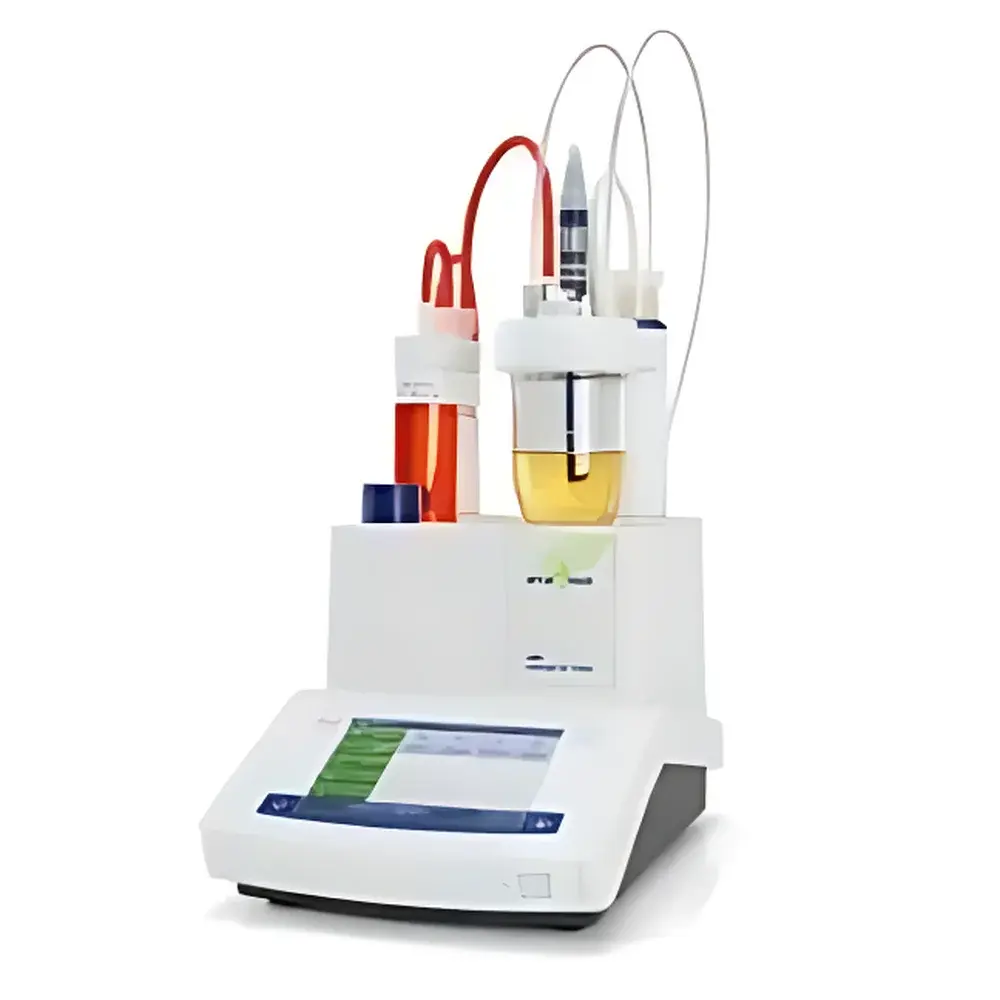
METTLER TOLEDO V30S Compact Coulometric Karl Fischer Moisture Analyzer
| Brand | METTLER TOLEDO |
|---|---|
| Origin | Switzerland |
| Instrument Type | Coulometric Karl Fischer Titrator |
| Titration Mode | Fully Automatic |
| Measurement Resolution | 0.1 mV |
| Moisture Range | 10 ppm to 100% (w/w) |
| Accuracy | ±0.3% (for samples containing >10 mg H₂O) |
| Minimum Dispensing Volume | 0.05 µL |
| Titration Control Precision | 20,000 steps |
| Supported Languages | 10 (English, German, French, Italian, Spanish, Chinese, Russian, Polish, Korean, Portuguese) |
| Preloaded Methods | 11 METTLER TOLEDO Expert Methods |
| User-Defined Methods | Up to 100 |
| Task Queue Capacity | 10 tasks |
| Optional Dryer | DO308 (manual) or Stromboli (automated, 14-position) |
Overview
The METTLER TOLEDO V30S Compact Coulometric Karl Fischer Moisture Analyzer is an engineered solution for high-precision, trace-level water quantification in demanding analytical laboratories. Based on the electrochemical coulometric principle—where iodine is generated *in situ* via controlled current at the anode—the V30S delivers exceptional sensitivity and reproducibility for samples with moisture content ranging from 10 ppm to 100% (w/w). Unlike volumetric KF systems, coulometric operation eliminates burette calibration drift and reagent standardization errors, making it ideal for low-water-content applications such as pharmaceutical excipients, lithium battery electrolytes, polymers, and high-purity solvents. Its compact footprint and integrated design align with modern lab space constraints without compromising metrological integrity. The instrument complies with ISO 8533, ASTM E203, and USP , and supports full audit trail generation required under GLP and GMP environments.
Key Features
- One Click® intuitive color touchscreen interface with customizable home screen—enabling direct access to routine methods, calibration, maintenance, and reporting functions
- RFID-enabled smart titration vessels: automatically read and store reagent batch number, expiration date, titer, and preparation date—ensuring data traceability and reducing manual entry errors
- Integrated solvent management system: monitors solvent level, conductivity, and over-titration status in real time; triggers automatic reagent replacement or purging via One Click—minimizing analyst exposure to hazardous KF reagents
- TTL I/O interface for seamless control of external devices including homogenizers, stirrers, and automated sample handlers
- Native compatibility with Stromboli 14-position heated oven sampler: fully synchronized with titration sequence for unattended analysis—including temperature ramping, sample weighing (when paired with compatible balance), and post-analysis cleaning cycles
- Dual connectivity architecture: USB and Ethernet (TCP/IP) support for LabX® Titration PC software—enabling remote method deployment, centralized data archiving, and electronic signature workflows
Sample Compatibility & Compliance
The V30S accommodates diverse sample matrices—including solids, liquids, pastes, and gases—via direct injection, oven coupling (DO308 or Stromboli), or external extraction modules. For samples prone to side reactions (e.g., aldehydes, ketones, or acidic compounds), the built-in external extraction method allows blank correction of the extraction solvent, ensuring accurate net water determination. All hardware and firmware meet CE marking requirements and are designed for compliance with FDA 21 CFR Part 11 when operated in LabX Server mode—including electronic signatures, role-based user permissions, immutable audit trails, and secure data encryption. Routine performance verification follows METTLER TOLEDO’s documented PQ protocols aligned with ISO/IEC 17025 and GxP validation frameworks.
Software & Data Management
LabX® Titration software serves as the central hub for method development, instrument control, and regulatory-compliant reporting. It provides full version-controlled method libraries, statistical evaluation of replicate series (including RSD, confidence intervals, and outlier detection per Grubbs’ test), and customizable PDF/CSV export templates compliant with internal SOPs. Audit trails record all user actions—including method edits, result overrides, calibration events, and login/logout timestamps—with tamper-proof hashing. Data integrity is further reinforced through optional integration with laboratory information management systems (LIMS) via ODBC or REST API. All print outputs—whether from USB-P25 thermal printers or networked multifunction devices—include GLP-compliant headers with instrument ID, operator name, timestamp, and digital signature fields.
Applications
The V30S is routinely deployed across regulated and research-intensive sectors: quantifying residual moisture in lyophilized biologics (per USP ); verifying dryness of active pharmaceutical ingredients (APIs) prior to tablet compression; measuring water ingress in sealed lithium-ion battery cells; characterizing hygroscopicity of catalysts and MOFs; validating solvent drying efficiency in fine chemical synthesis; and certifying moisture specifications in food-grade packaging films. Its ability to resolve sub-100 ppm levels with <0.5% RSD (n=6) makes it a reference-grade tool for stability-indicating assays and shelf-life modeling.
FAQ
What distinguishes coulometric from volumetric Karl Fischer titration?
Coulometric KF generates iodine electrochemically at the anode using Faraday’s law, enabling ultra-trace detection (down to 1 µg H₂O). Volumetric KF dispenses pre-standardized iodine solution from a burette—better suited for higher water concentrations (>100 ppm) but subject to burette calibration drift.
Can the V30S be validated for GMP use?
Yes—when configured with LabX Server in audit trail mode, it satisfies FDA 21 CFR Part 11, EU Annex 11, and PIC/S requirements for electronic records and signatures, provided IQ/OQ/PQ protocols are executed per METTLER TOLEDO’s qualification guides.
Is external extraction supported for non-soluble samples?
Yes—the instrument includes dedicated method templates for headspace and azeotropic distillation extraction, with automated blank subtraction for the extraction solvent.
How does solvent management prevent over-titration?
Real-time monitoring of cell conductivity and polarization voltage triggers automatic solvent refresh or purging before endpoint instability occurs—maintaining stoichiometric accuracy across extended sequences.
What is the maximum number of user-defined methods?
Up to 100 methods can be stored locally on the instrument, each supporting configurable endpoints, drift corrections, and multi-step titration sequences.




