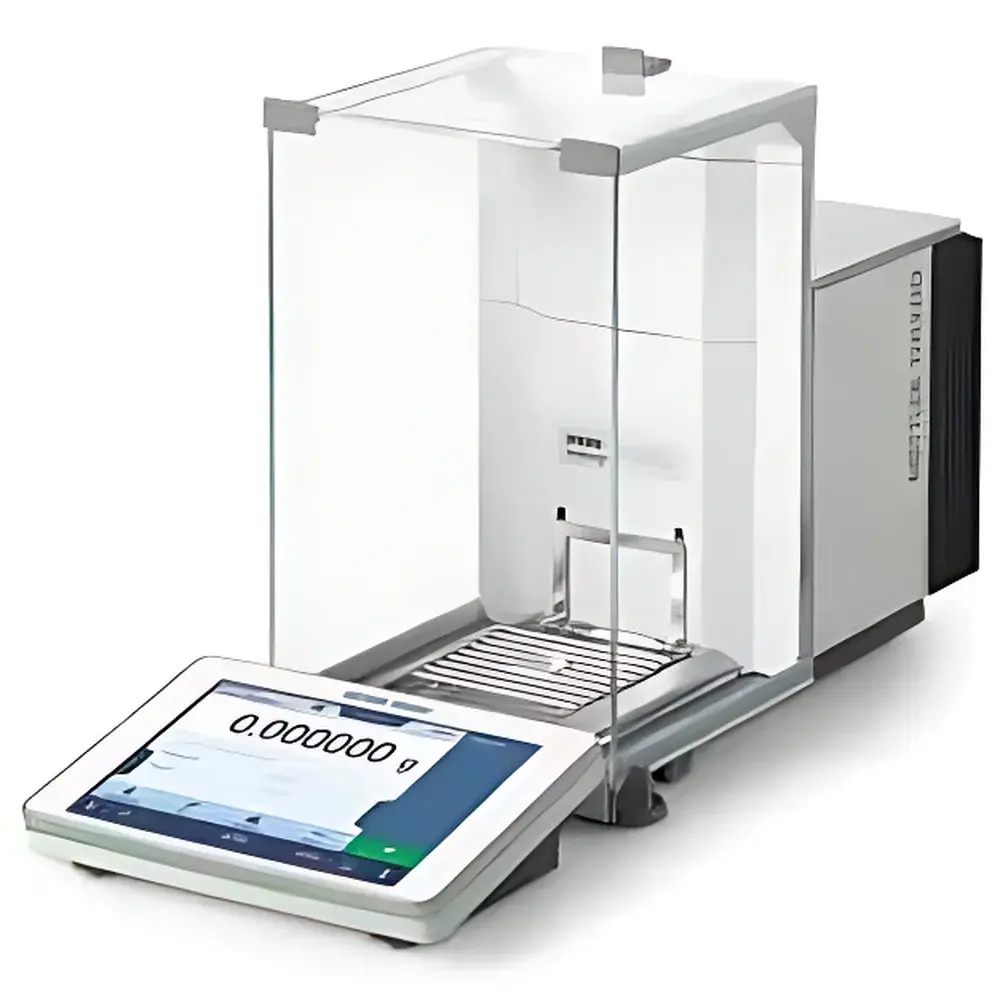
METTLER TOLEDO XPR Analytical Balance
| Brand | METTLER TOLEDO |
|---|---|
| Origin | Switzerland |
| Type | Analytical Balance |
| Maximum Capacity | 100 g |
| Readability | 0.01 mg (10 µg) |
| Repeatability | < ±1 mg |
| Calibration | Fully Automatic (proFACT) |
| Compliance | USP Chapter 41 & 1251, ISO/IEC 17025, GLP/GMP-ready |
| Display | Capacitive Color Touchscreen with StatusLight™ |
| Connectivity | 4× USB, 1× Ethernet (LAN) |
| Environmental Control | Active Temperature Control (ATC™), StaticDetect™ + optional ionizer, SmartGrid draft shield, LevelControl™ leveling system |
| Software Features | Built-in method storage, result notebook, MinWeigh™ warning, user permission management (multi-level), audit trail, GWP® Verification support |
Overview
The METTLER TOLEDO XPR Analytical Balance is an ultra-precision mass measurement instrument engineered for laboratories requiring traceable, reproducible, and regulatory-compliant weighing performance. Based on electromagnetic force compensation (EMFC) technology, the XPR series delivers high-resolution static mass determination under controlled environmental conditions. Its core architecture integrates real-time thermal stabilization, dynamic draft compensation, and electrostatic mitigation—critical for achieving consistent sub-milligram repeatability in regulated QC, pharmaceutical development, reference standard preparation, and analytical chemistry workflows. Designed and manufactured in Switzerland, each XPR unit undergoes rigorous factory calibration against national metrological standards and is certified to meet international requirements for analytical balance validation, including USP , , and ISO 9001 quality system alignment.
Key Features
- Active Temperature Control (ATC™): Compensates for thermal drift by maintaining a stable internal temperature gradient, reducing sensitivity to ambient fluctuations and enhancing long-term stability.
- SmartGrid Draft Shield: A perforated, aerodynamically optimized weighing chamber minimizes air turbulence effects, enabling faster settling times (as low as 1.5 seconds) without compromising accuracy or accessibility.
- StaticDetect™ Technology + Optional Ionizer: Continuously monitors electrostatic charge on samples and containers; when combined with the integrated ionizer module, it actively neutralizes surface charges to eliminate weighing errors caused by static attraction or repulsion.
- proFACT Automatic Calibration: Time- and temperature-triggered internal recalibration ensures continuous traceability. The system performs full linearity and zero-point verification using built-in motorized weights—no manual intervention required.
- StatusLight™ Visual Feedback System: A tri-color LED indicator mounted on the balance side provides immediate status awareness—green for ready, yellow for caution (e.g., unstable environment), red for error or critical alert—supporting rapid operator response without screen interaction.
- MinWeigh™ Intelligent Minimum Weight Monitoring: Enforces USP-defined minimum sample weight thresholds in real time. When sample mass falls below the validated lower limit (calculated per method and uncertainty budget), the system issues an audible and visual alert, preventing noncompliant measurements.
Sample Compatibility & Compliance
The XPR supports a wide range of sample forms—including powders, granules, liquids in tared vessels, and small solid components—across pharmaceutical, chemical, and materials science applications. Its modular design accommodates optional accessories such as ErgoClips for hands-free tare operation, anti-vibration tables, and draft shield extensions. Regulatory compliance is embedded at the firmware level: full audit trail logging (user actions, calibrations, method changes), configurable multi-tier user permissions (administrator, operator, reviewer), and electronic signature readiness align with FDA 21 CFR Part 11, EU Annex 11, and ISO/IEC 17025 documentation requirements. GWP® (Good Weighing Practice) Verification support enables automated assessment of balance suitability for specific tasks based on risk-based uncertainty analysis.
Software & Data Management
No external software is required for basic data handling. All weighing results, metadata (timestamp, operator ID, method name, environmental logs), and configuration changes are stored internally in a tamper-resistant result notebook. Data export is performed directly via USB flash drive or over Ethernet to networked PCs or LIMS systems. The touchscreen interface supports customizable method templates—each storing target weight, tolerance, units, display format, and post-weighing actions (e.g., auto-print, auto-export). For enterprise integration, METTLER TOLEDO LabX™ software (optional) provides centralized instrument management, advanced statistical process control (SPC), and full 21 CFR Part 11 compliance with electronic signatures and role-based access control.
Applications
- Pharmaceutical formulation and potency testing per USP monographs
- Reference standard weighing and dilution series preparation
- Residual solvent quantification in API manufacturing
- High-purity catalyst and reagent dispensing in R&D labs
- Gravimetric titration and Karl Fischer moisture analysis
- Quality control release testing under GMP environments
- Calibration laboratory mass comparison protocols
FAQ
What is the smallest sample mass that can be weighed reliably on the XPR series?
The minimum weighable quantity depends on application-specific uncertainty requirements and is calculated per USP . With typical repeatability of < ±0.001 g and readability of 0.00001 g, the validated minimum weight ranges from 10 mg to 82 mg across models—configurable and enforceable via MinWeigh™.
Does the XPR require external calibration weights?
No. proFACT uses motorized internal calibration masses triggered automatically by time or temperature change, eliminating dependency on external artifacts and minimizing operator error.
Can the XPR be integrated into a regulated LIMS or ERP system?
Yes. Native Ethernet connectivity and structured data export (CSV, XML) enable seamless integration with laboratory information management systems. Optional LabX software adds full 21 CFR Part 11 compliance for electronic records and signatures.
How does LevelControl™ improve measurement integrity?
LevelControl™ employs integrated tilt sensors and graphical on-screen guidance to verify horizontal alignment before operation. An out-of-level condition triggers an audible alarm and blocks weighing until correction—preventing systematic bias from gravitational vector deviation.
Is the draft shield fully removable for cleaning?
Yes. The entire glass enclosure is tool-free detachable and autoclavable (depending on model configuration), supporting strict hygiene protocols in cleanroom and biopharma environments.