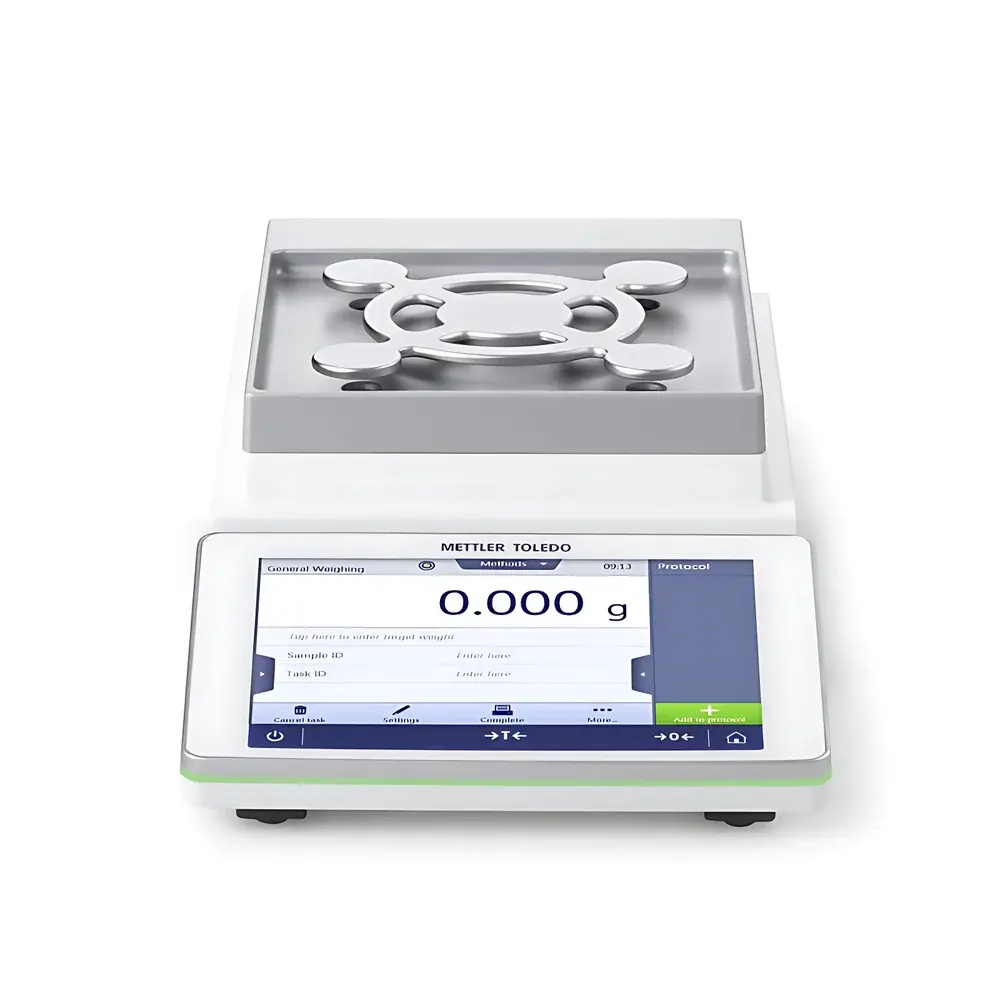
METTLER TOLEDO XPR603SN Precision Balance
| Brand | METTLER TOLEDO |
|---|---|
| Origin | Switzerland |
| Model | XPR603SN |
| Maximum Capacity | 610 g |
| Readability | 1 mg |
| Repeatability | 0.5 mg |
| Calibration | Internal |
| Compliance | GLP/GMP-ready, FDA 21 CFR Part 11–compatible (via LabX), ISO/IEC 17025 support |
| Sample Pan Type | SmartPan™ |
| Leveling System | LevelMatic™ |
| Connectivity | Ethernet, USB, RS232 |
| Data Integrity | LabX-integrated, audit trail enabled, electronic signature support |
Overview
The METTLER TOLEDO XPR603SN Precision Balance is an advanced laboratory balance engineered for high-reliability mass measurement in regulated and research-intensive environments. Operating on electromagnetic force compensation (EMFC) principle, it delivers traceable, reproducible results with 1 mg readability and exceptional short- and long-term stability. Designed for applications requiring strict adherence to data integrity standards—including pharmaceutical QC, chemical synthesis, materials science, and academic research—the XPR603SN integrates hardware-level metrological robustness with software-driven compliance architecture. Its core innovation lies in the SmartPan™ weighing pan, which employs aerodynamic geometry and optimized sensor shielding to minimize air current interference—enabling stable readings without traditional draft shields in most ambient lab conditions. This reduces operator intervention, accelerates measurement cycles, and improves throughput without compromising accuracy.
Key Features
- SmartPan™ Technology: Patented pan design reduces air turbulence impact on the load cell by >70% versus conventional pans, enabling faster stabilization (typical settling time <2 s) and improved repeatability (0.5 mg).
- LevelMatic™ Automatic Centering: Integrated mechanical self-centering mechanism ensures consistent load positioning across the pan surface, eliminating off-center error and maintaining accuracy under variable placement conditions.
- Internal Calibration & Adjustment: Motorized internal calibration weights and automatic recalibration routines ensure drift compensation over time and temperature fluctuations, supporting uninterrupted operation in dynamic lab environments.
- StatusLight™ Visual Feedback System: A three-color LED ring provides real-time status indication—green (ready), yellow (leveling required), red (error or maintenance needed)—reducing operator decision latency and procedural errors.
- GLP/GMP-Ready Hardware Architecture: Built-in level sensor, integrated environmental monitoring (temperature, barometric pressure), and tamper-evident firmware design meet foundational requirements for regulated workflows.
Sample Compatibility & Compliance
The XPR603SN accommodates a wide range of sample types—from powders and granules to small-volume liquids in tared vessels—within its 610 g maximum capacity and 120 mm diameter SmartPan™. Its open weighing chamber design supports compatibility with standard labware (e.g., weighing boats, crucibles, vials) while minimizing static charge accumulation via optional anti-static accessories. From a regulatory perspective, the balance conforms to ISO 9001, ISO/IEC 17025, USP , and ASTM E898-22 for precision balances. When connected to METTLER TOLEDO LabX software, it fully satisfies FDA 21 CFR Part 11 requirements—including role-based user access control, electronic signatures, full audit trail logging, and immutable data export. Routine verification protocols (e.g., daily performance checks, minimum weight determination) are automated and documented within the QA module.
Software & Data Management
LabX software integration transforms the XPR603SN from a standalone instrument into a networked data node. All measurements—including tare values, gross/net weights, density calculations, and statistical summaries—are captured automatically with timestamps, operator ID, and instrument metadata. Raw data and processed reports can be exported directly to LIMS, ERP, or ELN systems via configurable ODBC, CSV, or XML templates. USB and Ethernet interfaces support both local printing (with optional thermal or laser printers) and barcode scanning (for sample ID capture), eliminating manual transcription. Audit trails record every action—including parameter changes, calibration events, and user logins—with cryptographic hashing to ensure non-repudiation. Data backups and remote diagnostics are supported through LabX Server deployment models.
Applications
- Pharmaceutical quality control: assay preparation, reference standard weighing, content uniformity testing, and dissolution sample dosing.
- Chemical R&D: stoichiometric reagent dispensing, catalyst loading, and reaction mixture quantification.
- Materials science: powder blending consistency verification, coating thickness validation via mass loss, and additive manufacturing feedstock calibration.
- Academic teaching labs: gravimetric analysis, molar mass determination, and analytical chemistry method validation.
- Food & beverage QA: ingredient proportioning, nutritional labeling compliance, and shelf-life stability testing.
FAQ
What is the minimum weighable amount (MWA) for the XPR603SN?
The MWA is determined per USP and depends on process risk, required uncertainty, and repeatability. With 0.5 mg repeatability and 1 mg readability, typical MWA ranges from 100–200 mg at k=2 confidence level.
Does the XPR603SN require external calibration weights?
No—it features motorized internal calibration with certified reference masses; external weights are only needed for periodic verification or accreditation audits.
Can the balance operate in environments with elevated airflow or temperature variation?
Yes—SmartPan™ and active thermal compensation significantly reduce sensitivity to drafts and ambient drift; however, installation on a vibration-isolated bench and within ISO 14644 Class 8 (or better) environment is recommended for optimal performance.
Is LabX software included with the instrument?
LabX Basic is pre-installed; LabX Professional requires separate licensing and enables full 21 CFR Part 11 compliance, multi-instrument management, and custom method development.
How is user access managed for regulated use?
Via LabX’s role-based permissions system: administrators define profiles with granular rights (e.g., calibration authority, report generation, audit trail review), enforced at login and logged in all activity records.