
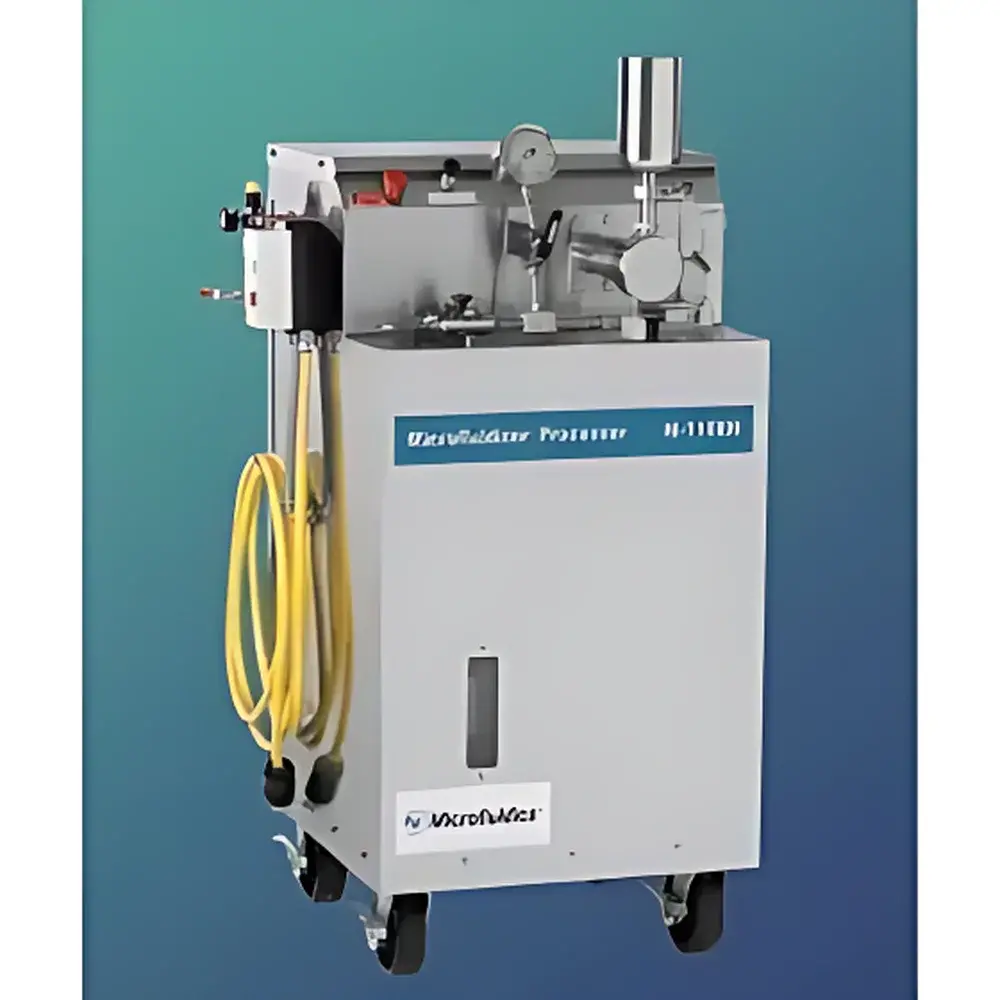
MFIC M-110EH30 High-Pressure Microfluidizer Homogenizer
| Origin | USA |
|---|---|
| Manufacturer Type | Authorized Distributor |
| Origin Category | Imported |
| Model | M-110EH30 |
| Instrument Type | High-Pressure Homogenizer |
| Max Operating Pressure | 30,000 psi (2070 bar) |
| Max Flow Rate | 450 mL/min |
| Max Feed Temperature | 75 °C |
| Motor Power | 5 HP (3.7 kW) |
| System Fluid Volume | 100 mL |
| Compressed Air Requirement | 50 psi, 1 SCFM, dew point 0–35 °F |
| Minimum Sample Volume | 120 mL |
| Dimensions | 84 × 87 × 148 cm |
| Weight | 205 kg |
Overview
The MFIC M-110EH30 High-Pressure Microfluidizer Homogenizer is an engineered solution for scalable, reproducible nano-scale particle size reduction and cell disruption under precisely controlled hydraulic conditions. Based on microfluidic interaction chamber technology—not conventional valve-based homogenization—the M-110EH30 subjects fluid streams to ultra-high shear, cavitation, and impact forces within a fixed-geometry diamond interaction chamber. This principle ensures consistent energy input per unit volume, eliminating batch-to-batch variability inherent in pressure-relief valve systems. Designed and manufactured by Microfluidics International Corporation (MFIC), a U.S.-based leader in high-pressure microfluidization since 1986, the M-110EH30 extends the legacy of the M-110EH platform with enhanced pressure stability (±150 psi at 30,000 psi), improved thermal management, and validated scalability from lab-scale development (120 mL minimum) through pilot production (450 mL/min continuous flow). Its architecture supports Good Manufacturing Practice (GMP)-aligned workflows, including integrated Clean-in-Place (CIP) and Steam-in-Place (SIP) protocols compliant with ASME BPE and FDA 21 CFR Part 11 data integrity requirements when paired with optional audit-trail software.
Key Features
- Diamond interaction chamber (U.S. Patent No. 6,217,215 & others): chemically inert, wear-resistant, and thermally stable—enabling >10,000 hours of operation without performance drift or chamber replacement.
- Zirconia ceramic plunger assembly: eliminates metal ion leaching, ensures compatibility with sensitive biologics and GMP-grade excipients.
- Active inline temperature control: dual-zone Peltier-cooled heat exchangers maintain sample temperature within ±1.5 °C across full pressure and flow range (up to 75 °C feed temperature).
- Single-pass efficiency: >95% microbial or mammalian cell lysis achieved in one pass at ≥20,000 psi; sub-100 nm particle size distributions (PDI < 0.1) routinely attained in lipid nanoparticles, polymeric nanocarriers, and nanoemulsions after 1–2 passes.
- Linear scale-up capability: identical fluid dynamics between lab (M-110EH30), pilot (M-725), and production (M-825) systems enable direct correlation of process parameters (pressure, flow rate, number of passes) without re-optimization.
- Integrated CIP/SIP functionality: fully automated cleaning and sterilization cycles validated per ISO 13408-1 and EU Annex 1, reducing manual intervention and cross-contamination risk.
- Low consumables dependency: no replaceable valves, gaskets, or seals in the high-pressure fluid path—only the diamond chamber requires periodic inspection (typically every 18–24 months under standard use).
Sample Compatibility & Compliance
The M-110EH30 processes aqueous, organic, and biphasic systems—including liposomes, siRNA-loaded LNPs, protein-stabilized nanocrystals, bacterial lysates, plant-derived pigment dispersions, and carbon nanotube suspensions—without introducing metallic contaminants or thermal degradation artifacts. It complies with CE marking directives (2006/42/EC Machinery Directive, 2014/30/EU EMC Directive) and meets essential requirements of ISO 13485:2016 for medical device manufacturing environments. When operated with MFIC’s optional Process Data Logger (PDL) module, the system generates ALCOA+ compliant electronic records—including timestamped pressure, temperature, flow, and cycle count—with user authentication, audit trail, and electronic signature support aligned with FDA 21 CFR Part 11 and EU Annex 11.
Software & Data Management
The M-110EH30 operates via a dedicated industrial touchscreen HMI running real-time embedded firmware. All critical process parameters are continuously logged at 10 Hz resolution and exportable in CSV or ASTM E1446-compliant XML format. Optional MFIC ProcessIQ™ software enables remote monitoring, multi-unit fleet management, SPC charting (X-bar/R), and deviation reporting per ICH Q8(R2) Quality by Design principles. Raw data files include cryptographic hash signatures to ensure immutability during regulatory submissions. Data storage adheres to GLP/GMP retention policies (minimum 25 years for clinical trial material batches).
Applications
- Nanomedicine development: reproducible formulation of mRNA-LNPs, stealth liposomes, and albumin-bound nanoparticles meeting USP & Ph. Eur. particle size distribution criteria.
- Bioprocessing: high-yield, low-shear disruption of E. coli, yeast, and CHO cells while preserving intracellular enzyme activity and minimizing protease release.
- Food & cosmetics: stabilization of nanoemulsions for nutraceutical delivery and uniform dispersion of hydrophobic actives (e.g., curcumin, retinol) without surfactant overload.
- Advanced materials: de-agglomeration of graphene oxide, quantum dots, and metal-organic frameworks into monodisperse colloids for inkjet printing or thin-film deposition.
- Quality control: routine verification of homogenization consistency across R&D, QC, and manufacturing units using standardized reference materials (e.g., NIST SRM 1963).
FAQ
What distinguishes microfluidization from traditional high-pressure homogenization?
Microfluidization uses fixed-geometry interaction chambers to generate consistent shear and impact forces—unlike adjustable valve systems where pressure fluctuations cause variable energy input and broader particle size distributions.
Can the M-110EH30 be integrated into a GMP manufacturing line?
Yes—its CIP/SIP design, ASME BPE-compliant wetted surfaces, and optional 21 CFR Part 11 software package support validation per FDA Process Validation Guidance (2011) and EU Annex 15.
Is process parameter data automatically archived for regulatory review?
When equipped with ProcessIQ™, all operational data—including pressure ramps, temperature profiles, and pass counts—are time-stamped, digitally signed, and stored in tamper-evident format for audit readiness.
What maintenance intervals are recommended for the diamond interaction chamber?
Chamber inspection is advised every 1,500–2,000 operating hours; typical service life exceeds 10,000 hours under optimized conditions (e.g., filtered feedstock, ≤75 °C inlet temperature).
Does MFIC provide technical support for method transfer to larger-scale systems?
Yes—MFIC’s Application Science team provides documented scale-up protocols, comparative DLS/NTA validation reports, and on-site commissioning support for M-725 and M-825 installations.



