
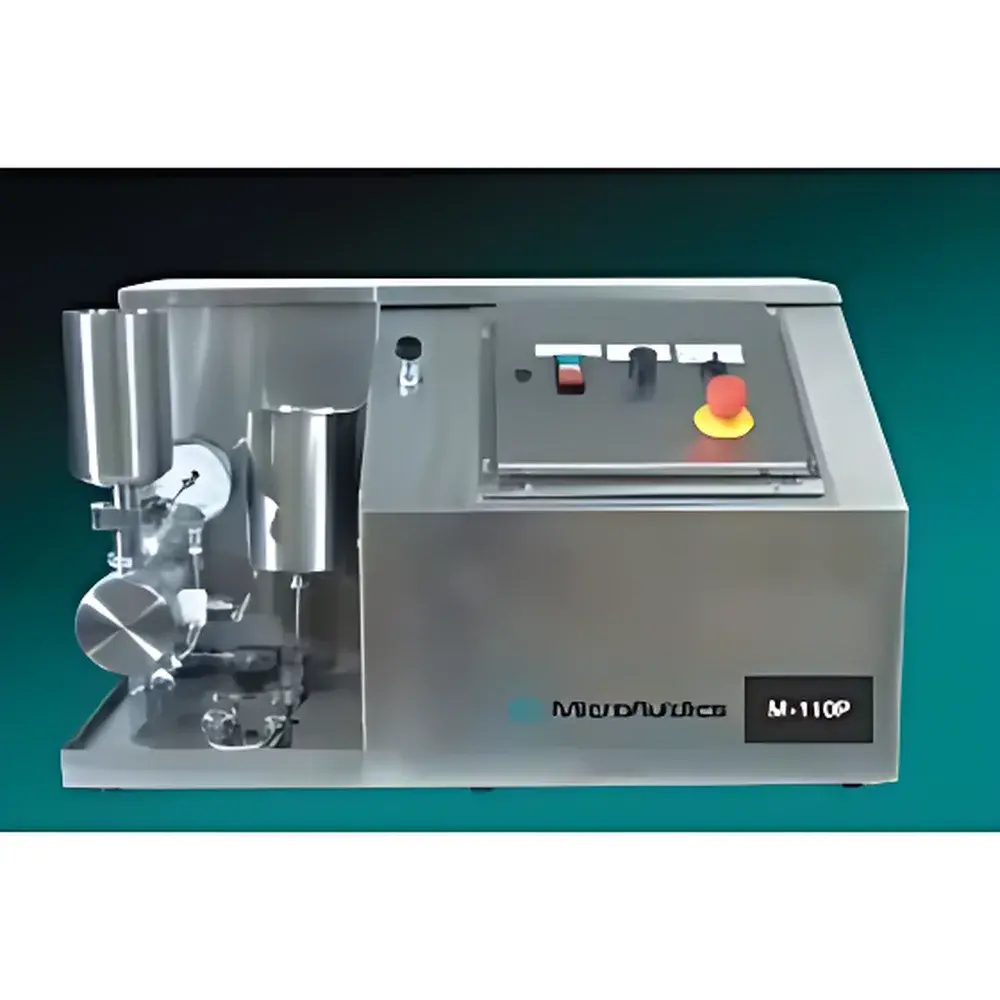
MFIC M-110P High-Pressure Microfluidic Homogenizer
| Origin | USA |
|---|---|
| Manufacturer Type | Authorized Distributor |
| Origin Category | Imported |
| Model | M-110P |
| Instrument Type | High-Pressure Homogenizer |
| Drive System | Hydraulic |
| Max Pressure | 30,000 psi |
| Flow Rate | 110–150 mL/min |
| Minimum Sample Volume | 25 mL |
| Interaction Chamber Material | Diamond (U.S. Patented) |
| Piston Material | Zirconia |
| Temperature Control | Integrated Inline Cooling System |
| Power Supply | 220 V AC |
Overview
The MFIC M-110P is a benchtop high-pressure microfluidic homogenizer engineered for precision nanoscale particle size reduction and reproducible cell disruption in research and development laboratories. Operating on a hydraulic drive system, it delivers stable, pulse-free pressure up to 30,000 psi—enabling consistent fluid dynamics within the patented diamond interaction chamber. Unlike conventional valve-based homogenizers, the M-110P employs fixed-geometry microchannels to generate intense shear, cavitation, and impact forces through controlled turbulent flow, resulting in narrow particle size distributions (PSD) with high batch-to-batch reproducibility. Its design conforms to fundamental principles of microfluidic homogenization, where laminar-to-turbulent transition and energy dissipation per unit volume are optimized for sub-200 nm processing. This makes the M-110P particularly suitable for applications requiring regulatory traceability, such as preclinical nanomedicine formulation, liposomal drug delivery development, and nanomaterial synthesis under GLP-compliant workflows.
Key Features
- Patented diamond interaction chamber (U.S. Patent No. US7896264B2) — provides exceptional wear resistance, chemical inertness, and thermal stability during repeated high-pressure cycles
- Hydraulic pressure generation system — ensures smooth, non-pulsating pressure delivery for improved process control and reduced sample degradation
- Integrated inline temperature control — actively manages sample temperature during processing to prevent thermal denaturation of proteins or sensitive biologics
- Zirconia-coated high-pressure piston — resists corrosion and abrasion from aqueous, organic, and abrasive suspensions
- Minimal dead volume architecture — supports processing of as little as 25 mL sample volume while maintaining full pressure integrity and cleaning efficiency
- CIP-compatible (Clean-in-Place) fluid path — enables rapid, validated cleaning between batches without disassembly, supporting multi-product lab environments
Sample Compatibility & Compliance
The M-110P accommodates a broad range of sample types including oil-in-water and water-in-oil emulsions, colloidal suspensions, polymeric nanoparticles, lipid vesicles, bacterial and mammalian cell lysates, and ceramic or metallic nanodispersions. It complies with material compatibility standards for pharmaceutical R&D (USP , ISO 13320 for laser diffraction correlation), and supports audit-ready operation under FDA 21 CFR Part 11 when integrated with compliant LIMS or ELN platforms. All wetted surfaces meet ASTM F86 and ISO 10993-5 biocompatibility requirements. The absence of metal-on-metal contact in the interaction zone eliminates contamination risk from metallic leachables—a critical factor for parenteral nanocarrier development.
Software & Data Management
While the M-110P operates via analog pressure regulation and manual flow adjustment, its operational parameters—including pressure setpoint, run duration, inlet/outlet temperatures, and total processed volume—are fully documentable via external data loggers or laboratory information management systems (LIMS). For GMP-aligned labs, optional digital pressure transducers and temperature sensors can be installed and calibrated to NIST-traceable standards. Process logs support retrospective review for root cause analysis and deviation investigation, fulfilling ALCOA+ data integrity criteria (Attributable, Legible, Contemporaneous, Original, Accurate, Complete, Consistent, Enduring, Available).
Applications
- Nanoparticle formulation: production of uniform liposomes, polymeric micelles, solid lipid nanoparticles (SLNs), and nanoemulsions for drug delivery
- Cell lysis: high-efficiency disruption of E. coli, yeast, insect, and mammalian cells with >95% lysis efficiency in a single pass
- Vaccine adjuvant preparation: homogenization of squalene-based emulsions (e.g., MF59 analogs) under sterile conditions
- Materials science: dispersion of carbon nanotubes, graphene oxide, quantum dots, and metal-organic frameworks (MOFs) in aqueous or organic media
- Food & cosmetic R&D: stabilization of functional ingredient emulsions (e.g., curcumin, resveratrol, coenzyme Q10) with enhanced bioavailability
FAQ
What is the maximum recommended operating pressure for routine use?
The M-110P is rated for continuous operation at pressures up to 25,000 psi; 30,000 psi is specified as the absolute maximum limit for short-duration validation runs.
Can the M-110P be used with organic solvents?
Yes—provided solvent compatibility is confirmed with the elastomer seals (standard Viton® or optional Kalrez®); zirconia and diamond components remain chemically inert across most common organics including ethanol, chloroform, and ethyl acetate.
Is the diamond interaction chamber replaceable, and what is its typical service life?
The chamber is field-replaceable and designed for ≥500 hours of cumulative operation at 20,000 psi with aqueous buffers; lifespan extends significantly with low-abrasion formulations.
Does the system support scalability to pilot-scale production?
Yes—the M-110P’s process parameters (pressure, specific energy input, residence time distribution) correlate directly with MFIC’s larger M-120Y and M-210 series, enabling seamless technology transfer.
How is temperature rise during homogenization managed?
The integrated inline cooling loop maintains sample temperature within ±2 °C of setpoint using recirculated chilled water or glycol solution, independently adjustable from ambient lab conditions.



