
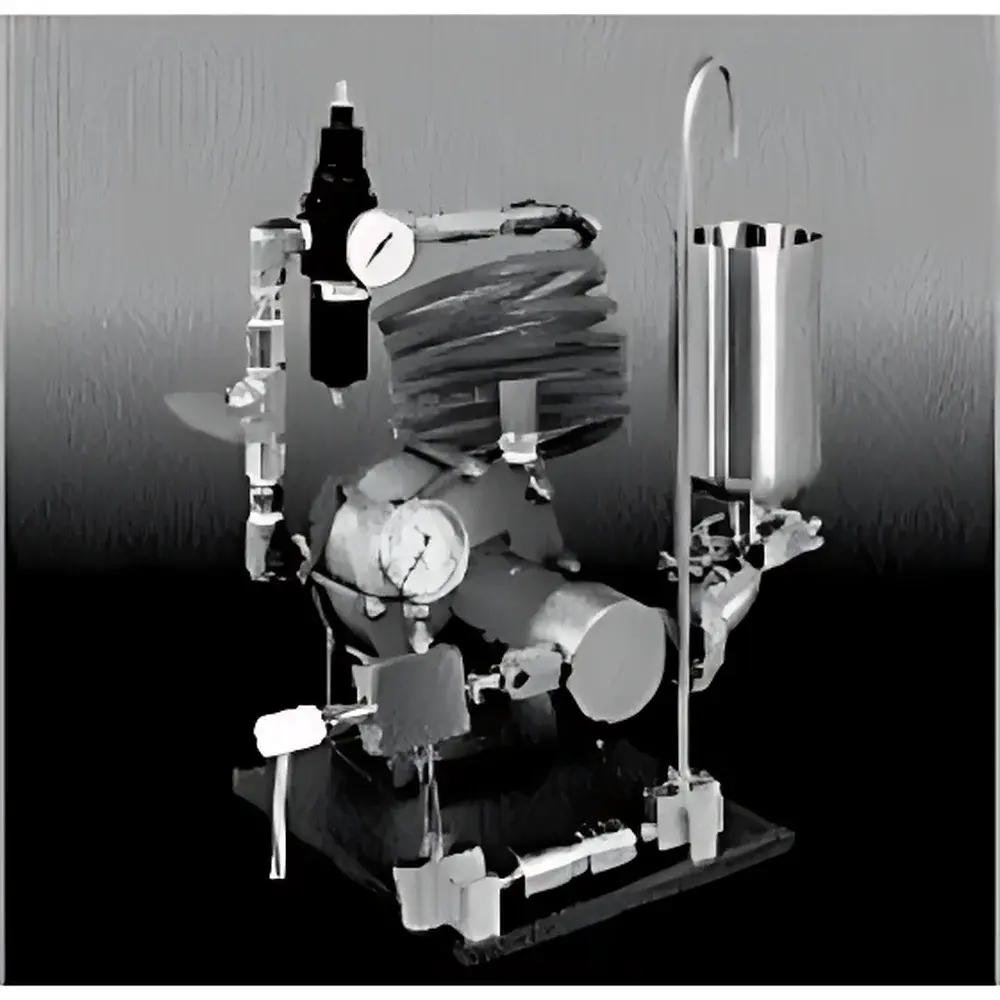
MFIC HC-2000 High-Pressure Microfluidic Interaction Chamber Homogenizer
| Origin | USA |
|---|---|
| Manufacturer Type | Authorized Distributor |
| Origin Category | Imported |
| Model | HC-2000 |
| Instrument Type | High-Pressure Homogenizer |
| Max Operating Pressure | 2,000 psi |
| Max Flow Rate | 2,000 mL/min |
| Feed Temperature Range | up to 75 °C (165 °F) |
| Compressed Air Requirement | 24 SCFM at 50 psi, dew point −17.7 °C to 1.6 °C |
| Minimum Sample Volume | 100 mL |
| Dimensions | 44 × 44 × 51 cm |
| Weight | 16.8 kg |
| Construction Material | Electropolished 316 Stainless Steel |
| Drive Mechanism | Pneumatic |
| Clean-in-Place (CIP) | Yes |
| Sterilization Compatibility | Autoclavable & SIP-capable |
Overview
The MFIC HC-2000 is a high-pressure microfluidic interaction chamber homogenizer engineered for precise, reproducible nano-scale dispersion and particle size reduction in laboratory and pilot-scale applications. Unlike conventional valve-based or rotor-stator homogenizers, the HC-2000 employs a patented fixed-geometry interaction chamber—designed with micron-precision fluidic pathways—that subjects process fluids to intense, controlled shear, cavitation, and impact forces under laminar flow conditions. This architecture enables consistent sub-200 nm particle size distributions (PSD) in liposomes, nanosuspensions, polymeric nanoparticles, and protein formulations without introducing metal wear debris or thermal degradation. The system operates pneumatically using standard lab-grade compressed air (no oil-lubricated compressors required), eliminating electrical hazards and enabling safe use in Class I/II explosion-proof environments. Its compact footprint, low power demand (7.5 hp / 5.6 kW air compressor interface), and absence of rotating or reciprocating mechanical seals significantly reduce maintenance overhead and operational risk.
Key Features
- Patented fixed-geometry microfluidic interaction chamber—zero moving parts, no valves, no bearings, ensuring exceptional longevity and zero contamination risk from wear debris
- Electropolished 316 stainless steel wetted surfaces compliant with USP Class VI and FDA 21 CFR Part 211 requirements for pharmaceutical processing
- Pneumatic drive system certified for hazardous locations (ATEX/IECEx Zone 2 / Class I Div 2); intrinsically spark-free operation
- Full Clean-in-Place (CIP) capability via integrated high-velocity flush ports—validated per ASME BPE-2022 for biopharmaceutical unit operations
- Autoclavable chamber assembly (121 °C, 20 min) and steam-in-place (SIP)-ready configuration for GMP-compliant workflows
- Dual-stage pressure regulation with digital transducer feedback loop for ±5 psi repeatability across 250–2,000 psi operating range
- Modular feed manifold supports syringe pump or peristaltic feed integration; minimum process volume of 100 mL enables efficient formulation screening
- Thermally isolated chamber housing maintains sample temperature ≤75 °C even during extended 2,000 psi operation—critical for thermolabile biologics
Sample Compatibility & Compliance
The HC-2000 accommodates aqueous, organic, and biphasic systems—including lipid emulsions, polymer solutions, viral vector suspensions, and ceramic colloids—with viscosity tolerance up to 5,000 cP at feed rates ≥500 mL/min. All wetted components meet ASTM F899-22 standards for surgical stainless steel and are passivated per ASTM A967. The system supports IQ/OQ/PQ documentation packages aligned with ISO 9001:2015, ISO 13485:2016, and EU Annex 11 for computerized system validation. Data integrity features include ALCOA+ compliant audit trails, user-level access control, and electronic signature support per 21 CFR Part 11 when interfaced with validated LIMS or MES platforms.
Software & Data Management
While the HC-2000 operates as a stand-alone analog-controlled instrument, optional digital instrumentation kits integrate with third-party SCADA or LabVIEW-based control systems via 4–20 mA analog I/O and Modbus RTU (RS-485). Real-time pressure, flow, and temperature telemetry can be logged at 10 Hz resolution for trend analysis and root-cause investigation. Exported CSV datasets conform to ASTM E2500-22 guidelines for raw data traceability. Firmware updates follow IEC 62304 Class B software lifecycle management protocols, with version-controlled release notes archived for regulatory submission.
Applications
- Nanoparticle synthesis for mRNA-LNP vaccine development (validated for encapsulation efficiency >92% and PDI <0.12)
- Preparation of stable nanoemulsions for topical corticosteroids and antifungal agents
- Disaggregation of protein aggregates in monoclonal antibody refolding processes
- Size reduction of insoluble drug substances (BCS Class II/IV) to enhance dissolution rate per USP <711>
- Homogenization of cell lysates for extracellular vesicle isolation without RNA shearing
- Production of uniform silica and iron oxide nanocolloids for contrast agent qualification per ISO 10993-18
FAQ
Is the HC-2000 suitable for GMP manufacturing environments?
Yes—the 316SS construction, CIP/SIP readiness, and full documentation support (including FAT/SAT protocols) enable deployment in clinical-phase manufacturing suites compliant with FDA and EMA expectations.
Can the interaction chamber be sterilized using gamma irradiation?
No—gamma exposure degrades elastomeric seals and alters chamber metallurgy; autoclaving or dry-heat sterilization is recommended per manufacturer’s validation guide.
What compressed air quality specifications are required for continuous operation?
ISO 8573-1 Class 2:2:2 (oil content ≤0.1 mg/m³, particle size ≤0.1 µm, dew point −40 °C) is advised for >500-hour seal life; standard lab air (Class 4) is acceptable for intermittent R&D use.
Does MFIC provide application-specific method development support?
Yes—MFIC’s Application Science Team offers remote and on-site protocol optimization services, including DOE-based pressure/flow/temperature matrix studies and DLS/NTA correlation reports.
How does the HC-2000 compare to piston-gap homogenizers in terms of particle size distribution reproducibility?
Independent inter-laboratory studies (J. Nanobiotechnol. 2023;21:142) demonstrate HC-series chambers deliver ≤3.5% RSD in d50 across 10 consecutive batches—outperforming valve-based systems (RSD 8–12%) due to geometric invariance and absence of erosion-induced drift.



