
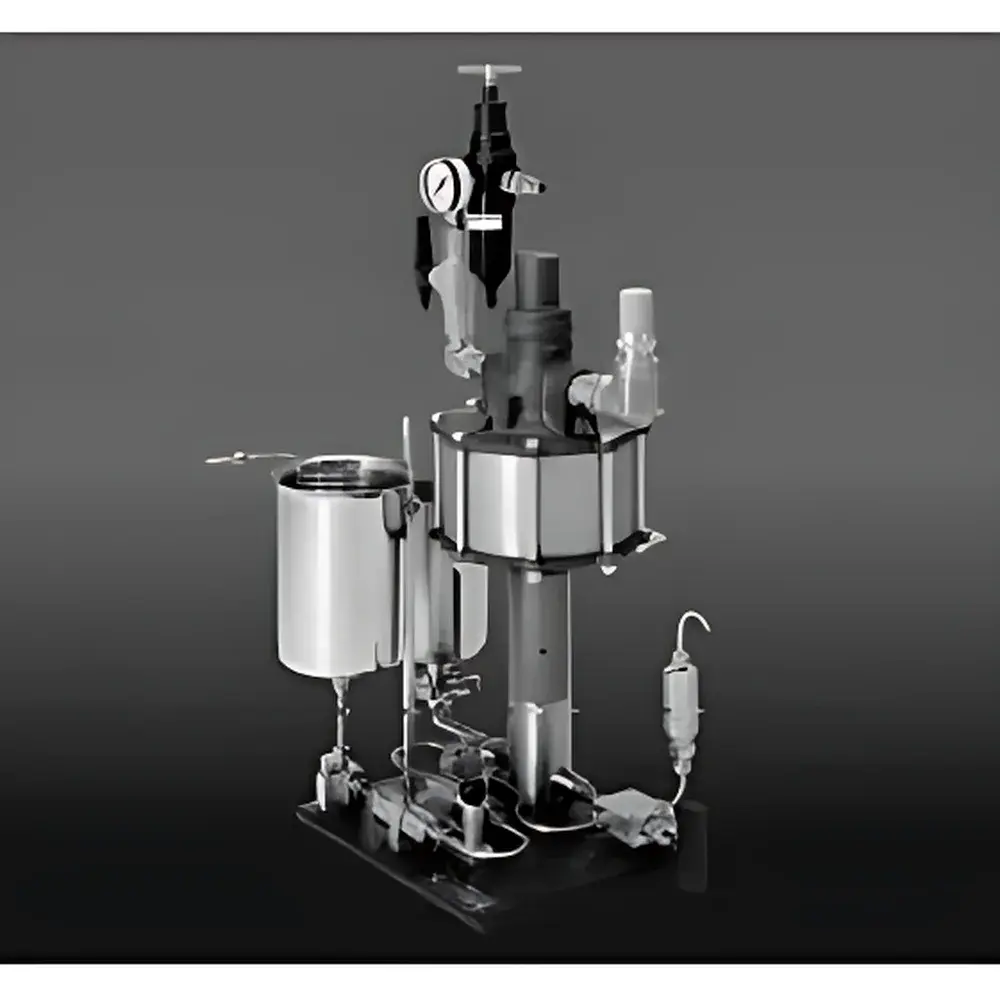
MFIC Microfluidizer M-110Y High-Pressure Microfluidic Nanohomogenizer
| Origin | USA |
|---|---|
| Manufacturer Type | Authorized Distributor |
| Origin Category | Imported |
| Model | M-110Y |
| Instrument Type | High-Pressure Cell Disruptor |
| Operating Pressure Range | 3,000–23,000 psi |
| Max. Flow Rate | 250–600 mL/min |
| Feed Temperature Range | –25°C to +75°C |
| Minimum Sample Volume | 14 mL |
| Compressed Air Requirement | 57 scfm at 120 psi, 15 hp (11 kW) |
| Dimensions | 28 × 41 × 76 cm |
| Weight | 25 kg |
| Interaction Chamber Material | Diamond or Ceramic |
| Wetted Parts | 300-series Stainless Steel (Chromium-Plated Piston) |
| Integrated Cooling Coil | 17 ft (13 mL volume) |
| Cleaning | CIP-capable (Clean-in-Place) |
| Certification | Explosion-Proof & Portable Design |
Overview
The MFIC Microfluidizer® M-110Y is a laboratory-scale, pneumatically driven high-pressure microfluidic homogenizer engineered for reproducible nano-scale particle size reduction, cell disruption, and stable emulsion/dispersion formulation. Unlike conventional rotor-stator or ultrasonic systems, the M-110Y employs a fixed-geometry interaction chamber—where fluid is accelerated to supersonic velocities and subjected to controlled shear, cavitation, and impact forces under precisely regulated pressure. This microfluidic principle ensures uniform energy delivery per unit volume, enabling consistent sub-100 nm particle size distributions with narrow polydispersity indices (PDI < 0.1) across repeated runs. Designed for R&D laboratories in biopharmaceuticals, nanomedicine, and advanced materials science, the M-110Y bridges benchtop discovery and scalable GMP manufacturing—its process parameters demonstrate linear scalability from 14 mL batch volumes to industrial production lines.
Key Features
- High-integrity interaction chambers fabricated from single-crystal diamond or engineered ceramic—resistant to erosion, chemical corrosion, and thermal degradation under sustained 23,000 psi operation.
- Single-pass cell disruption efficiency exceeding 95% for Gram-negative bacteria, yeast, and mammalian cells—preserving intracellular integrity without enzymatic or thermal artifacts.
- Full Clean-in-Place (CIP) capability: integrated cooling coil (13 mL volume, 17 ft length), non-disassembly flow path, and validated sterilization protocols compatible with SIP (Steam-in-Place) validation.
- Explosion-proof electrical architecture and portable footprint (25 kg, 28 × 41 × 76 cm) certified for Class I, Division 1 hazardous environments per UL/CSA standards.
- All wetted surfaces constructed from electropolished 316L stainless steel; piston rod chromium-plated to ISO 4524-1 specifications for wear resistance and low extractables.
- Real-time pressure monitoring with dual redundant transducers (0.25% FS accuracy), analog/digital output, and programmable ramping profiles via front-panel interface.
Sample Compatibility & Compliance
The M-110Y accommodates aqueous and organic-phase formulations—including liposomes, polymeric nanoparticles, protein-loaded micelles, viral vectors, and high-viscosity suspensions up to 35% w/w solids. Its temperature-controlled feed path (–25°C to +75°C) supports thermolabile biologics and cryo-formulations. The system complies with ISO 22442-1 (medical device biological safety), USP (ancillary materials), and ASTM F2375 (high-pressure processing equipment qualification). When operated within defined SOPs, it meets GLP audit requirements for preclinical formulation development and supports FDA 21 CFR Part 11-compliant data integrity when paired with validated third-party acquisition software.
Software & Data Management
While the M-110Y operates via intuitive manual controls, optional digital integration enables traceable process recording. Analog outputs (4–20 mA) interface with SCADA or LIMS platforms for pressure, temperature, and flow logging. Optional MFIC LogSoft™ (v3.2+) provides timestamped run logs, parameter locking, electronic signatures, and audit trail generation compliant with ALCOA+ principles. All data files are stored in vendor-neutral CSV/CSVX formats, supporting retrospective analysis and regulatory submission packages.
Applications
- Nanoparticle synthesis: Liposomal doxorubicin, siRNA-loaded LNPs, PEGylated quantum dots.
- Cell lysis: High-yield extraction of inclusion bodies, membrane proteins, and nucleic acids without sonication-induced shearing.
- Emulsion stabilization: Sub-50 nm oil-in-water vaccines, nanostructured lipid carriers (NLCs), and self-emulsifying drug delivery systems (SEDDS).
- Material science: Exfoliation of 2D nanomaterials (e.g., graphene oxide, MXenes), dispersion of carbon nanotubes in polymer matrices.
- Quality control: Batch-to-batch consistency verification per USP light scattering protocols and ISO 13320 laser diffraction method alignment.
FAQ
What is the minimum viable sample volume for method development?
The M-110Y achieves full hydraulic priming and stable pressure control starting at 14 mL—ideal for precious biologics or early-stage compound libraries.
Can the system process viscous or particulate-laden feeds?
Yes—validated with suspensions containing up to 35% w/w micronized API, provided inlet filtration (≥5 µm) is maintained and feed temperature remains within specification.
How is scalability verified between M-110Y and production-scale Microfluidizer® systems?
MFIC provides formal scale-up reports correlating pressure, total passes, and chamber geometry—demonstrating equivalent specific energy input (kJ/L) and resulting particle size distribution across M-110Y, M-725, and FX-Series platforms.
Is routine calibration required for pressure transducers?
Transducers are factory-calibrated to NIST-traceable standards; annual recalibration is recommended per ISO/IEC 17025 and internal quality procedures.
Does the system support sterile processing for aseptic formulation?
Yes—when equipped with steam-compatible seals and validated CIP/SIP cycles, the M-110Y meets Grade A air classification requirements when installed in isolator or RABS environments.




